


Page 16 - JSOM Spring 2026
P. 16
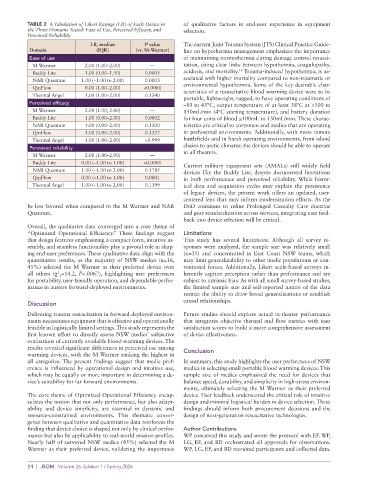
TABLE 2  A Tabulation of Likert Ratings (LR) of Each Device in   of  qualitative  factors  in  end-user experience  in equipment
          the Three Domains Tested: Ease of Use, Perceived Efficacy, and   selection.
          Perceived Reliability
                               LR, median       P value      The current Joint Trauma System (JTS) Clinical Practice Guide-
           Domain                (IQR)       (vs. M-Warmer)  line on hypothermia management emphasizes the importance
           Ease of use                                       of maintaining normothermia during damage control resusci-
            M Warmer         2.00 (1.00–2.00)     —          tation, citing clear links between hypothermia, coagulopathy,
                                                                               16
            Buddy Lite       1.00 (0.00–1.50)   0.0005       acidosis, and mortality.  Trauma-induced hypothermia, is as-
            NAR Quantum     1.00 (–1.00 to 2.00)  0.0003     sociated with higher mortality compared to non-traumatic or
            QinFlow          0.00 (1.00–2.00)   <0.0001      environmental hypothermia. Some of the key desirable char-
                                                             acteristics of a resuscitative blood warming device were to be
            Thermal Angel    1.00 (1.00–2.00)   0.1340       portable, lightweight, rugged, to have operating conditions of
           Perceived efficacy                                –10 to 45°C, output temperature of at least 38°C at ≥100 to
            M Warmer         2.00 (1.00, 2.00)    —          150mL/min (4°C starting temperature), and battery duration
            Buddy Lite       1.00 (0.00–2.00)   0.0002       for four units of blood >100mL to 150mL/min. These charac-
            NAR Quantum      1.00 (0.00–2.00)   0.1300       teristics are critical to corpsmen and medics that are operating
            QinFlow          1.00 (0.00–2.00)   0.1327       in prehospital environments. Additionally, with more remote
            Thermal Angel    1.00 (1.00–2.00)   >0.999       battlefields and in harsh operating environments, from island
           Perceived reliability                             chains to arctic climates; the devices should be able to operate
            M Warmer         2.00 (1.00–2.00)     —          in all theaters.
            Buddy Lite      0.00 (–1.00 to 1.00)  <0.0001    Current military equipment sets (AMALs) still widely field
            NAR Quantum     1.00 (–1.00 to 2.00)  0.1785     devices like the Buddy Lite, despite documented limitations
            QinFlow         0.00 (–1.00 to 1.00)  0.0001     in both performance and perceived reliability. While histor-
            Thermal Angel   1.00 (–1.00 to 2.00)  0.1399     ical  data  and  acquisition  cycles  may  explain  the  persistence
                                                             of legacy devices, the present work offers an updated, user-
                                                             centered lens that may inform modernization efforts. As the
          be less favored when compared to the M Warmer and NAR   DoD continues to refine Prolonged Casualty Care doctrine
          Quantum.                                           and gear standardization across services, integrating user feed-
                                                             back into device selection will be critical.
          Overall, the qualitative data converged into a core theme of
          “Optimized Operational Efficiency.”  These findings suggest   Limitations
          that design features emphasizing a compact form, intuitive as-  This study has several limitations.  Although all survey re-
          sembly, and seamless functionality play a pivotal role in shap-  sponses were analyzed, the sample size was relatively small
          ing end-user preferences. These qualitative data align with the   (n=35) and concentrated in East Coast NSW teams, which
          quantitative results, as the majority of NSW medics (n=16,   may limit generalizability to other medic populations or con-
          45%) selected the M Warmer as their preferred device over   ventional forces. Additionally, Likert scale-based  surveys in-
          all others (χ =14.2,  P=.0067), highlighting user preferences  herently capture perception rather than performance and are
                    2
                    4
          for portability, user-friendly operation, and dependable perfor-  subject to intrinsic bias. As with all small survey-based studies,
          mance in austere forward-deployed environments.    the limited sample size and self-reported nature of the data
                                                             restrict the ability to draw broad generalizations or establish
                                                             causal relationships.
          Discussion
          Delivering trauma resuscitation in forward-deployed environ-  Future studies should explore actual in-theater performance
          ments necessitates equipment that is effective and operationally   that integrates objective thermal and flow metrics with user
          feasible in logistically limited settings. This study represents the   satisfaction scores to build a more comprehensive assessment
          first known effort to directly assess NSW medics’ subjective   of device effectiveness.
          evaluations of currently available blood-warming devices. The
          results revealed significant differences in perceived use among   Conclusion
          warming devices, with the M Warmer ranking the highest in
          all categories. The present findings suggest that medic pref-  In summary, this study highlights the user preferences of NSW
          erence is influenced by operational design and intuitive use,   medics in selecting small portable blood warming devices. This
          which may be equally or more important in determining a de-  sample size of medics emphasized the need for devices that
          vice’s suitability for far forward environments.   balance speed, durability, and simplicity in high-stress environ-
                                                             ments, ultimately selecting the M Warmer as their preferred
          The core theme of Optimized Operational Efficiency encap-  device. User feedback underscored the critical role of intuitive
          sulates the notion that not only performance, but also adapt-  design and minimal logistical burden in device selection. These
          ability and device simplicity, are essential in dynamic and   findings should inform both procurement decisions and the
          resource-constrained environments.  This thematic conver-  design of next-generation resuscitative technologies.
          gence between qualitative and quantitative data reinforces the
          finding that device choice is shaped not only by clinical perfor-  Author Contributions
          mance but also by applicability to real-world mission profiles.   WP conceived this study and wrote the protocol with EF. WP,
          Nearly half of surveyed NSW medics (45%) selected the M   LG, EF, and BD orchestrated all approvals for observations.
          Warmer as their preferred device, validating the importance   WP, LG, EF, and BD recruited participants and collected data.

          14  |  JSOM   Volume 26, Edition 1 / Spring 2026

