


Page 25 - JSOM Spring 2026
P. 25
hospitals, adhering to clinical guidelines and protocols estab-  FIGURE 1  PRISMA 2020 flow diagram.
              lished by the Ukrainian Ministry of Health. Moreover, health-
              care authorities must coordinate efforts to ensure high-quality
              care while maintaining sufficient medical resources for the
              broader population. 12
              This systematic review aims to synthesize available literature
              on orthopedic and musculoskeletal injuries sustained during
              the ongoing conflict in Ukraine. Specifically, it seeks to char-
              acterize the nature and mechanisms of these injuries, evaluate
              current clinical management practices, and identify areas for
              future research in combat-related trauma affecting both mili-
              tary and civilian populations.

              Methods
              Study Protocol, Search Strategy, and Data Collection
              This systematic review was conducted in accordance with
              the  Preferred  Reporting Items  for  Systematic  Reviews  and
              Meta-Analyses (PRISMA) guidelines.  The protocol was not
                                           13
              registered with PROSPERO. A comprehensive literature search
              was carried out in February 2025 across four electronic data-
              bases: PubMed, Scopus, Web of Science (WoS), and MEDLINE
              via WoS. The search strategy combined relevant keywords and
              Boolean operators tailored to each database’s indexing system,
              using the following terms: ((“combat injury” OR “war wound”
              OR  “battlefield injury” OR  “blast injury” OR  “gunshot
              wound” OR “war-related  trauma” OR “military personnel”   Screening, study selection, and data extraction.
              OR “soldier” OR “combatant” OR “casualty”  OR “ortho-
                                                                             15
              pedic surgery” OR “fracture fixation” OR “amputation” OR   as high quality.  Observational studies were evaluated using
              “external fixation” OR “wound management” OR “damage   the Strengthening the Reporting of Observational Studies in
                                                                                             16
              control surgery” OR “trauma surgery” OR “emergency sur-  Epidemiology (STROBE) guidelines.  Any disagreements in
              gery” OR “war injury” OR “war surgery” OR “wound man-  quality assessment were resolved by a third reviewer.
              agement”)  AND (“Ukraine” OR  “Ukrainian conflict” OR
              “Russia-Ukraine war” OR “invasion of Ukraine”)).   Data Synthesis
                                                                 A qualitative synthesis was performed by systematically sum-
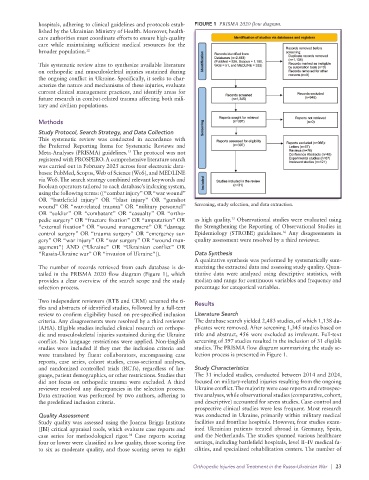
              The number of records retrieved from each database is de-  marizing the extracted data and assessing study quality. Quan-
              tailed in the PRISMA 2020 flow diagram (Figure 1), which   titative data were analyzed using descriptive statistics, with
              provides a clear overview of the search scope and the study   median and range for continuous variables and frequency and
              selection process.                                 percentage for categorical variables.

              Two independent reviewers (RTB and CRM) screened the ti-  Results
              tles and abstracts of identified studies, followed by a full-text
              review to confirm eligibility based on pre-specified inclusion   Literature Search
              criteria. Any disagreements were resolved by a third reviewer   The database search yielded 2,483 studies, of which 1,138 du-
              (AHA). Eligible studies included clinical research on orthope-  plicates were removed. After screening 1,345 studies based on
              dic and musculoskeletal injuries sustained during the Ukraine   title and abstract, 456 were excluded as irrelevant. Full-text
              conflict. No language restrictions were applied. Non-English   screening of 397 studies resulted in the inclusion of 31 eligible
              studies  were  included  if they  met  the  inclusion  criteria  and   studies. The PRISMA flow diagram summarizing the study se-
              were translated by fluent collaborators, encompassing case   lection process is presented in Figure 1.
              reports, case series, cohort studies, cross-sectional analyses,
              and randomized controlled trials (RCTs), regardless of lan-  Study Characteristics
              guage, patient demographics, or other restrictions. Studies that   The 31 included studies, conducted between 2014 and 2024,
              did not focus on orthopedic trauma were excluded. A third   focused on military-related injuries resulting from the ongoing
              reviewer resolved any discrepancies in the selection process.   Ukraine conflict. The majority were case reports and retrospec-
              Data extraction was performed by two authors, adhering to   tive analyses, while observational studies (comparative, cohort,
              the predefined inclusion criteria.                 and descriptive) accounted for seven studies. Case- control and
                                                                 prospective clinical studies were less frequent. Most research
              Quality Assessment                                 was conducted in Ukraine, primarily within military medical
              Study quality was assessed using the Joanna Briggs Institute   facilities and frontline hospitals. However, four studies exam-
              (JBI) critical appraisal tools, which evaluate case reports and   ined Ukrainian patients treated abroad in Germany, Spain,
              case  series  for  methodological  rigor.   Case  reports  scoring   and the Netherlands. The studies spanned various healthcare
                                           14
              four or lower were classified as low quality, those scoring five   settings, including battlefield hospitals, level II–IV medical fa-
              to six as moderate quality, and those scoring seven to eight   cilities, and specialized rehabilitation centers. The number of

                                                                Orthopedic Injuries and Treatment in the Russo-Ukrainian War   |  23

