


Page 26 - JSOM Winter 2025
P. 26
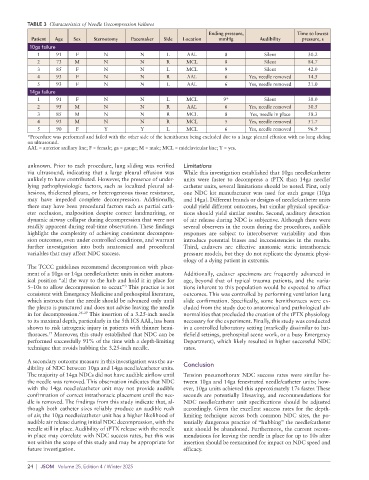
TABLE 3  Characteristics of Needle Decompression Failures
                                                                     Ending pressure,             Time to lowest
           Patient  Age  Sex    Sternotomy   Pacemaker  Side  Location  mmHg          Audibility    pressure, s
           10ga failure
             1     91     F        N           N       L      AAL         8            Silent         30.2
             2     73    M         N           N       R      MCL         8            Silent         84.7
             3     85     F        N           N       L      MCL         9            Silent         42.0
             4     93     F        N           N       R      AAL         6       Yes, needle removed  14.5
             5     93     F        N           N       L      AAL         6       Yes, needle removed  21.0
           14ga failure
             1     91     F        N           N       L      MCL         9*           Silent         38.0
             2     95    M         N           N       R      AAL         6       Yes, needle removed  30.5
             3     85    M         N           N       R      MCL         8        Yes, needle in place  58.3
             4     93    M         N           N       R      MCL         5       Yes, needle removed  51.7
             5     90     F        Y           Y       L      MCL         6       Yes, needle removed  96.9
          *Procedure was performed and failed with the other side of the hemithorax being excluded due to a large pleural effusion with no lung sliding
          on ultrasound.
          AAL = anterior axillary line; F = female; ga = gauge; M = male; MCL = midclavicular line; Y = yes.

          unknown. Prior to each procedure, lung sliding was verified   Limitations
          via ultrasound, indicating that a large pleural effusion was   While this investigation established that 10ga needle/catheter
          unlikely to have contributed. However, the presence of under-  units  were faster to  decompress a  tPTX than  14ga needle/
          lying pathophysiologic factors, such as localized pleural ad-  catheter units, several limitations should be noted. First, only
          hesions, thickened pleura, or heterogeneous tissue resistance,   one NDC kit manufacturer was used for each gauge (10ga
          may have impeded complete decompression.  Additionally,   and 14ga). Different brands or designs of needle/catheter units
          there may have been procedural factors such as partial cath-  could yield different outcomes, but similar physical specifica-
          eter  occlusion,  malposition  despite  correct  landmarking,  or   tions should yield similar results. Second, auditory detection
          dynamic airway collapse during decompression that were not   of air release during NDC is subjective. Although there were
          readily apparent during real-time observation. These findings   several observers in the room during the procedures, audible
          highlight the complexity of achieving consistent decompres-  responses are subject to interobserver variability and thus
          sion outcomes, even under controlled conditions, and warrant   introduce potential biases and inconsistencies in the results.
          further investigation into both anatomical and procedural   Third, cadavers are effective anatomic static intrathoracic
          variables that may affect NDC success.             pressure models, but they do not replicate the dynamic physi-
                                                             ology of a dying patient in extremis.
          The TCCC guidelines recommend decompression with place-
          ment of a 10ga or 14ga needle/catheter units in either anatom-  Additionally, cadaver specimens are frequently advanced in
          ical position “all the way to the hub and hold it in place for   age, beyond that of typical trauma patients, and the varia-
          5–10s to allow decompression to occur.”  This practice is not   tions inherent to this population would be expected to affect
                                          3
          consistent with Emergency Medicine and prehospital literature,   outcomes. This was controlled by performing ventilation lung
          which instructs that the needle should be advanced only until   slide confirmation. Specifically, some hemithoraces were ex-
          the pleura is punctured and does not advise leaving the needle   cluded from the study due to anatomical and pathological ab-
          in for decompression. 25–27  This insertion of a 3.25-inch needle   normalities that precluded the creation of the tPTX physiology
          to its maximal depth, particularly in the 5th ICS AAL, has been   necessary for the experiment. Finally, this study was conducted
          shown to risk iatrogenic injury in patients with thinner hemi-  in a controlled laboratory setting (markedly dissimilar to bat-
                 17
          thoraces.  Moreover, this study established that NDC can be   tlefield settings, prehospital scene work, or a busy Emergency
          performed successfully 91% of the time with a depth-limiting   Department), which likely resulted in higher successful NDC
          technique that avoids hubbing the 3.25-inch needle.  rates.
          A secondary outcome measure in this investigation was the au-  Conclusion
          dibility of NDC between 10ga and 14ga needle/catheter units.
          The majority of 14ga NDCs did not have audible airflow until   Tension pneumothorax NDC success rates were similar be-
          the needle was removed. This observation indicates that NDC   tween 10ga and 14ga fenestrated needle/ catheter units; how-
          with the 14ga needle/catheter unit may not provide audible   ever, 10ga units achieved this approximately 17s faster. These
          confirmation of correct intrathoracic placement until the nee-  seconds are potentially lifesaving, and recommendations for
          dle is removed. The findings from this study indicate that, al-  NDC needle/catheter unit specifications should be adjusted
          though both catheter sizes reliably produce an audible rush   accordingly. Given the excellent success rates for the depth-
          of air, the 10ga needle/catheter unit has a higher likelihood of   limiting technique across both common NDC sites, the po-
          audible air release during initial NDC decompression, with the   tentially dangerous practice of “hubbing” the needle/catheter
          needle still in place. Audibility of tPTX release with the needle   unit should be abandoned. Furthermore, the current recom-
          in place may correlate with NDC success rates, but this was   mendations for leaving the needle in place for up to 10s after
          not within the scope of this study and may be appropriate for   insertion should be reexamined for impact on NDC speed and
          future investigation.                              efficacy.

          24  |  JSOM   Volume 25, Edition 4 / Winter 2025

