


Page 25 - JSOM Winter 2025
P. 25
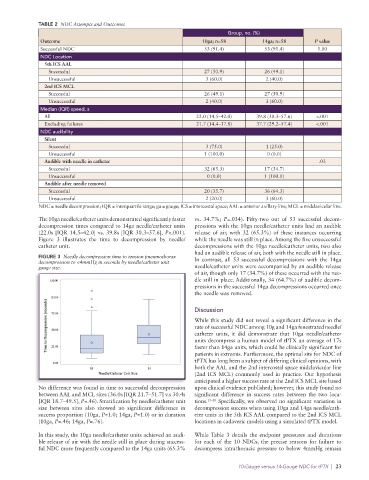
TABLE 2  NDC Attempts and Outcomes
                                                                           Group, no. (%)
              Outcome                                              10ga; n=58          14ga; n=58       P value
              Successful NDC                                        53 (91.4)          53 (91.4)         1.00
              NDC Location
                 5th ICS AAL
                    Successful                                      27 (50.9)          26 (49.1)
                    Unsuccessful                                    3 (60.0)            2 (40.0)
                 2nd ICS MCL
                    Successful                                      26 (49.1)          27 (50.9)
                    Unsuccessful                                    2 (40.0)            3 (60.0)
              Median (IQR) speed, s
                 All                                             22.0 (14.5–42.0)    39.8 (30.3–57.6)   <.001
                 Excluding failures                              21.7 (14.4–37.8)    37.7 (29.2–57.4)   <.001
              NDC audibility
                 Silent
                    Successful                                      3 (75.0)            1 (25.0)
                    Unsuccessful                                    1 (100.0)           0 (0.0)
                 Audible with needle in catheter                                                         .03
                    Successful                                      32 (65.3)          17 (34.7)
                    Unsuccessful                                     0 (0.0)           1 (100.0)
                 Audible after needle removed
                    Successful                                      20 (35.7)          36 (64.3)
                    Unsuccessful                                    2 (20.0)            3 (60.0)
              NDC = needle decompression; IQR = interquartile range; ga = gauge; ICS = intercostal space; AAL = anterior axillary line; MCL = midclavicular line.

              The 10ga needle/catheter units demonstrated significantly faster   vs. 34.7%;  P=.034). Fifty-two out of 53 successful decom-
              decompression times compared to 14ga needle/catheter units   pressions with the 10ga needle/catheter units had an audible
              (22.0s [IQR 14.5–42.0] vs. 39.8s [IQR 30.3–57.6], P<.001).   release of air, with 32 (65.3%) of these instances occurring
              Figure 3 illustrates the time to decompression by   needle/   while the needle was still in place. Among the five unsuccessful
              catheter unit.                                     decompressions with the 10ga needle/catheter units, two also
                                                                 had an audible release of air, both with the needle still in place.
              FIGURE 3  Needle decompression time to tension pneumothorax   In contrast, all 53 successful decompressions with the 14ga
              decompression to <4mmHg in seconds by needle/catheter unit
              gauge size.                                        needle/catheter units were accompanied by an audible release
                                                                 of air, though only 17 (34.7%) of these occurred with the nee-
                                                                 dle still in place. Additionally, 34 (64.7%) of audible decom-
                                                                 pressions in the successful 14ga decompressions occurred once
                                                                 the needle was removed.

                                                                 Discussion

                                                                 While this study did not reveal a significant difference in the
                                                                 rate of successful NDC among 10g and 14ga fenestrated needle/
                                                                 catheter units, it did demonstrate that 10ga needle/catheter
                                                                 units decompress a human model of tPTX an average of 17s
                                                                 faster than 14ga units, which could be clinically significant for
                                                                 patients in extremis. Furthermore, the optimal site for NDC of
                                                                 tPTX has long been a subject of differing clinical opinions, with
                                                                 both the AAL and the 2nd intercostal space midclavicular line
                                                                 (2nd ICS MCL) commonly used in practice. Our hypothesis
                                                                 anticipated a higher success rate at the 2nd ICS MCL site based
              No difference was found in time to successful decompression   upon clinical evidence published; however, this study found no
              between AAL and MCL sites (36.0s [IQR 21.7–51.7] v.s 30.4s   significant difference in success rates between the two loca-
              [IQR 18.7–49.5], P=.46). Stratification by needle/catheter unit   tions. 15–20  Specifically, we observed no significant variation in
              size between sites also showed no significant difference in   decompression success when using 10ga and 14ga needle/cath-
              success proportion (10ga, P=1.0; 14ga, P=1.0) or in duration   eter units in the 5th ICS AAL compared to the 2nd ICS MCL
              (10ga, P=.46; 14ga, P=.76).                        locations in cadaveric models using a simulated tPTX model.

              In this study, the 10ga needle/catheter units achieved an audi-  While Table 3 details the endpoint pressures and durations
              ble release of air with the needle still in place during success-  for each of the 10 NDCs, the precise reasons for failure to
              ful NDC more frequently compared to the 14ga units (65.3%   decompress intrathoracic pressure to below 4mmHg remain

                                                                               10-Gauge versus 14-Gauge NDC for tPTX  |  23

