


Page 57 - 2023 SMOG Digital
P. 57
Cardiac


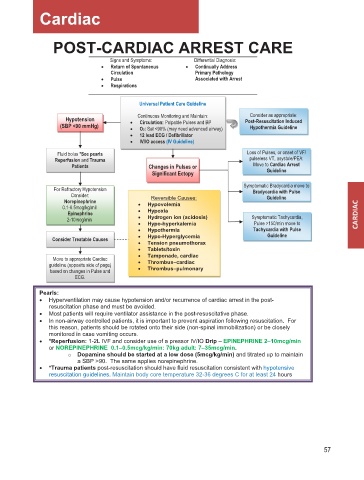
             POST-CARDIAC ARREST CARE

                         Signs and Symptoms:   Differential Diagnosis:
                       •  Return of Spontaneous  •  Continually Address
                         Circulation       Primary Pathology
                       •  Pulse            Associated with Arrest
                       •  Respirations
                               Universal Patient Care Guideline
                                                       Consider as appropriate:
               Hypotension   •  Continuous Monitoring and Maintain:   Post-Resuscitation Induced
                               Circulation: Palpable Pulses and BP
              (SBP <90 mmHg)   •  O2: Sat <90% (may need advanced airway)  Hypothermia Guideline
                             •  12 lead ECG / Defibrillator
                             •  IV/IO access (IV Guideline)
              Fluid bolus *See pearls                  Loss of Pulses, or onset of VF/
             Reperfusion and Trauma                    pulseless VT, asystole/PEA:
                 Patients        Changes in Pulses or   Move to Cardiac Arrest
                                                           Guideline
                                  Significant Ectopy
                                                      Symptomatic Bradycardia move to
             For Refractory Hypotension                 Bradycardia with Pulse
                Consider:         Reversible Causes:       Guideline
               Norepinephrine   •  Hypovolemia
               0.1-0.5mcg/kg/mil   •  Hypoxia
                Epinephrine
                2-10mcg/min    •  Hydrogen ion (acidosis)  Symptomatic Tachycardia,
                               •  Hypo-hyperkalemia     Pulse >150/min move to
                               •  Hypothermia           Tachycardia with Pulse
            Consider Treatable Causes   •  Hypo-Hyperglycemia  Guideline
                               •  Tension pneumothorax
                               •  Tablets/toxin
             Move to appropriate Cardiac   •  Tamponade, cardiac
            guideline (opposite side of page)   •  Thrombus–cardiac
            based on changes in Pulse and   •  Thrombus–pulmonary
                 ECG.
          Pearls:
          •  Hyperventilation may cause hypotension and/or recurrence of cardiac arrest in the post-
            resuscitation phase and must be avoided.
          •  Most patients will require ventilator assistance in the post-resuscitative phase.
          •  In non-airway controlled patients, it is important to prevent aspiration following resuscitation.  For
            this reason, patients should be rotated onto their side (non-spinal immobilization) or be closely
            monitored in case vomiting occurs.
          •  *Reperfusion: 1-2L IVF and consider use of a pressor IV/IO Drip – EPINEPHRINE 2–10mcg/min
            or NOREPINEPHRINE  0.1–0.5mcg/kg/min: 70kg adult: 7–35mcg/min.
                o  Dopamine should be started at a low dose (5mcg/kg/min) and titrated up to maintain
                  a SBP >90.  The same applies norepinephrine.
          •  *Trauma patients post-resuscitation should have fluid resuscitation consistent with hypotensive
            resuscitation guidelines. Maintain body core temperature 32-36 degrees C for at least 24 hours


                                                                        57

