


Page 154 - 2023 SMOG Digital
P. 154
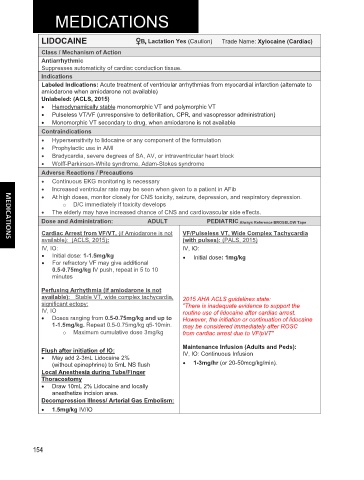
LIDOCAINE             B Lactation Yes (Caution)    Trade Name: Xylocaine (Cardiac)
          Class / Mechanism of Action
          Antiarrhythmic
          Suppresses automaticity of cardiac conduction tissue.
          Indications
          Labeled Indications: Acute treatment of ventricular arrhythmias from myocardial infarction (alternate to
          amiodarone when amiodarone not available)
          Unlabeled: (ACLS, 2015)
          •  Hemodynamically stable monomorphic VT and polymorphic VT
          •  Pulseless VT/VF (unresponsive to defibrillation, CPR, and vasopressor administration)
          •  Monomorphic VT secondary to drug, when amiodarone is not available
          Contraindications
          •  Hypersensitivity to lidocaine or any component of the formulation
          •  Prophylactic use in AMI
          •  Bradycardia, severe degrees of SA, AV, or intraventricular heart block
          •  Wolff-Parkinson-White syndrome, Adam-Stokes syndrome
          Adverse Reactions / Precautions
          •  Continuous EKG monitoring is necessary
          •  Increased ventricular rate may be seen when given to a patient in AFib
          •  At high doses, monitor closely for CNS toxicity, seizure, depression, and respiratory depression.
               o  D/C immediately if toxicity develops
          •  The elderly may have increased chance of CNS and cardiovascular side effects.
          Dose and Administration:    ADULT    PEDIATRIC Always Reference BROSELOW Tape
          Cardiac Arrest from VF/VT, (if Amiodarone is not   VF/Pulseless VT, Wide Complex Tachycardia
          available):  (ACLS, 2015):     (with pulses): (PALS, 2015)
          IV, IO:                        IV, IO:
          •  Initial dose: 1-1.5mg/kg    •  Initial dose: 1mg/kg
          •  For refractory VF may give additional
            0.5-0.75mg/kg IV push, repeat in 5 to 10
            minutes
               o  Maximum of 3 doses or total of 3mg/kg
          Perfusing Arrhythmia (if amiodarone is not
          available):   Stable VT, wide complex tachycardia,   2015 AHA ACLS guidelines state:
          significant ectopy:            "There is inadequate evidence to support the
          IV, IO                         routine use of lidocaine after cardiac arrest.
          •  Doses ranging from 0.5-0.75mg/kg and up to   However, the initiation or continuation of lidocaine
            1-1.5mg/kg. Repeat 0.5-0.75mg/kg q5-10min.  may be considered immediately after ROSC
               o  Maximum cumulative dose 3mg/kg  from cardiac arrest due to VF/pVT"
                                         Maintenance Infusion (Adults and Peds):
          Flush after initiation of IO:   IV, IO: Continuous Infusion
          •  May add 2-3mL Lidocaine 2%
            (without epinephrine) to 5mL NS flush  •  1-3mg/hr (or 20-50mcg/kg/min).
          Local Anesthesia during Tube/Finger
          Thoracostomy
          •  Draw 10mL 2% Lidocaine and locally
            anesthetize incision area.
          Decompression Illness/ Arterial Gas Embolism:
          •  1.5mg/kg IV/IO


        154

