


Page 130 - JSOM Fall 2025
P. 130
nonurgent) to maintain focus on casualty movement, com-  medical responders can work together to optimize casualty
          munication, and security. As such, the Committee on Tactical   survival and mission outcomes.
          Combat Casualty Care (CoTCCC) recommends transitioning
          to a principles-based prehospital triage method that sorts ca-  Currently, under the basic management plan for triage during
          sualties into urgent, priority, and routine categories mirroring   tactical field care, the TCCC guidelines only recommend that re-
          the existing evacuation categories. This approach aims to sim-  sponders triage casualties while removing weapons and equip-
                                                                                                    6
          plify training for first responders, improve communication for   ment from casualties with an altered mental status.  There is no
          shared understanding, expedite decision-making, and facilitate   guidance on how to categorize casualties based on injuries, nor
          casualty transition to evacuation platforms for optimal casu-  are there best practices on the prioritization of casualties based
          alty outcomes and mission completion.              on their medical and evacuation needs. There is no mention of
                                                             the ongoing actions that transpire during triage and treatment.
          It is important to note that the overall scale of a mass casualty   The following TCCC update for triage addresses these gaps
          event greatly affects the casualty response. As such, military   and provides responders with a systematic two-step approach
          leaders, logisticians, planners, and medical personnel should   to triage as part of MCM. It standardizes how prehospital re-
          categorize MCM into three classes: multiple casualties, MAS-  sponders can communicate to ensure shared understanding, ex-
          CAL (<100 casualties), or ultra-MASCAL (>100, possibly   pedite decisions, and drive actions to improve outcomes.
          thousands of casualties).  During MCM class one, resources
                             1
          including personnel and supplies are stretched but not ex-  Move, Treat, Transport
          ceeded. Typically, the threat is controlled, evacuation is pos-
          sible, and responders can arrive to treat urgent casualties. In   The concept of move, treat, transport  offers a basic MCM
                                                                                           7
          MCM class two, the MASCAL event exceeds planned casualty   framework for first responders that highlights the need to
          response, the threat may not be controlled, evacuation can be   prioritize overall incident management rather than adhering
          delayed, resource limitations affect survival, and medical re-  to formal triage systems that emphasize linear assessment of
          sponders may have delayed response time to render care. A   individual casualties. Moving casualties to a safe location will
          MCM ultra-MASCAL class three event is overwhelming, the   take precedence over medical interventions when there is an
          threat is likely ongoing, resources are severely limited, evac-  ongoing threat. Treatment focuses on limited life-saving in-
          uation is denied, and medical responders will be delayed or   terventions when tactically possible once a casualty has been
          denied, which will require nonmedical responders involved in   moved away from immediate threat or danger. Casualties are
          the incident to triage, treat, transport, and provide prolonged   moved to an area where responders can also assess the re-
          casualty care. In general, the larger the casualty event, the   sources needed to manage the incident and determine casualty
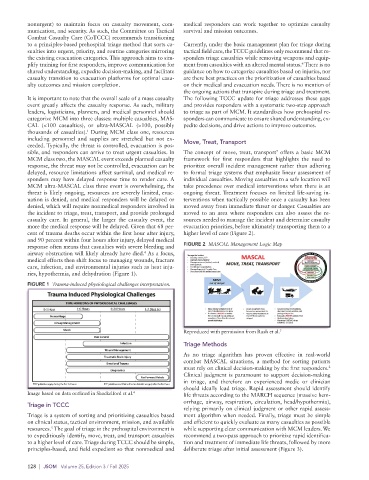
          more the medical response will be delayed. Given that 68 per-  evacuation priorities, before ultimately transporting them to a
          cent of trauma deaths occur within the first hour after injury,   higher level of care (Figure 2).
          and 90 percent within four hours after injury, delayed medical
          response often means that casualties with severe bleeding and   FIGURE 2  MASCAL Management Logic Map
                                                4
          airway obstruction will likely already have died.  As a focus,
          medical efforts then shift focus to managing wounds, fracture
          care, infection, and environmental injuries such as heat inju-
          ries, hypothermia, and dehydration (Figure 1).
          FIGURE 1  Trauma-induced physiological challenges interpretation.


                                                             Reproduced with permission from Rush et al. 7

                                                             Triage Methods
                                                             As no triage algorithm has proven effective in real-world
                                                             combat MASCAL situations, a method for sorting patients
                                                             must rely on clinical decision-making by the first responders.
                                                                                                            2
                                                             Clinical judgment is paramount to support decision-making
                                                             in triage, and therefore an experienced medic or clinician
                                                             should ideally lead triage. Rapid assessment should identify
          Image based on data outlined in Shackelford et al. 4  life threats according to the MARCH sequence (massive hem-
                                                             orrhage, airway, respiration, circulation, head/hypothermia),
          Triage in TCCC
                                                             relying primarily on clinical judgment or other rapid assess-
          Triage is a system of sorting and prioritizing casualties based   ment algorithm when needed. Finally, triage must be simple
          on clinical status, tactical environment, mission, and available   and efficient to quickly evaluate as many casualties as possible
                  5
          resources.  The goal of triage in the prehospital environment is   while supporting clear communication with MCM leaders. We
          to expeditiously identify, move, treat, and transport casualties   recommend a two-pass approach to prioritize rapid identifica-
          to a higher level of care. Triage during TCCC should be simple,   tion and treatment of immediate life threats, followed by more
          principles-based, and field expedient so that nonmedical and   deliberate triage after initial assessment (Figure 3).

          128  |  JSOM   Volume 25, Edition 3 / Fall 2025

