


Page 87 - JSOM Spring 2025
P. 87
An Ongoing Series


                                   Special Operations Forces Lessons Learned

                                                        Beirut Blast


                                                                         2
                                                                                                   3
                                              1
                          Zachary LeBlanc, BS *; Matthew A. Bergens, MR ; Isabella R. McKinney, BS ;
                                                                      5
                                Brian L. Edlow, MD ; Mark Shapiro, MD ; Francisca Aguilar, DO ;
                                                                                             6
                                                  4
                                                             7
                                       Rachel E. Bridwell, MD ; Ricky M. Ditzel Jr., BSHS 8
              ABSTRACT
              The Beirut Port Explosion of 4 August 2020 posed significant   away in Cyprus.  Half of our team was located approximately
                                                                             4
              medical challenges for relief teams and caused diverse blast   400m from the epicenter, while the rest were approximately
              injuries to individuals in the area. Several days after the ex-  2km away.
              plosion occurred, a Special Operations Forces (SOF) medic
              provided care for a Servicemember who developed neurologic   Streets, buildings, and cars shielded the team closest to the
              symptoms that led to his medical evacuation out of Lebanon.   blast from the direct pressure wave. However, the team fur-
              These relief efforts underscore the need for vigilant post-blast   thest away lacked shielding and may have been exposed to a
              monitoring and consideration of long-term consequences.  more intense focus of pressure.
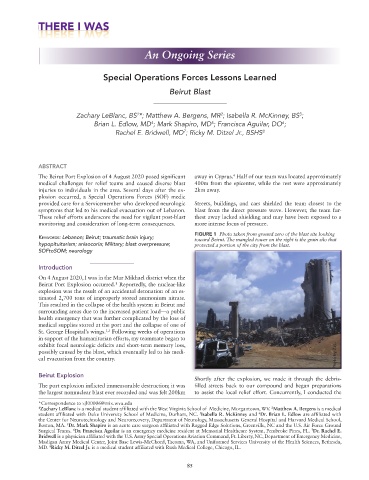
                                                                 FIGURE 1  Photo taken from ground zero of the blast site looking
              Keywords: Lebanon; Beirut; traumatic brain injury;   toward Beirut. The mangled tower on the right is the grain silo that
              hypopituitarism; anisocoria; Military; blast overpressure;   protected a portion of the city from the blast.
              SOFtoSOM; neurology


              Introduction
              On 4 August 2020, I was in the Mar Mikhael district when the
              Beirut Port Explosion occurred.  Reportedly, the nuclear-like
                                       1
              explosion was the result of an accidental detonation of an es-
              timated 2,700 tons of improperly stored ammonium nitrate.
              This resulted in the collapse of the health system in Beirut and
              surrounding areas due to the increased patient load—a public
              health emergency that was further complicated by the loss of
              medical supplies stored at the port and the collapse of one of
              St. George Hospital’s wings.  Following weeks of operations
                                    2,3
              in support of the humanitarian efforts, my teammate began to
              exhibit focal neurologic deficits and short-term memory loss,
              possibly caused by the blast, which eventually led to his medi-
              cal evacuation from the country.                                                                 Photo by ZJL.


              Beirut Explosion
                                                                 Shortly after the explosion, we made it through the debris-
              The port explosion inflicted immeasurable destruction; it was   filled streets back to our compound and began preparations
              the largest nonnuclear blast ever recorded and was felt 200km   to assist the local relief effort. Concurrently, I conducted the

              *Correspondence to zjl00006@mix.wvu.edu
                                                                                          2
              1 Zachary LeBlanc is a medical student affiliated with the West Virginia School of  Medicine, Morgantown, WV.  Matthew A. Bergens is a medical
                                                                  3
                                                                                      4
              student affiliated with Duke University School of Medicine, Durham, NC.  Isabella R. McKinney and  Dr. Brian L. Edlow are affiliated with
              the Center for Neurotechnology and Neurorecovery, Department of Neurology, Massachusetts General Hospital and Harvard Medical School,
              Boston, MA.  Dr. Mark Shapiro is an acute care surgeon affiliated with Ragged Edge Solutions, Greenville, NC and the U.S. Air Force Ground
                       5
              Surgical Teams.  Dr. Francisca Aguilar is an emergency medicine resident at Memorial Healthcare System, Pembroke Pines, FL.  Dr. Rachel E.
                                                                                                       7
                         6
              Bridwell is a physician affiliated with the U.S. Army Special Operations Aviation Command, Ft. Liberty, NC, Department of Emergency Medicine,
              Madigan Army Medical Center, Joint Base Lewis-McChord, Tacoma, WA, and Uniformed Services University of the Health Sciences, Bethesda,
                 8
              MD.  Ricky M. Ditzel Jr. is a medical student affiliated with Rush Medical College, Chicago, IL.
                                                              85

