


Page 83 - JSOM Spring 2025
P. 83
BOX 4  Post-technique Damage Scoring System 16     the emergent surgical airway technique in canines. Although
                                                                 not statistically significant, the MD group completed both
                Score                 Description                CTT and  TT in less time when compared with the DVM
                 0     No gross damage.                          group. However, the MD group had an average of 2 years of
                 1     Minor damage (e.g., tracheal abrasions, scratches,   experience practicing medicine, while four out of five experi-
                       off-midline incision, and minor laceration of muscle
                       <5mm).                                    menters in the DVM group consisted of new graduates with
                 2     Moderate damage (e.g., dorsal tracheal lesions, partial   less than 1 year of clinical experience practicing veterinary
                       thickness mucosal laceration <5mm, laceration of   medicine. The shorter procedure times for the MD group most
                       muscle >5mm, and deformation of tracheal rings).  likely reflect their greater exposure to surgical procedures and
                 3     Severe damage (e.g., full-thickness tracheal tear,   tissue handling skills when compared with the DVM group.
                       tracheal ring or cricoid cartilage fracture, esophageal   Considering the VCO with approximately 5 years of clinical
                       tear, and incision between tracheal rings greater than   experience performed CTT in 20 seconds, this supports the
                       half the circumference of the trachea).
                                                                 notion that prior surgical experience played a role in the time
                                                                 to complete the techniques.
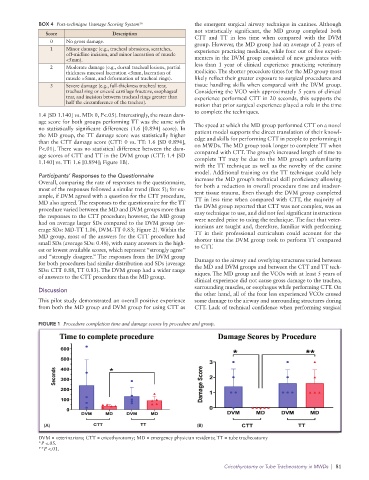
              1.4 [SD 1.140] vs. MD: 0, P<.05). Interestingly, the mean dam-
              age score for both groups performing TT was the same with
              no statistically significant differences (1.6 [0.894] score). In   The speed at which the MD group performed CTT on a novel
              the MD group, the TT damage score was statistically higher   patient model supports the direct translation of their knowl-
              than the CTT damage score (CTT: 0 vs. TT: 1.6 [SD 0.894],   edge and skills for performing CTT in people to performing it
              P<.01). There was no statistical difference between the dam-  on MWDs. The MD group took longer to complete TT when
              age scores of CTT and TT in the DVM group (CTT: 1.4 [SD   compared with CTT. The group’s increased length of time to
              1.140] vs. TT: 1.6 [0.894]; Figure 1B).            complete TT may be due to the MD group’s unfamiliarity
                                                                 with the TT technique as well as the novelty of the canine
                                                                 model. Additional training on the TT technique could help
              Participants’ Responses to the Questionnaire
              Overall, comparing the rate of responses to the questionnaire,   increase the MD group’s technical skill proficiency allowing
              most of the responses followed a similar trend (Box 5); for ex-  for both a reduction in overall procedure time and inadver-
              ample, if DVM agreed with a question for the CTT procedure,   tent tissue trauma. Even though the DVM group completed
              MD also agreed. The responses to the questionnaire for the TT   TT in less time when compared with CTT, the majority of
              procedure varied between the MD and DVM groups more than   the DVM group reported that CTT was not complex, was an
              the responses to the CTT procedure; however, the MD group   easy technique to use, and did not feel significant instructions
              had on average larger SDs compared to the DVM group (av-  were needed prior to using the technique. The fact that veter-
              erage SDs: MD-TT 1.06, DVM-TT 0.83; Figure 2). Within the   inarians are taught and, therefore, familiar with performing
              MD group, most of the answers for the CTT procedure had   TT in their professional curriculum could account for the
              small SDs (average SDs: 0.48), with many answers in the high-  shorter time the DVM group took to perform TT compared
              est or lowest available scores, which represent “strongly agree”   to CTT.
              and “strongly disagree.” The responses from the DVM group
              for both procedures had similar distribution and SDs (average   Damage to the airway and overlying structures varied between
              SDs: CTT 0.88, TT 0.83). The DVM group had a wider range   the MD and DVM groups and between the CTT and TT tech-
              of answers to the CTT procedure than the MD group.  niques. The MD group and the VCOs with at least 5 years of
                                                                 clinical experience did not cause gross damage to the trachea,
              Discussion                                         surrounding muscles, or esophagus while performing CTT. On
                                                                 the other hand, all of the four less experienced VCOs caused
              This pilot study demonstrated an overall positive experience   some damage to the airway and surrounding structures during
              from both the MD group and DVM group for using CTT as   CTT. Lack of technical confidence when performing surgical

              FIGURE 1  Procedure completion time and damage scores by procedure and group.


               (A)                                               (B)

              DVM = veterinarians; CTT = cricothyrotomy; MD = emergency physician residents; TT = tube tracheostomy
              *P <.05.
              **P <.01.

                                                                          Cricothyrotomy or Tube Tracheostomy in MWDs  |  81

