


Page 82 - JSOM Spring 2025
P. 82
Model Preparation for Cricothyrotomy and           the DVM and MD groups performing CTT, the DVM and MD
          Tube Tracheostomy                                  groups performing  TT, and in each group comparing their
          Evaluators prepared cadavers and study areas and laid out sur-  performance of CTT and TT. Five experimenters per group
          gical instruments for each technique to ensure standardization   performed each procedure and were rated/scored by two inde-
          between both groups. Cadavers were positioned and secured in   pendent observers.
          dorsal recumbency. A rolled towel was placed under the dorsal
          aspect of the neck to mildly hyperextend the cranial cervical   Results
          region; this facilitated laryngeal cartilage exposure and tra-
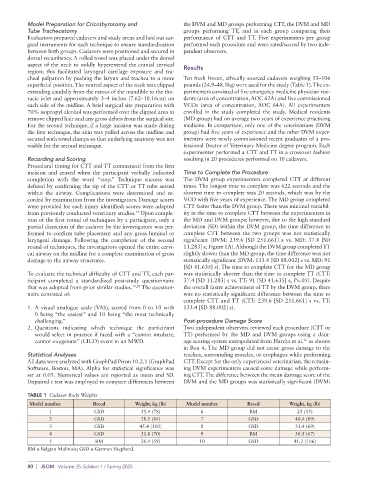
          cheal palpation by pushing the larynx and trachea to a more   Ten fresh frozen, ethically sourced cadavers weighing 55–106
          superficial position. The ventral aspect of the neck was clipped   pounds (24.9–48.1kg) were used for the study (Table 1). The ex-
          extending caudally from the ramus of the mandible to the tho-  perimenters consisted of five emergency medicine physician resi-
          racic inlet and approximately 3–4 inches (7.62–10.16cm) on   dents (area of concentration, AOC 62A) and five commissioned
          each side of the midline. A brief surgical site preparation with   VCOs (area of  concentration,  AOC 64A).  All  experimenters
          70% isopropyl alcohol was performed over the clipped area to   enrolled in the study completed the study. Medical residents
          remove clipped hair and any gross debris from the surgical site.   (MD group) had on average two years of experience practicing
          For the second technique, if a large incision was made during   medicine. In comparison, only one of the veterinarians (DVM
          the first technique, the skin was pulled across the midline and   group) had five years of experience and the other DVM exper-
          secured with towel clamps so that underlying anatomy was not   imenters were newly commissioned recent graduates of a pro-
          visible for the second technique.                  fessional Doctor of Veterinary Medicine degree program. Each
                                                             experimenter performed a CTT and TT in a crossover fashion
          Recording and Scoring                              resulting in 20 procedures performed on 10 cadavers.
          Procedural timing for CTT and TT commenced from the first
          incision and ceased when the participant verbally indicated   Time to Complete the Procedure
          completion with the word  “stop.”  Technique success was   The DVM group experimenters completed CTT at different
          defined by confirming the tip of the CTT or TT tube seated   times. The longest time to complete was 622 seconds and the
          within  the airway.  Complications  were  determined  and re-  shortest time to complete was 20 seconds, which was by the
          corded by examination from the investigators. Damage scores   VCO with five years of experience. The MD group completed
          were provided for each injury identified; scores were adapted   CTT faster than the DVM group. There was minimal variabil-
          from previously conducted veterinary studies.  Upon comple-  ity in the time to complete CTT between the experimenters in
                                             19
          tion of the first round of techniques by a participant, only a   the MD and DVM groups; however, due to the high standard
          partial dissection of the cadaver by the investigators was per-  deviation (SD) within the DVM group, the time difference to
          formed to confirm tube placement and any gross luminal or   complete CTT between the two groups was not statistically
          laryngeal damage. Following the completion of the second   significant  (DVM:  239.6  [SD 251.661]  s  vs.  MD:  37.4 [SD
          round of techniques, the investigators opened the entire cervi-  11.283] s; Figure 1A). Although the DVM group completed TT
          cal airway on the midline for a complete examination of gross   slightly slower than the MD group, the time difference was not
          damage to the airway structures.                   statistically significant (DVM: 133.4 [SD 88.002] s vs. MD: 91
                                                             [SD 41.635] s). The time to complete CTT for the MD group
          To evaluate the technical difficulty of CTT and TT, each par-  was statistically shorter than the time to complete TT (CTT:
          ticipant completed a standardized post-study questionnaire   37.4 [SD 11.283] s vs. TT: 91 [SD 41.635] s, P<.05). Despite
          that was adopted from prior similar studies. 19,20  The question-  the overall faster achievement of TT by the DVM group, there
          naire consisted of:                                was no statistically significant difference between the time to
                                                             complete CTT and TT (CTT: 239.6 [SD 251.661] s vs. TT:
          1.  A visual analogue scale (VAS), scored from 0 to 10 with   133.4 [SD 88.002] s).
            0 being “the easiest” and 10 being “the most technically
            challenging.”                                    Post-procedure Damage Score
          2.  Questions indicating which technique the participant   Two independent observers reviewed each procedure (CTT or
            would select in practice if faced with a “cannot intubate,   TT) performed by the MD and DVM groups using a dam-
            cannot oxygenate” (CICO) event in an MWD.        age scoring system extrapolated from Hardjo et al.  as shown
                                                                                                    16
                                                             in Box 4. The MD group did not cause gross damage to the
          Statistical Analyses                               trachea, surrounding muscles, or esophagus while performing
          All data were analyzed with GraphPad Prism 10.2.1 ( GraphPad   CTT. Except for the only experienced veterinarian, the remain-
          Software, Boston, MA). Alpha for statistical significance was   ing DVM experimenters caused some damage while perform-
          set at 0.05. Numerical values are reported as mean and SD.   ing CTT. The difference between the mean damage score of the
          Unpaired t test was employed to compare differences between   DVM and the MD groups was statistically significant (DVM:

          TABLE 1  Cadaver Body Weights
           Model number        Breed         Weight, kg (lb)  Model number        Breed         Weight, kg (lb)
                 1              GSD            35.4 (78)           6               BM             25 (55)
                 2              GSD            38.1 (84)           7              GSD            40.4 (89)
                 3              GSD            45.4 (100)          8              GSD            31.4 (69)
                 4              GSD            31.8 (70)           9               BM            30.5 (67)
                 5              BM             26.4 (58)          10              GSD            41.2 (106)
          BM = Belgian Malinois; GSD = German Shepherd.

          80  |  JSOM   Volume 25, Edition 1 / Spring 2025

