


Page 85 - JSOM Spring 2025
P. 85
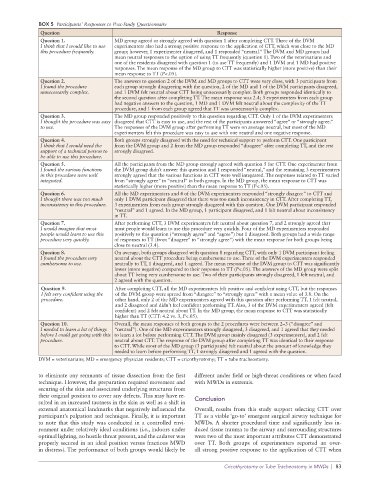
BOX 5  Participants’ Responses to Post-Study Questionnaire
              Question                                                  Response
              Question 1.             MD group agreed or strongly agreed with question 1 after completing CTT. Three of the DVM
              I think that I would like to use   experimenters also had a strong positive response to the application of CTT, which was close to the MD
              this procedure frequently.  group; however, 1 experimenter disagreed, and 1 responded “neutral.” The DVM and MD groups had
                                      mean neutral responses to the option of using TT frequently (question 1). Two of the veterinarians and
                                      one of the residents disagreed with question 1 (to use TT frequently) and 1 DVM and 1 MD had positive
                                      responses. The mean response of the MD group to CTT was statistically higher (more positive) than their
                                      mean response to TT (P<.05).
              Question 2.             The answers to question 2 of the DVM and MD groups to CTT were very close, with 3 participants from
              I found the procedure   each group strongly disagreeing with the question, 2 of the MD and 1 of the DVM participants disagreed,
              unnecessarily complex.  and 1 DVM felt neutral about CTT being unnecessarily complex. Both groups responded identically to
                                      the second question after completing TT. The mean response was 2.4; 3 experimenters from each group
                                      had negative answers to the question, 1 MD and 1 DVM felt neutral about the complexity of the TT
                                      procedure, and 1 from each group agreed that TT was unnecessarily complex.
              Question 3.             The MD group responded positively to this question regarding CTT. Only 1 of the DVM experimenters
              I thought the procedure was easy  disagreed that CTT is easy to use, and the rest of the participants answered “agree” or “strongly agree.”
              to use.                 The responses of the DVM group after performing TT were on average neutral, but most of the MD
                                      experimenters felt this procedure was easy to use with one neutral and one negative response.
              Question 4.             Both groups strongly disagreed with the need for technical support to perform CTT. One participant
              I think that I would need the   from the DVM group and 2 from the MD group responded “disagree” after completing TT, and the rest
              support of a technical person to   strongly disagreed.
              be able to use this procedure.
              Question 5.             All the participants from the MD group strongly agreed with question 5 for CTT. One experimenter from
              I found the various functions   the DVM group didn’t answer this question and 1 responded “neutral,” and the remaining 3 experimenters
              in this procedure were well   strongly agreed that the various functions in CTT were well integrated. The responses related to TT varied
              integrated.             from “strongly agree” to “neutral” in both groups. In the MD group, the mean response to CTT was
                                      statistically higher (more positive) than the mean response to TT (P<.05).
              Question 6.             All the MD experimenters and 4 of the DVM experimenters responded “strongly disagree” to CTT and
              I thought there was too much   only 1 DVM participant disagreed that there was too much inconsistency in CTT. After completing TT,
              inconsistency in this procedure.  3 experimenters from each group strongly disagreed with this question. One DVM participant responded
                                      “neutral” and 1 agreed. In the MD group, 1 participant disagreed, and 1 felt neutral about inconsistency
                                      in TT.
              Question 7.             After performing CTT, 3 DVM experimenters felt neutral about question 7, and 2 strongly agreed that
              I would imagine that most   most people would learn to use this procedure very quickly. Four of the MD experimenters responded
              people would learn to use this   positively to this question (“strongly agree” and “agree”) but 1 disagreed. Both groups had a wide range
              procedure very quickly.  of responses to TT (from “disagree” to “strongly agree”) with the mean response for both groups being
                                      close to neutral (3.4).
              Question 8.             On average, both groups disagreed with question 8 regarding CTT, with only 1 DVM participant feeling
              I found the procedure very   neutral about the CTT procedure being cumbersome to use. Three of the DVM experimenters responded
              cumbersome to use.      neutrally to TT, 1 disagreed, and 1 agreed. The mean response of the DVM group to CTT was significantly
                                      lower (more negative) compared to their response to TT (P<.05). The answers of the MD group were split
                                      about TT being very cumbersome to use. Two of their participants strongly disagreed, 1 felt neutral, and
                                      2 agreed with the question.
              Question 9.              After completing CTT, all the MD experimenters felt positive and confident using CTT, but the responses
              I felt very confident using the   of the DVM group were spread from “disagree” to “strongly agree” with a mean value of 3.8. On the
              procedure.               other hand, only 2 of the MD experimenters agreed with this question after performing TT, 1 felt neutral,
                                       and 2 disagreed and didn’t feel confident performing TT. Also, 3 of the DVM experimenters agreed (felt
                                       confident) and 2 felt neutral about TT. In the MD group, the mean response to CTT was statistically
                                       higher than TT (CTT: 4.2 vs. 3, P<.05).
              Question 10.            Overall, the mean responses of both groups to the 2 procedures were between 2–3 (“disagree” and
              I needed to learn a lot of things   “neutral”). One of the MD experimenters strongly disagreed, 3 disagreed, and 1 agreed that they needed
              before I could get going with this  to learn a lot before performing CTT. The DVM group mainly disagreed (3 experimenters), and 2 felt
              procedure.              neutral about CTT. The response of the DVM group after completing TT was identical to their response
                                      to CTT. While most of the MD group (3 participants) felt neutral about the amount of knowledge they
                                      needed to learn before performing TT, 1 strongly disagreed and 1 agreed with the question.
              DVM = veterinarians; MD = emergency physician residents; CTT = cricothyrotomy; TT = tube tracheostomy.

              to eliminate any remnants of tissue dissection from the first   different under field or high-threat conditions or when faced
              technique. However, the preparation required movement and   with MWDs in extremis.
              securing of the skin and associated underlying structures from
              their original position to cover any defects. This may have re-  Conclusion
              sulted in an increased tautness in the skin as well as a shift in
              external anatomical landmarks that negatively influenced the   Overall, results from this study support selecting CTT over
              participant’s palpation and technique. Finally, it is important   TT as a viable ‘go-to’ emergent surgical airway technique for
              to note that this study was conducted in a controlled envi-  MWDs. A shorter procedural time and significantly less in-
              ronment under relatively ideal conditions (i.e., indoors under   duced tissue trauma to the airway and surrounding structures
              optimal lighting, no hostile threat present, and the cadaver was   were two of the most important attributes CTT demonstrated
              properly secured in an ideal position versus fractious MWD   over  TT. Both groups of experimenters reported an over-
              in distress). The performance of both groups would likely be   all strong positive response to the application of CTT when

                                                                          Cricothyrotomy or Tube Tracheostomy in MWDs  |  83

