


Page 81 - JSOM Spring 2025
P. 81
proficiency for human patients, emergency human healthcare   instruments, and materials were standardized  between both
              clinicians have limited time in their schedule to learn a novel,   groups and both techniques. Each experimenter was randomly
              technical,  and  perishable  skill such  as  the TT. In  particular   assigned to a cadaver pair to perform both techniques on each
              since their use of TT would be limited to MWDs with UAO.   cadaver. Experimenters performed their first attempt of each
              Having the ability to readily translate the training, skills, and   technique on a fresh cadaver while their second attempt was
              knowledge they already possess for performing CTT in people   on the same paired cadavers, but the techniques were crossed
              to MWDs prevents the need and time associated with learning   over.
              the TT technique. Furthermore, training U.S. Army Veterinary
              Corps Officers (VCOs) in a technique that is the least tech-  Description of Techniques
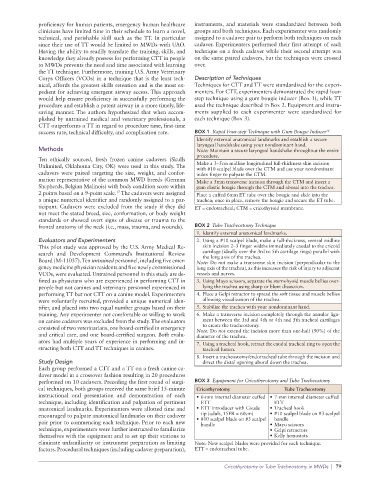
              nical, affords the greatest skills retention and is the most ex-  Techniques for CTT and TT were standardized for the experi-
              pedient for achieving emergent airway access. This approach   menters. For CTT, experimenters demonstrated the rapid four-
              would help ensure proficiency in successfully performing the   step technique using a gum bougie inducer (Box 1), while TT
              procedure and establish a patent airway in a more timely, life-  used the technique described in Box 2. Equipment and instru-
              saving manner. The authors hypothesized that when accom-  ments  supplied to  each experimenter  were  standardized for
              plished by untrained medical and veterinary professionals, a   each technique (Box 3).
              CTT outperforms a TT in regard to procedure time, first-time
              success rate, technical difficulty, and complication rate.  BOX 1  Rapid Four-step Technique with Gum Bougie Inducer 18
                                                                 Identify external anatomical landmarks and establish a secure
                                                                 laryngeal handshake using your nondominant hand.
              Methods                                            Note: Maintain a secure laryngeal handshake throughout the entire
                                                                 procedure.
              Ten ethically sourced, fresh frozen canine cadavers (Skulls
              Unlimited, Oklahoma City, OK) were used in this study. The   Make a 3–5cm midline longitudinal full-thickness skin incision
              cadavers were paired targeting the size, weight, and confor-  with #10 scalpel blade over the CTM and use your nondominant
                                                                 index finger to palpate the CTM.
              mation representative of the common MWD breeds (German   Make a 5mm transverse incision through the CTM and insert a
              Shepherds, Belgian Malinois) with body condition score within   gum elastic bougie through the CTM and aboral into the trachea.
              2 points based on a 9-point scale.  The cadavers were assigned   Place a cuffed 6mm ET tube over the bougie and slide into the
                                       17
              a unique numerical identifier and randomly assigned to a par-  trachea; once in place, remove the bougie and secure the ET tube.
              ticipant. Cadavers  were excluded from  the study  if they  did   ET = endotracheal; CTM = cricothyroid membrane.
              not meet the stated breed, size, conformation, or body weight
              standards or showed overt signs of disease or trauma to the
              frontal anatomy of the neck (i.e., mass, trauma, and wounds).  BOX 2  Tube Tracheostomy Technique
                                                                 1.  Identify external anatomical landmarks.
              Evaluators and Experimenters                       2.  Using a #10 scalpel blade, make a full-thickness, ventral midline
              This pilot study was approved by the U.S. Army Medical Re-  skin incision 2–3 finger widths immediately caudal to the cricoid
              search and Development Command’s Institutional Review   cartilage (ideally over the 3rd to 5th cartilage rings) parallel with
                                                                   the long axis of the trachea.
              Board (M-11037). Ten untrained personnel, including five emer-  Note: Do not make a transverse skin incision (perpendicular to the
              gency medicine physician residents and five newly commissioned   long axis of the trachea), as this increases the risk of injury to adjacent
              VCOs, were evaluated. Untrained personnel in this study are de-  vessels and nerves.
              fined as physicians who are experienced in performing CTT in   3.  Using Mayo scissors, separate the sternohyoid muscle bellies over-
              people but not canines and veterinary personnel experienced in   lying the trachea using sharp or blunt dissection.
              performing TT but not CTT on a canine model. Experimenters   4.  Place a Gelpi retractor to spread the soft tissue and muscle bellies
              were voluntarily recruited, provided a unique numerical iden-  allowing visualization of the trachea.
              tifier, and placed into two equal number groups based on their   5.  Stabilize the trachea with your nondominant hand.
              training. Any experimenter not comfortable or willing to work   6.  Make a transverse incision completely through the annular liga-
              on canine cadavers was excluded from the study. The evaluators   ment between the 3rd and 4th or 4th and 5th tracheal cartilages
              consisted of two veterinarians, one board-certified in emergency   to create the tracheostomy.
              and critical care, and one board-certified surgeon. Both evalu-  Note: Do not extend the incision more than one-half (50%) of the
                                                                 diameter of the trachea.
              ators had multiple years of experience in performing and in-  7.  Using a tracheal hook, retract the caudal tracheal ring to open the
              structing both CTT and TT techniques in canines.     tracheal lumen.
                                                                 8.  Insert a tracheostomy/endotracheal tube through the incision and
              Study Design                                         direct the distal opening aboral down the trachea.
              Each group performed a CTT and a TT on a fresh canine ca-
              daver model in a crossover fashion resulting in 20 procedures
              performed on 10 cadavers. Preceding the first round of surgi-  BOX 3  Equipment for Cricothyrotomy and Tube Tracheostomy
              cal techniques, both groups received the same brief 15- minute   Cricothyrotomy  Tube Tracheostomy
              instructional  oral  presentation  and  demonstration  of  each   • 6-mm internal diameter cuffed  • 7-mm internal diameter cuffed
              technique, including identification and palpation of pertinent   ETT         ETT
              anatomical landmarks. Experimenters were allotted time and   • ETT introducer with Coude   • Tracheal hook
              encouraged to palpate anatomical landmarks on their cadaver   tip (adult, 15FR × 60cm)  • #10 scalpel blade on #3 scalpel
                                                                                           handle
              pair prior to commencing each technique. Prior to each new   • #10 scalpel blade on #3 scalpel   • Mayo scissors
                                                                   handle
              technique, experimenters were further instructed to familiarize            • Gelpi retractors
              themselves with the equipment and to set up their stations to              • Kelly hemostats
              eliminate unfamiliarity or instrument preparation as limiting   Note: New scalpel blades were provided for each technique.
              factors. Procedural techniques (including cadaver preparation),   ETT = endotracheal tube.

                                                                          Cricothyrotomy or Tube Tracheostomy in MWDs  |  79

