


Page 77 - JSOM Spring 2025
P. 77
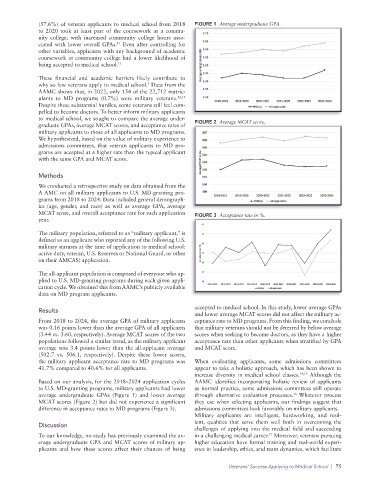
(57.6%) of veteran applicants to medical school from 2018   FIGURE 1  Average undergraduate GPA.
              to 2020 took at least part of the coursework at a commu-
              nity college, with increased community college hours asso-
                                       11
              ciated with lower overall GPAs.  Even after controlling for
              other variables, applicants with any background of academic
              coursework at community college had a lower likelihood of
              being accepted to medical school. 11

              These  financial  and academic  barriers  likely  contribute  to
                                                 5
              why so few veterans apply to medical school.  Data from the
              AAMC shows that, in 2022, only 154 of the 22,712 matric-
              ulants to MD programs (0.7%) were military veterans. 12,13
              Despite these substantial hurdles, some veterans still feel com-
              pelled to become doctors. To better inform military applicants
              to medical school, we sought to compare the average under-
              graduate GPAs, average MCAT scores, and acceptance rates of   FIGURE 2  Average MCAT score.
              military applicants to those of all applicants to MD programs.
              We hypothesized, based on the value of military experience to
              admissions committees, that veteran applicants to MD pro-
              grams are accepted at a higher rate than the typical applicant
              with the same GPA and MCAT score.

              Methods
              We conducted a retrospective study on data obtained from the
              A AMC on all military applicants to U.S. MD-granting pro-
              grams from 2018 to 2024. Data included general demograph-
              ics (age, gender, and race)  as well  as average  GPA, average
              MCAT score, and overall acceptance rate for each application   FIGURE 3  Acceptance rate in %.
              year.

              The military population, referred to as “military applicant,” is
              defined as an applicant who reported any of the following U.S.
              military statuses at the time of application to medical school:
              active duty, veteran, U.S. Reserves or National Guard, or other
              on their AMCAS) application.

              The all-applicant population is composed of everyone who ap-
              plied to U.S. MD-granting programs during each given appli-
              cation cycle. We obtained this from AAMC’s publicly available
              data on MD program applicants.

                                                                 accepted to medical school. In this study, lower average GPAs
              Results
                                                                 and lower average MCAT scores did not affect the military ac-
              From 2018 to 2024, the average GPA of military applicants   ceptance rate to MD programs. From this finding, we conclude
              was 0.16 points lower than the average GPA of all applicants   that military veterans should not be deterred by below average
              (3.44 vs. 3.60, respectively). Average MCAT scores of the two   scores when seeking to become doctors, as they have a higher
              populations followed a similar trend, as the military applicant   acceptance rate than other applicants when stratified by GPA
              average was 3.4 points lower than the all-applicant average   and MCAT score.
              (502.7 vs. 506.1, respectively). Despite these lower scores,
              the military applicant acceptance rate to MD programs was   When evaluating applicants, some admissions committees
              41.7% compared to 40.6% for all applicants.        appear to take a holistic approach, which has been shown to
                                                                 increase diversity in medical school classes. 14,15  Although the
              Based on our analysis, for the 2018–2024 application cycles   AAMC identifies incorporating holistic review of applicants
              to U.S. MD-granting programs, military applicants had lower   as normal practice, some admissions committees still operate
                                                                                                 16
              average undergraduate GPAs (Figure 1) and lower average   through alternative evaluation processes.  Whatever  process
              MCAT scores (Figure 2) but did not experience a significant   they use when selecting applicants, our findings suggest that
              difference in acceptance rates to MD programs (Figure 3).  admissions committees look favorably on military applicants.
                                                                 Military applicants are intelligent, hardworking, and resil-
                                                                 ient, qualities that serve them well both in overcoming the
              Discussion
                                                                 challenges of applying into the medical field and succeeding
                                                                                         17
              To our knowledge, no study has previously examined the av-  in a challenging medical career.  Moreover, veterans pursuing
              erage undergraduate GPA and MCAT scores of military ap-  higher education have formal training and real-world experi-
              plicants and how these scores affect their chances of being   ence in leadership, ethics, and team dynamics, which facilitate

                                                                            Veterans’ Success Applying to Medical School  |  75

