


Page 26 - JSOM Spring 2025
P. 26
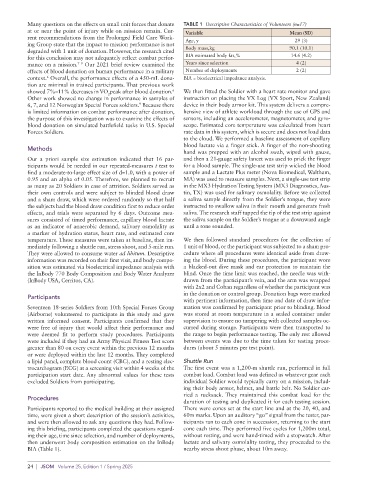
Many questions on the effects on small unit forces that donate   TABLE 1  Descriptive Characteristics of Volunteers (n=17)
          at or near the point of injury while on mission remain. Cur-  Variable                Mean (SD)
          rent recommendations from the Prolonged Field Care Work-  Age, y                       29 (3)
          ing Group state that the impact to mission performance is not
          degraded with 1 unit of donation. However, the research cited   Body mass,kg          90.1 (10.1)
          for this conclusion may not adequately reflect combat perfor-  BIA estimated body fat,%  14.6 (4.2)
                          7–9
          mance on a mission.  Our 2021 brief review examined the   Years since selection         4 (2)
          effects of blood donation on human performance in a military   Number of deployments    2 (2)
                6
          context.  Overall, the performance effects of a 450-mL dona-  BIA = bioelectrical impedance analysis.
          tion are minimal in trained participants. That previous work
                                                         6
          showed 7%–11% decreases in VO peak after blood donation.    We then fitted the Soldier with a heart rate monitor and gave
                                    2
          Other work showed no change in performance in samples of   instruction on placing the VX Log (VX Sport, New Zealand)
          6, 7, and 12 Norwegian Special Forces soldiers.  Because there   device in their body armor kit. This system delivers a compre-
                                              9
          is limited information on combat performance after donation,   hensive view of athlete workload through the use of GPS and
          the purpose of this investigation was to examine the effects of   sensors, including an accelerometer, magnetometer, and gyro-
          blood donation on simulated battlefield tasks in U.S. Special   scope. Estimated core temperature was calculated from heart
          Forces Soldiers.                                   rate data in this system, which is secure and does not load data
                                                             to the cloud. We performed a baseline assessment of capillary
                                                             blood lactate via a finger stick. A finger of the non-shooting
          Methods
                                                             hand was prepped with an alcohol swab, wiped with gauze,
          Our  a priori  sample  size  estimation indicated  that 16  par-  and then a 21-gauge safety lancet was used to prick the finger
          ticipants would be needed in our repeated-measures t test to   for a blood sample. The single-use test strip wicked the blood
          find a moderate-to-large effect size of d=1.0, with a power of   sample and a Lactate Plus meter (Nova Biomedical, Waltham,
          0.95 and an alpha of 0.05. Therefore, we planned to recruit   MA) was used to measure samples. Next, a single-use test strip
          as many as 20 Soldiers in case of attrition. Soldiers served as   in the MX3 Hydration Testing System (MX3 Diagnostics, Aus-
          their own controls and were subject to blinded blood draw   tin, TX) was used for salivary osmolality. Before we collected
          and a sham draw, which were ordered randomly so that half   a saliva sample directly from the Soldier’s tongue, they were
          the subjects had the blood draw condition first to reduce order   instructed to swallow saliva in their mouth and generate fresh
          effects, and trials were separated by 6 days. Outcome mea-  saliva. The research staff tapped the tip of the test strip against
          sures consisted of timed performance, capillary blood lactate   the saliva sample on the Soldier’s tongue at a downward angle
          as an indicator of anaerobic demand, salivary osmolality as   until a tone sounded.
          a marker of hydration status, heart rate, and estimated core
          temperature. These measures were taken at baseline, then im-  We  then  followed  standard  procedures  for  the  collection  of
          mediately following a shuttle run, stress shoot, and 5-mile run.   1 unit of blood, or the participant was subjected to a sham pro-
          They were allowed to consume water ad libitum. Descriptive   cedure where all procedures were identical aside from draw-
          information was recorded on their first visit, and body compo-  ing the blood. During these procedures, the participant wore
          sition was estimated via bioelectrical impedance analysis with   a blacked-out dive mask and ear protection to maintain the
          the InBody 770 Body Composition and Body Water Analyzer   blind. Once the time limit was reached, the needle was with-
          (InBody USA, Cerritos, CA).                        drawn from the participant’s vein, and the arm was wrapped
                                                             with 2x2 and Coban regardless of whether the participant was
                                                             in the donation or control group. Donation bags were marked
          Participants
                                                             with pertinent information, then time and date of draw infor-
          Seventeen 18-series Soldiers from 10th Special Forces Group   mation was confirmed by participant prior to blinding. Blood
          (Airborne) volunteered to participate in this study and gave   was stored at room temperature in a sealed container under
          written informed consent. Participants confirmed that they   supervision to ensure no tampering with collected samples oc-
          were free of injury that would affect their performance and   curred during storage. Participants were then transported to
          were deemed fit to perform study procedures. Participants   the range to begin performance testing. The only rest allowed
          were included if they had an Army Physical Fitness Test score   between events was due to the time taken for testing proce-
          greater than 80 on every event within the previous 12 months   dures (about 5 minutes per test point).
          or were deployed within the last 12 months. They completed
          a lipid panel, complete blood count (CBC), and a resting elec-  Shuttle Run
          trocardiogram (ECG) at a screening visit within 4 weeks of the   The first event was a 1,200-m shuttle run, performed in full
          participation start date. Any abnormal values for these tests   combat load. Combat load was defined as whatever gear each
          excluded Soldiers from participating.              individual Soldier would typically carry on a mission, includ-
                                                             ing their body armor, helmet, and battle belt. No Soldier car-
                                                             ried a rucksack.  They maintained this combat load for the
          Procedures
                                                             duration of testing and duplicated it for each testing session.
          Participants reported to the medical building at their assigned   There were cones set at the start line and at the 20, 40, and
          time, were given a short description of the session’s activities,   60m marks. Upon an auditory “go” signal from the tester, par-
          and were then allowed to ask any questions they had. Follow-  ticipants ran to each cone in succession, returning to the start
          ing this briefing, participants completed the questions regard-  cone each time. They performed five cycles for 1,200m total,
          ing their age, time since selection, and number of deployments,   without resting, and were hand-timed with a stopwatch. After
          then underwent body composition estimation on the InBody   lactate and salivary osmolality testing, they proceeded to the
          BIA (Table 1).                                     nearby stress shoot phase, about 10m away.

          24  |  JSOM   Volume 25, Edition 1 / Spring 2025

