


Page 22 - JSOM Spring 2025
P. 22
small decrease in pressure. At the high pressure, fluid buildup   due to channel material being stiff and unable to expand with
                                                                     12
          around the valves due to inefficient venting caused a failure in   fluid flow.  The material of the H*VENT is also very stiff,
          the adhesive, creating an unwanted channel for fluid to escape.   reducing the effective size of the channels even more. Even still,
          A second Bolin chest seal was used to attempt to complete   within the novel design group, where all design materials were
          the testing, but the adhesive again failed at the high pressure.   the same, there was a benefit to larger channel width. Between
          At 30cmH O, the flow rate was less than all other chest seals,   Designs B and C, the only design difference was channel width,
                  2
          except for the H*VENT.                             showing wider channels (Table 1) led to higher flow rates (Fig-
                                                             ure 3a) and lower channel saturation (Figure 4a).
          Channel Saturation
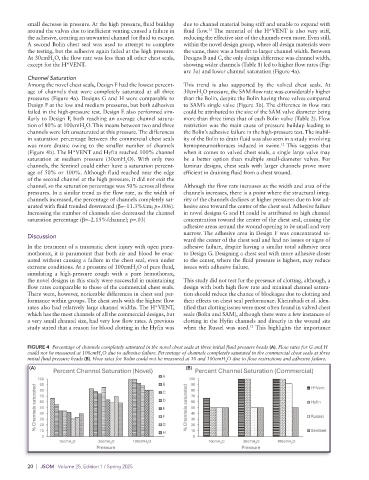
          Among the novel chest seals, Design F had the lowest percent-  This trend is also supported by the valved chest seals.  At
          age of channels that were completely saturated at all three   30cmH O pressure, the SAM flow rate was considerably higher
                                                                   2
          pressures (Figure 4a). Designs G and H were comparable to   than the Bolin, despite the Bolin having three valves compared
          Design F at the low and medium pressures, but both adhesives   to SAM’s single valve (Figure 3b). The difference in flow rate
          failed in the high-pressure test. Design E also performed sim-  could be attributed to the size of the SAM valve diameter being
          ilarly to Design F, both reaching an average channel satura-  more than three times that of each Bolin valve (Table 2). Flow
          tion of 80% at 100cmH O. This means between two and three   restriction was the main cause of pressure buildup leading to
                             2
          channels were left unsaturated at this pressure. The differences   the Bolin’s adhesive failure in the high- pressure test. The inabil-
          in saturation percentage between the commercial chest seals   ity of the Bolin to drain fluid was also seen in a study involving
                                                                                             12
          was more drastic owing to the smaller number of channels   hemopneumothoraces induced in swine.  This suggests that
          (Figure 4b). The H*VENT and Hyfin reached 100% channel   when it comes to valved chest seals, a single large valve may
          saturation at medium pressure (30cmH O).  With only two   be a better option than multiple small-diameter valves. For
                                          2
          channels, the Sentinel could either have a saturation percent-  laminar designs, chest seals with larger channels prove more
          age of 50% or 100%. Although fluid reached near the edge   efficient in draining fluid from a chest wound.
          of the second channel at the high pressure, it did not exit the
          channel, so the saturation percentage was 50% across all three   Although the flow rate increases as the width and area of the
          pressures. In a similar trend as the flow rate, as the width of   channels increases, there is a point where the structural integ-
          channels increased, the percentage of channels completely sat-  rity of the channels declines at higher pressures due to low ad-
          urated with fluid trended downward (β=–11.3%/cm; p=.006).   hesive area toward the center of the chest seal. Adhesive failure
          Increasing the number of channels also decreased the channel   in novel designs G and H could be attributed to high channel
          saturation percentage (β=–2.15%/channel; p=.03)    concentration toward the center of the chest seal, causing the
                                                             adhesive areas around the wound opening to be small and very
                                                             narrow. The adhesive area in Design F was concentrated to-
          Discussion
                                                             ward the center of the chest seal and had no issues or signs of
          In the treatment of a traumatic chest injury with open pneu-  adhesive failure, despite having a similar total adhesive area
          mothorax, it is paramount that both air and blood be evac-  to Design G. Designing a chest seal with more adhesive closer
          uated without causing a failure in the chest seal, even under   to the center, where the fluid pressure is highest, may reduce
          extreme conditions. At a pressure of 100cmH O of pure fluid,   issues with adhesive failure.
                                             2
          simulating a high-pressure cough with a pure hemothorax,
          the novel designs in this study were successful in maintaining   This study did not test for the presence of clotting, although, a
          flow rates comparable to those of the commercial chest seals.   design with both high flow rate and minimal channel satura-
          There were, however, noticeable differences in chest seal per-  tion should reduce the chance of blockages due to clotting and
          formance within groups. The chest seals with the highest flow   their effects on chest seal performance. Kheirabadi et al. iden-
          rates also had relatively large channel widths. The H*VENT,   tified that clotting issues were most often found in valved chest
          which has the most channels of all the commercial designs, but   seals (Bolin and SAM), although there were a few instances of
          a very small channel size, had very low flow rates. A previous   clotting in the Hyfin channels and directly in the wound site
          study stated that a reason for blood clotting in the Hyfin was   when the Russel was used.  This highlights the importance
                                                                                   12

          FIGURE 4  Percentage of channels completely saturated in the novel chest seals at three initial fluid pressure heads (A). Flow rates for G and H
          could not be measured at 100cmH O due to adhesive failure. Percentage of channels completely saturated in the commercial chest seals at three
                                  2
          initial fluid pressure heads (B). Flow rates for Bolin could not be measured at 10 and 100cmH O due to flow restrictions and adhesive failure.
                                                                           2
           (A)                                                (B)


          20  |  JSOM   Volume 25, Edition 1 / Spring 2025

