


Page 27 - JSOM Spring 2025
P. 27
Stress Shoot                                       range, and finishing where they began testing (8km total). This
              Upon finishing the 1,200-m Bronco shuttle sprint, the Soldiers   run was hand-timed, then verified with the VX Log. After re-
              moved to the range, in which designated range facilitators re-  turning to the initial testing site, lactate and salivary osmolal-
              cited a scripted safety brief, followed by loading and safety   ity tests were performed one final time. Then each donation
              demonstrations. Soldiers completed three lanes of both static   group participant had their donated blood returned under
              and dynamic stress shoot marksmanship tasks while wearing   medical provider supervision or was given a sham infusion of
              a normal combat load. The stress shoot marksmanship tasks   500mL normal saline. Each participant was asked after each
              were completed using their assigned 5.56×45-mm chambered   testing session which procedure (blood draw or sham control)
              M4A1 carbine assault rifle and 9-mm pistol.        they had been subject to on that day. Participants were then re-
                                                                 leased no earlier than 10 minutes after a successful autologous
              At the facilitator’s signal, the Soldiers moved to lane 1 and   transfusion of collected blood.
              initiated contact with three International Practical Shooting
              Confederation (IPSC) silhouette cardboard targets at 40m,   Data were recorded on data sheets and entered into a secure
              shooting two rounds per target using the rifle. After six rounds,   spreadsheet. The VX Log devices were downloaded daily, and
              they sprinted to a cone 10m from the targets to shoot at the   files were manually analyzed using the corresponding times
              same three targets, two shots per target. They then sprinted   from the data sheets. Markers were set for each phase includ-
              back to the 40m cone to repeat two rounds per target using the   ing rest, 1,200-m shuttle run, stress shoot, and distance run.
              rifle. Each IPSC target was placed 7m apart from each other.  Maximum heart rate and estimated core temperature for each
                                                                 phase were then exported. Prism 10 (GraphPad Software,
              After 24 rounds were shot at lane 1, the Soldiers immediately   Boston, MA) was used for all statistical analyses. Dependent
              transitioned to lane 2. They ran 20m around the berm and up   t tests were used to compare the trials, and Hedges’ g effect
              to the 10m cone to shoot four IPSC targets, two shots per tar-  size was calculated to provide the magnitude of the differences
              get. By the third target, the Soldier’s magazine was empty, and   between trials in terms of standard deviation. Magnitude was
              they switched to their pistol for the last two targets. Following   interpreted where small = 0.2, moderate = 0.6, large = 1.2,
                                                                              10
              completion of these four targets, they ran 25m to a five-target   very large = 2.0.  A 2×4 condition-by-time RMANOVA was
              dueling tree and shot once per target at 10m. After hitting all   used to examine heart rate, estimated core temperature, blood
              five targets, they ran back to the 50m cone and switched to   lactate, and salivary osmolality. For all statistical tests, α was
              the rifle, with which they shot two times each IPSC target.   set at 0.05.
              After the last target was shot, the Soldiers grabbed a 2-handed
              rope handle and dragged a 90-lb sled backwards for 25m to   Results
              the next position. At this position, they shot five times at an
              IPSC target from 50m away, quickly moved to a 10m cone,   All Soldiers who began the study completed both testing pro-
              and then shot three IPSC targets while moving laterally, two   tocols, and no adverse events were noted. Blinding was only
              shots per target.                                  26% effective, as Soldiers were able to correctly identify the
                                                                 procedure that they had been subjected to 74% of the time.
              The Soldiers then ran to the third lane and engaged a single   There was a moderate-to-large, statistically significant increase
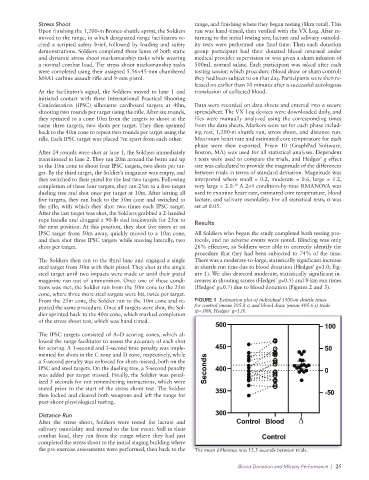
              steel target from 50m with their pistol. They shot at the single   in shuttle run time due to blood donation (Hedges’ g=1.0; Fig-
              steel target until two impacts were made or until their pistol   ure 1). We also detected moderate, statistically significant in-
              magazine ran out of ammunition. Once one of these condi-  creases in shooting scores (Hedges’ g=0.5) and 8-km run times
              tions was met, the Soldier ran from the 50m cone to the 25m   (Hedges’ g=0.7) due to blood donation (Figures 2 and 3).
              cone, where three more steel targets were hit, twice per target.
              From the 25m cone, the Soldier ran to the 10m cone and re-  FIGURE 1  Estimation plot of individual 1500-m shuttle times
              peated the same procedure. Once all targets were shot, the Sol-  for control (mean 395.8 s) and blood draw (mean 405.6 s) trials
              dier sprinted back to the 40m cone, which marked completion   (p=.008, Hedges’ g=1.0).
              of the stress shoot test, which was hand timed.

              The IPSC targets consisted of A–D scoring zones, which al-
              lowed the range facilitator to assess the accuracy of each shot
              for scoring. A 1-second and 3-second time penalty was imple-
              mented for shots in the C zone and D zone, respectively, while
              a 5-second penalty was enforced for shots missed, both on the
              IPSC and steel targets. On the dueling tree, a 5-second penalty
              was added per target missed. Finally, the Soldier was penal-
              ized 5 seconds for not remembering instructions, which were
              stated prior to the start of the stress shoot test. The Soldier
              then locked and cleared both weapons and left the range for
              post-shoot physiological testing.

              Distance Run
              After the stress shoot, Soldiers were tested for lactate and                         ∆
              salivary osmolality and moved to the last event. Still in their
              combat load, they ran from the range where they had just
              completed the stress shoot to the initial staging building where
              the pre-exercise assessments were performed, then back to the   The mean difference was 12.5 seconds between trials.

                                                                               Blood Donation and Military Performance  |  25

