


Page 29 - JSOM Spring 2025
P. 29
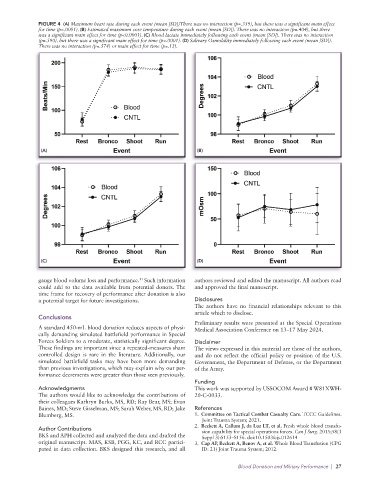
FIGURE 4  (A) Maximum heart rate during each event (mean [SD])There was no interaction (p=.359), but there was a significant main effect
              for time (p<.0001). (B) Estimated maximum core temperature during each event (mean [SD]). There was no interaction (p=.404), but there
              was a significant main effect for time (p<0.0001). (C) Blood lactate immediately following each event (mean [SD]). There was no interaction
              (p=.590), but there was a significant main effect for time (p<.0001). (D) Salivary Osmolality immediately following each event (mean [SD]).
              There was no interaction (p=.574) or main effect for time (p=.13).


              (A)                                                (B)


              (C)                                                (D)

                                               11
              gauge blood volume loss and performance.  Such information   authors reviewed and edited the manuscript. All authors read
              could add to the data available from potential donors. The   and approved the final manuscript.
              time frame for recovery of performance after donation is also
              a potential target for future investigations.      Disclosures
                                                                 The authors have no financial relationships relevant to this
                                                                 article which to disclose.
              Conclusions
                                                                 Preliminary results were presented at the Special Operations
              A standard 450-mL blood donation reduces aspects of physi-  Medical Association Conference on 13–17 May 2024.
              cally demanding simulated battlefield performance in Special
              Forces Soldiers to a moderate, statistically significant degree.   Disclaimer
              These findings are important since a repeated-measures sham   The views expressed in this material are those of the authors,
              controlled design is rare in the literature.  Additionally, our   and do not reflect the official policy or position of the U.S.
              simulated battlefield tasks may have been more demanding   Government, the Department of Defense, or the Department
              than previous investigations, which may explain why our per-  of the Army.
              formance decrements were greater than those seen previously.
                                                                 Funding
              Acknowledgments                                    This work was supported by USSOCOM Award # W81XWH-
              The authors would like to acknowledge the contributions of   20-C-0033.
              their colleagues Kathryn Burks, MS, RD; Ray Bear, MS; Evan
              Baines, MD; Steve Gisselman, MS; Sarah Weber, MS, RD; Jake   References
              Blumberg, MS.                                      1.  Committee on Tactical Combat Casualty Care. TCCC Guidelines.
                                                                   Joint Trauma System; 2021.
                                                                 2.  Beckett A, Callum J, da Luz LT, et al. Fresh whole blood transfu-
              Author Contributions                                 sion capability for special operations forces. Can J Surg. 2015;58(3
              BKS and APH collected and analyzed the data and drafted the   Suppl 3):S153–S156. doi:10.1503/cjs.012614
              original manuscript. MAS, KSB, PGG, KC, and RCC partici-  3.  Cap AP, Beckett A, Benov A, et al. Whole Blood Transfusion (CPG
              pated in data collection. BKS designed this research, and all   ID: 21) Joint Trauma System; 2012.

                                                                               Blood Donation and Military Performance  |  27

