


Page 34 - JSOM Spring 2025
P. 34
At time 4, the BD-control group (mean 38.56 [SD .39]) had   group did not differ as a function of condition (Wilcoxon
          higher core temperatures relative to the control-BD group   signed rank tests, all Ps>.07). Thermal sensations were lower
          (mean 37.95 [SD .41]; Welch’s t (15.63) =3.36, P=.004). At time 5,   at  time  point  1  in  the  control  condition  (median  –2  [IQR
          the BD- control group (mean 38.5 [SD .35]) continued to have   1.25]) relative to the BD condition (median 1 [IQR 1.25]) for
          higher temperatures temps relative to the control-BD group   the control-BD group (P=.021). No other differences were sig-
          (mean 37.93 [SD .49]; Welch’s t (17.85) =3.09, P=.006). For the   nificant (all Ps>.07).
          order × condition interaction, the BD-control group showed
          similar core temperatures during the BD condition (mean 38.1   RPE
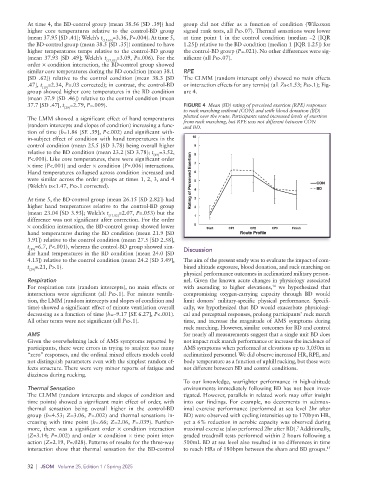
          [SD .62]) relative to the control condition (mean 38.3  [SD   The CLMM (random intercept only) showed no main effects
          .47], t (19) =2.34, P=.03 corrected); in contrast, the control-BD   or interaction effects for any term(s) (all Zs<1.53; Ps>.1); Fig-
          group showed higher core temperatures in the BD condition   ure 4.
          (mean 37.9 [SD .46]) relative to the control condition (mean
          37.7 [SD .47], t  =2.79, P=.009).                  FIGURE 4  Mean (SD) rating of perceived exertion (RPE) responses
                      (29)
                                                             to ruck marching without (CON) and with blood donation (BD)
          The LMM showed a significant effect of hand temperatures   plotted over the route. Participants rated increased levels of exertion
          (random intercepts and slopes of condition) increasing a func-  from ruck marching, but RPE was not different between CON
                                                             and BD.
          tion of time (b=1.86 [SE .39], P<.002) and significant with-
          in-subject effect of condition with hand temperatures in the
          control condition (mean 25.5 [SD 3.78) being overall higher
          relative to the BD condition (mean 23.2 [SD 3.78]; t (49) =3.52,
          P<.001). Like core temperatures, there were significant order
          × time (P<.001) and order × condition (P=.006) interactions.
          Hand temperatures collapsed across condition increased and
          were similar across the order groups at times 1, 2, 3, and 4
          (Welch’s ts<1.47, Ps>.1 corrected).

          At time 5, the BD-control group (mean 26.15 [SD 2.82]) had
          higher hand temperatures relative to the control-BD group
          (mean 23.04 [SD 3.93]; Welch’s t (17.82) =2.07, P=.053) but the
          difference was not significant after correction. For the order
          × condition interaction, the BD-control group showed lower
          hand temperatures during the BD condition (mean 21.9 [SD
          3.91]) relative to the control condition (mean 27.5 [SD 2.58],
          t (19) =6.7, P<.001), whereas the control-BD group showed sim-  Discussion
          ilar hand temperatures in the BD condition (mean 24.0 [SD
          4.13]) relative to the control condition (mean 24.2 [SD 3.49],   The aim of the present study was to evaluate the impact of com-
          t  =.21, P>.1).                                    bined altitude exposure, blood donation, and ruck marching on
           (29)
                                                             physical performance outcomes in acclimatized military person-
          Respiration                                        nel. Given the known acute changes in physiology associated
                                                                                          14
          For respiration rate (random intercepts), no main effects or   with ascending to higher elevations,  we hypothesized that
          interactions  were  significant  (all  Ps>.1).  For minute  ventila-  compromising oxygen-carrying capacity through BD would
          tion, the LMM (random intercepts and slopes of condition and   limit donors’ military-specific physical performance. Specifi-
          time) showed a significant effect of minute ventilation overall   cally, we hypothesized that BD would exacerbate physiologi-
          decreasing as a function of time (b=–9.17 [SE 6.27], P<.001).   cal and perceptual responses, prolong participants’ ruck march
          All other terms were not significant (all Ps>.1).  time, and increase the magnitude of  AMS symptoms during
                                                             ruck marching. However, similar outcomes for BD and control
          AMS                                                for nearly all measurements suggest that a single unit BD does
          Given the overwhelming lack of AMS symptoms reported by   not impact ruck march performance or increase the incidence of
          participants, there were errors in trying to analyze too many   AMS symptoms when performed at elevations up to 3,050m in
          “zero” responses, and the ordinal mixed effects models could   acclimatized personnel. We did observe increased HR, RPE, and
          not distinguish parameters even with the simplest random ef-  body temperature as a function of uphill rucking, but these were
          fects structure. There were very minor reports of fatigue and   not different between BD and control conditions.
          dizziness during rucking.
                                                             To our knowledge, warfighter performance in high-altitude
          Thermal Sensation                                  environments immediately following BD has not been inves-
          The CLMM (random intercepts and slopes of condition and   tigated. However, parallels in related work may offer insight
          time points) showed a significant main effect of order, with   into our findings. For example, no decrements in submax-
          thermal sensation being overall higher in the control-BD   imal exercise performance (performed at sea level 2hr after
          group (b=4.53;  Z=3.06,  P=.002) and thermal sensations in-  BD) were observed with cycling intensities up to 170bpm HR,
          creasing with time point (b=.66;  Z=2.06,  P=.039). Further-  yet a 6% reduction in aerobic capacity was observed during
          more,  there  was  a  significant  order  ×  condition  interaction   maximal exercise (also performed 2hr after BD).  Additionally,
                                                                                                  7
          (Z=3.14; P=.002) and order × condition × time point inter-  graded treadmill tests performed within 2 hours following a
          action (Z=2.19, P=.028). Patterns of results for the three-way   500mL BD at sea level also resulted in no differences in time
                                                                                                            15
          interaction show that thermal sensation for the BD-control   to reach HRs of 180bpm between the sham and BD groups.
          32  |  JSOM   Volume 25, Edition 1 / Spring 2025

