


Page 20 - JSOM Spring 2025
P. 20
purpose of a chest seal is to manage airflow through the chest   open chest wound. Ensuring that not all channels are filled
          wound, the inability to properly allow blood drainage will se-  with fluid, in the case of a hemopneumothorax or pleural effu-
          verely impact the efficiency of the chest seal to treat an open   sion, should reduce the chance of a complete blockage due to
          pneumothorax. This study will aim to determine the effects   clotting, which prohibits the chest seal from properly venting.
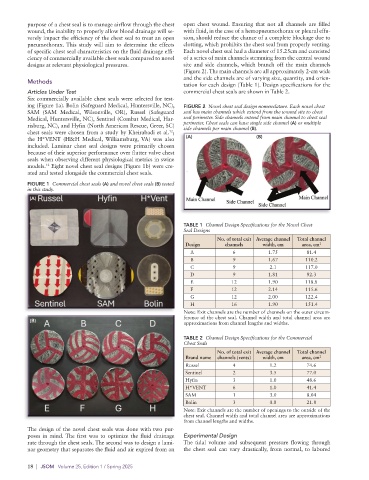
          of specific chest seal characteristics on the fluid drainage effi-  Each novel chest seal had a diameter of 15.25cm and consisted
          ciency of commercially available chest seals compared to novel   of a series of main channels stemming from the central wound
          designs at relevant physiological pressures.       site and side channels, which branch off the main channels
                                                             (Figure 2). The main channels are all approximately 2-cm wide
                                                             and the side channels are of varying size, quantity, and orien-
          Methods
                                                             tation for each design (Table 1). Design specifications for the
          Articles Under Test                                commercial chest seals are shown in Table 2.
          Six commercially available chest seals were selected for test-
          ing (Figure 1a). Bolin (Safeguard Medical, Huntersville, NC),   FIGURE 2  Novel chest seal design nomenclature. Each novel chest
          SAM (SAM Medical,  Wilsonville, OR), Russel (Safeguard   seal has main channels which extend from the wound site to chest
          Medical, Huntersville, NC), Sentinel (Combat Medical, Har-  seal perimeter. Side channels extend from main channel to chest seal
          risburg, NC), and Hyfin (North American Rescue, Greer, SC)   perimeter. Chest seals can have single side channel (A) or multiple
          chest seals were chosen from a study by Kheirabadi et al. ;   side channels per main channel (B).
                                                        12
          the H*VENT (H&H Medical,  Williamsburg,  VA) was also   (A)                (B)
          included.  Laminar chest  seal  designs were  primarily chosen
          because of their superior performance over flutter valve chest
          seals when observing different physiological metrics in swine
          models.  Eight novel chest seal designs (Figure 1b) were cre-
                12
          ated and tested alongside the commercial chest seals.
          FIGURE 1  Commercial chest seals (A) and novel chest seals (B) tested
          in this study.
           (A)


                                                             TABLE 1  Channel Design Specifications for the Novel Chest
                                                             Seal Designs
                                                                        No. of total exit  Average channel   Total channel
                                                              Design       channels    width, cm    area, cm 2
                                                               A             6           1.75        81.4
                                                               B             9           1.67        110.2
                                                               C             9           2.1         117.0
                                                               D             9           1.81        92.3
                                                               E             12          1.90        118.8
                                                               F             12          2.14        115.6
                                                               G             12          2.00        122.4
                                                               H             16          1.90        151.4
                                                             Note: Exit channels are the number of channels on the outer circum-
                                                             ference of the chest seal. Channel width and total channel area are
           (B)                                               approximations from channel lengths and widths.

                                                             TABLE 2  Channel Design Specifications for the Commercial
                                                             Chest Seals
                                                                        No. of total exit  Average channel   Total channel
                                                              Brand name  channels (vents)  width, cm  area, cm 2
                                                              Russel         4           1.2         74.6
                                                              Sentinel       2           3.5         77.0
                                                              Hyfin          3           1.0         48.6
                                                              H*VENT         6           1.0         41.4
                                                              SAM            1           3.0         8.04
                                                              Bolin          3           0.8         21.8
                                                             Note: Exit channels are the number of openings to the outside of the
                                                             chest seal. Channel width and total channel area are approximations
                                                             from channel lengths and widths.
          The design of the novel chest seals was done with two pur-
          poses in mind. The first was to optimize the fluid drainage   Experimental Design
          rate through the chest seals. The second was to design a lami-  The tidal volume and subsequent pressure flowing through
          nar geometry that separates the fluid and air expired from an   the chest seal can vary drastically, from normal, to labored

          18  |  JSOM   Volume 25, Edition 1 / Spring 2025

