


Page 15 - JSOM Spring 2025
P. 15
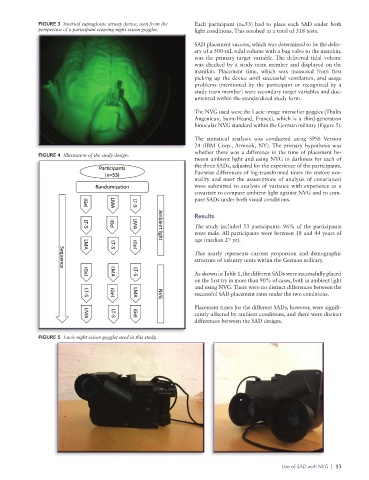
FIGURE 3  Inserted supraglottic airway device, seen from the   Each participant (n=53) had to place each SAD under both
              perspective of a participant wearing night vision goggles.  light conditions. This resulted in a total of 318 tests.

                                                                 SAD placement success, which was determined to be the deliv-
                                                                 ery of a 500-mL tidal volume with a bag valve to the manikin,
                                                                 was the primary target variable. The delivered tidal volume
                                                                 was checked by a study team member and displayed on the
                                                                 manikin. Placement  time, which  was  measured  from first
                                                                 picking up the device until successful ventilation, and usage
                                                                 problems (mentioned by the participant or recognized by a
                                                                 study team member) were secondary target variables and doc-
                                                                 umented within the standardized study form.

                                                                 The NVG used were the Lucie image intensifier goggles (Thales
                                                                 Angenieux, Saint-Héand, France), which is a third- generation
                                                                 binocular NVG standard within the German military (Figure 5).

                                                                 The statistical analysis was conducted using SPSS  Version
                                                                 24 (IBM Corp., Armonk, NY). The primary hypothesis was
                                                                 whether there was a difference in the time of placement be-
              FIGURE 4  Illustration of the study design.
                                                                 tween ambient light and using NVG in darkness for each of
                                                                 the three SADs, adjusted for the experience of the participants.
                                                                 Pairwise differences of log-transformed times (to restore nor-
                                                                 mality and meet the assumptions of analysis of covariance)
                                                                 were submitted to analysis of variance with experience as a
                                                                 covariate to compare ambient light against NVG and to com-
                                                                 pare SADs under both visual conditions.

                                                                 Results

                                                                 The study included 53 participants. 96% of the participants
                                                                 were male. All participants were between 18 and 44 years of
                                                                 age (median 27 yr).

                                                                 This nearly represents current proportion and demographic
                                                                 structure of infantry units within the German military.

                                                                 As shown in Table 1, the different SADs were successfully placed
                                                                 on the first try in more than 90% of cases, both in ambient light
                                                                 and using NVG. There were no distinct differences between the
                                                                 successful SAD placement rates under the two conditions.

                                                                 Placement times for the different SADs, however, were signifi-
                                                                 cantly affected by ambient conditions, and there were distinct
                                                                 differences between the SAD designs.

              FIGURE 5  Lucie night vision goggles used in this study.


                                                                                             Use of SAD with NVG  |  13

