


Page 10 - JSOM Spring 2025
P. 10
FEATURE ARTICLES                                   The researchers found that a single-unit whole blood donation
          The Use of Different Types of Supraglottic Airway Devices   does not impact donor physical performance in acclimatized par-
          by Medics on a Manikin with Night Vision Goggles: A Pilot   ticipants during combat-load carries at elevations up to 3,050m,
          Study: In this study, Jänig and colleagues evaluated the use of dif-  except with respect to oxygen saturation.
          ferent supraglottic airway devices (SADs) using night vision gog-
          gles (NVG) on a manikin. Fifty-three medically trained soldiers
          were given a brief demonstration of how to place three different
          types of SAD in a manikin’s airway. The authors found that NVG
          have a measurable impact on the speed of placement but do not
          prolong placement to a clinically significant extent in this setting.
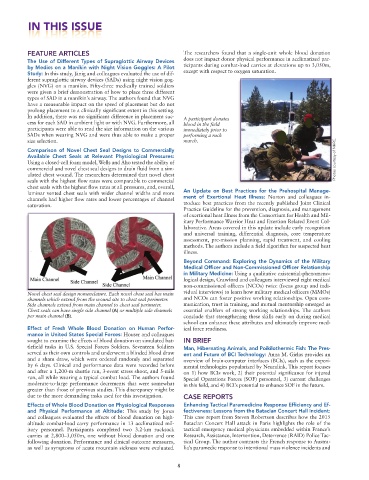
          In addition, there was no significant difference in placement suc-  A participant donates
          cess for each SAD in ambient light or with NVG. Furthermore, all   blood in the field
          participants were able to read the size information on the various   immediately prior to
          SADs when wearing NVG and were thus able to make a proper   performing a ruck
          size selection.                                    march.
          Comparison of Novel Chest Seal Designs to Commercially
          Available Chest Seals at Relevant Physiological Pressures:                                           Photos courtesy of NHRC.
          Using a closed-cell foam model, Wells and Aho tested the ability of
          commercial and novel chest seal designs to drain fluid from a sim-
          ulated chest wound. The researchers determined that novel chest
          seals with the highest flow rates were comparable to commercial
          chest seals with the highest flow rates at all pressures, and, overall,
          laminar vented chest seals with wider channel widths and more   An Update on Best Practices for the Prehospital Manage-
          channels had higher flow rates and lower percentages of channel   ment of Exertional Heat Illness:  Norton and colleagues in-
          saturation.                                        troduce best practices from the recently published Joint Clinical
                                                             Practice Guideline for the prevention, diagnosis, and management
                                                             of exertional heat illness from the Consortium for Health and Mil-
                                                             itary Performance Warrior Heat and Exertion Related Event Col-
                                                             laborative. Areas covered in this update include early recognition
                                                             and universal training, differential diagnosis, core temperature
                                                             assessment, pre-mission planning, rapid treatment, and cooling
                                                             methods. The authors include a field algorithm for suspected heat
                                                             illness.
                                                             Beyond Command: Exploring the Dynamics of the Military
                                                             Medical Officer and Non-Commissioned Officer Relationship
                                                             in Military Medicine: Using a qualitative existential-phenomeno-
                                                             logical design, Crawford and colleagues interviewed eight medical
                                                             non-commissioned officers (NCOs) twice (focus group and indi-
          Novel chest seal design nomenclature. Each novel chest seal has main   vidual interviews) to learn how military medical officers (MMOs)
          channels which extend from the wound site to chest seal perimeter.   and NCOs can foster positive working relationships. Open com-
          Side channels extend from main channel to chest seal perimeter.   munication, trust in training, and mutual mentorship emerged as
          Chest seals can have single side channel (A) or multiple side channels   essential enablers of strong working relationships. The authors
          per main channel (B).                              conclude that strengthening these skills early on during medical
                                                             school can enhance these attributes and ultimately improve med-
          Effect  of  Fresh  Whole  Blood  Donation  on  Human  Perfor-  ical force readiness.
          mance in United States Special Forces: Houser and colleagues
          sought to examine the effects of blood donation on simulated bat-  IN BRIEF
          tlefield tasks in U.S. Special Forces Soldiers. Seventeen Soldiers   Man, Hibernating Animals, and Poikilothermic Fish: The Pres-
          served as their own controls and underwent a blinded blood draw   ent and Future of BCI Technology: Anna M. Gielas provides an
          and a sham draw, which were ordered randomly and separated   overview of brain-computer interfaces (BCIs), such as the experi-
          by 6 days. Clinical and performance data were recorded before   mental technologies popularized by Neuralink. This report focuses
          and after a 1,200-m shuttle run, 3-event stress shoot, and 5-mile   on 1) how BCIs work, 2) their potential significance for injured
          run, all while wearing a typical combat load. The authors found   Special Operations Forces (SOF) personnel, 3) current challenges
          moderate-to-large performance decrements that were somewhat   in this feild, and 4) BCI’s potential to enhance SOF in the future.
          greater than those of previous studies. This discrepancy might be
          due to the more demanding tasks used for this investigation.  CASE REPORTS
          Effects of Whole Blood Donation on Physiological Responses   Enhancing Tactical Paramedicine Response Efficiency and Ef-
          and  Physical  Performance at  Altitude:  This study by Jones   fectiveness: Lessons from the Bataclan Concert Hall Incident:
          and colleagues evaluated the effects of blood donation on high-   This case report from Steven Robertson describes how the 2015
          altitude combat-load carry performance in 13 acclimatized mil-  Bataclan Concert Hall attack in Paris highlights the role of the
          itary personnel. Participants completed two 3.2-km rucksack   tactical emergency medical physicians embedded within France’s
          carries at 2,800–3,050m, one without blood donation and one   Research, Assistance, Intervention, Deterrence (RAID) Police Tac-
          following donation. Performance and clinical outcome measures,   tical Group. The author contrasts the French response to Austra-
          as well as symptoms of acute mountain sickness were evaluated.   lia’s paramedic response to intentional mass violence incidents and

                                                           8

