


Page 14 - JSOM Spring 2025
P. 14
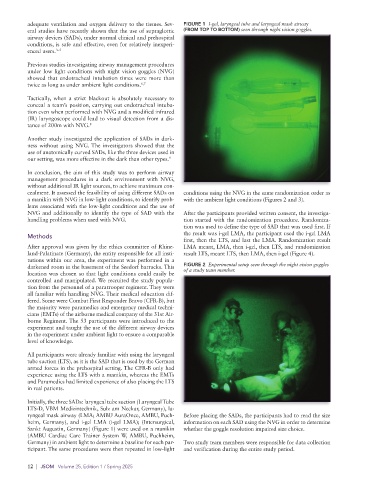
adequate ventilation and oxygen delivery to the tissues. Sev-  FIGURE 1  I-gel, laryngeal tube and laryngeal mask airway
          eral studies have recently shown that the use of supraglottic   (FROM TOP TO BOTTOM) seen through night vision goggles.
          airway devices (SADs), under normal clinical and prehospital
          conditions, is safe and effective, even for relatively inexperi-
          enced users. 3–5
          Previous studies investigating airway management procedures
          under low light conditions with night vision goggles (NVG)
          showed that endotracheal intubation times were more than
          twice as long as under ambient light conditions. 6,7
          Tactically, when a strict blackout is absolutely necessary to
          conceal a team’s position, carrying out endotracheal intuba-
          tion even when performed with NVG and a modified infrared
          (IR) laryngoscope could lead to visual detection from a dis-
          tance of 200m with NVG. 8

          Another study investigated the application of SADs in dark-
          ness without using NVG. The investigators showed that the
          use of anatomically curved SADs, like the three devices used in
          our setting, was more effective in the dark than other types. 9
          In conclusion, the aim of this study was to perform airway
          management procedures in a dark environment with NVG,
          without additional IR light sources, to achieve maximum con-
          cealment. It assessed the feasibility of using different SADs on   conditions using the NVG in the same randomization order as
          a manikin with NVG in low-light conditions, to identify prob-  with the ambient light conditions (Figures 2 and 3).
          lems associated with the low-light conditions and the use of
          NVG and additionally to identify the type of SAD with the   After the participants provided written consent, the investiga-
          handling problems when used with NVG.              tion started with the randomization procedure. Randomiza-
                                                             tion was used to define the type of SAD that was used first. If
                                                             the result was i-gel LMA, the participant used the i-gel LMA
          Methods
                                                             first, then the LTS, and last the LMA. Randomization result
          After approval was given by the ethics committee of Rhine-  LMA meant, LMA, then i-gel, then LTS, and randomization
          land-Palatinate (Germany), the entity responsible for all insti-  result LTS, meant LTS, then LMA, then i-gel (Figure 4).
          tutions within our area, the experiment was performed in a
          darkened room in the basement of the Seedorf barracks. This   FIGURE 2  Experimental setup seen through the night vision goggles
          location was chosen so that light conditions could easily be   of a study team member.
          controlled and manipulated. We recruited the study popula-
          tion from the personnel of a paratrooper regiment. They were
          all familiar with handling NVG. Their medical education dif-
          fered. Some were Combat First Responder Bravo (CFR-B), but
          the majority were paramedics and emergency medical techni-
          cians (EMTs) of the airborne medical company of the 31st Air-
          borne Regiment. The 53 participants were introduced to the
          experiment and taught the use of the different airway devices
          in the experiment under ambient light to ensure a comparable
          level of knowledge.

          All participants were already familiar with using the laryngeal
          tube suction (LTS), as it is the SAD that is used by the German
          armed forces in the prehospital setting. The CFR-B only had
          experience using the LTS with a manikin, whereas the EMTs
          and Paramedics had limited experience of also placing the LTS
          in real patients.

          Initially, the three SADs: laryngeal tube suction (Laryngeal Tube
          LTS-D, VBM Medizintechnik, Sulz am Neckar, Germany), la-
          ryngeal mask airway (LMA; AMBU AuraOnce, AMBU, Puch-  Before placing the SADs, the participants had to read the size
          heim, Germany), and i-gel LMA (i-gel LMA); (Intersurgical,   information on each SAD using the NVG in order to determine
          Sankt Augustin, Germany) (Figure 1) were used on a manikin   whether the goggle resolution impaired size choice.
          (AMBU Cardiac Care Trainer System W, AMBU, Puchheim,
          Germany) in ambient light to determine a baseline for each par-  Two study team members were responsible for data collection
          ticipant. The same procedures were then repeated in low-light   and verification during the entire study period.

          12  |  JSOM   Volume 25, Edition 1 / Spring 2025

