


Page 16 - JSOM Spring 2025
P. 16
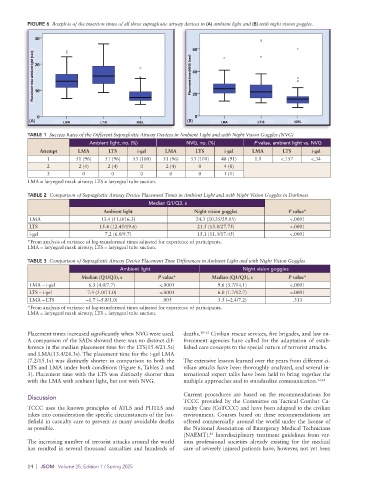
FIGURE 6  Boxplots of the insertion times of all three supraglottic airway devices in (A) ambient light and (B) with night vision goggles.


           (A)                                                (B)

          TABLE 1  Success Rates of the Different Supraglottic Airway Devices in Ambient Light and with Night Vision Goggles (NVG)
                              Ambient light, no. (%)          NVG, no. (%)          P value, ambient light vs. NVG
              Attempt      LMA      LTS       i-gel    LMA       LTS      i-gel    LMA       LTS       i-gel
                1         51 (96)  51 (96)  53 (100)  51 (96)  53 (100)  48 (91)    1.0      <.157     <.34
                2          2 (4)    2 (4)      0       2 (4)      0       4 (8)
                3           0        0         0        0         0       1 (1)
          LMA = laryngeal mask airway; LTS = laryngeal tube suction.

          TABLE 2  Comparison of Supraglottic Airway Device Placement Times in Ambient Light and with Night Vision Goggles in Darkness
                                                  Median Q1/Q3, s
                                   Ambient light                 Night vision goggles          P value*
           LMA                    13.4 (11.0/16.3)               24.3 (20.25/29.05)             <.0001
           LTS                    15.4 (12.45/19.6)              21.5 (15.8/27.75)              <.0001
           i-gel                   7.2 (6.0/9.7)                 15.1 (11.3/17.45)              <.0001
          *From analysis of variance of log-transformed times adjusted for experience of participants.
          LMA = laryngeal mask airway; LTS = laryngeal tube suction.

          TABLE 3  Comparison of Supraglottic Airway Device Placement Time Differences in Ambient Light and with Night Vision Goggles
                                        Ambient light                           Night vision goggles
                            Median (Q1/Q3), s        P value*         Median (Q1/Q3), s        P value*
           LMA – i-gel        6.3 (4.0/7.7)          <.0001             9.6 (3.7/14.1)          <.0001
           LTS – i-gel        7.4 (5.0/11.0)         <.0001             6.0 (1.7/12.7)          <.0001
           LMA – LTS         –1.7 (–5.8/1.0)          .005              3.5 (–2.4/7.2)           .313
          *From analysis of variance of log-transformed times adjusted for experience of participants.
          LMA = laryngeal mask airway; LTS = laryngeal tube suction.


          Placement times increased significantly when NVG were used.   deaths. 10–12  Civilian rescue services, fire brigades, and law en-
          A comparison of the SADs showed there was no distinct dif-  forcement agencies have called for the adaptation of estab-
          ference in the median placement time for the LTS(15.4/21.5s)   lished care concepts to the special nature of terrorist attacks.
          and LMA(13.4/24.3s). The placement time for the i-gel LMA
          (7.2/15.1s) was distinctly shorter in comparison to both the   The extensive lessons learned over the years from different ci-
          LTS and LMA under both conditions (Figure 6, Tables 2 and   vilian attacks have been thoroughly analyzed, and several in-
          3). Placement time with the LTS was distinctly shorter than   ternational expert talks have been held to bring together the
          with the LMA with ambient light, but not with NVG.  multiple approaches and to standardize communication. 13,14

                                                             Current procedures are based on the recommendations for
          Discussion
                                                             TCCC provided by the Committee on Tactical Combat Ca-
          TCCC uses the known principles of ATLS and PHTLS and   sualty Care (CoTCCC) and have been adapted to the civilian
          takes into consideration the specific circumstances of the bat-  environment. Courses based on these recommendations are
          tlefield in casualty care to prevent as many avoidable deaths   offered commercially around the world under the license of
          as possible.                                       the National Association of Emergency Medical Technicians
                                                             (NAEMT).  Interdisciplinary treatment guidelines from var-
                                                                      15
          The increasing number of terrorist attacks around the world   ious professional societies  already existing  for the  medical
          has resulted in several thousand casualties and hundreds of   care of severely injured patients have, however, not yet been

          14  |  JSOM   Volume 25, Edition 1 / Spring 2025

