


Page 11 - JSOM Spring 2025
P. 11
concludes that embedding clinicians within tactical groups may   More  Than  a  Score:  Evaluating  Military  Veterans’  Success
              enhance survival rates, operational success, and cost-effectiveness.  When Applying to Medical School: Campbell and colleagues
                                                                 sought to determine whether veterans’ comparatively lower GPAs
                                                                 and MCAT scores negatively affect their chances of success when
                                                                 applying to medical school. The authors found that despite lower
                                                                 academic metrics, the military applicant acceptance rate to MD
                                                                 programs was 41.7% compared to 40.7% for all applicants;
                                                                 therefore, veterans should not be deterred from seeking a path of
                                                                 service in medicine because of these perceived limitations.

                                                                 ONGOING SERIES
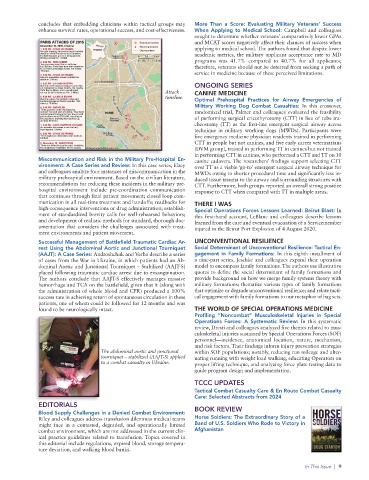
                                                       Attack    CANINE MEDICINE
                                                       timeline.
                                                                 Optimal Prehospital Practices for Airway Emergencies of
                                                                 Military Working Dog Combat Casualties:  In this crossover,
                                                                 randomized trial, Palmer and colleagues evaluated the feasibility
                                                                 of performing surgical cricothyrotomy (CTT) in lieu of tube tra-
                                                                 cheostomy (TT) as the first-line emergent surgical airway access
                                                                 technique  in  military  working dogs (MWDs).  Participants  were
                                                                 five emergency medicine physician residents trained in performing
                                                                 CTT in people but not canines, and five early career veterinarians
                                                                 (DVM group), trained in performing TT in canines but not trained
                                                                 in performing CTT in canines, who performed a CTT and TT on 10
              Miscommunication and Risk in the Military Pre-Hospital En-  canine cadavers. The researchers’ findings support selecting CTT
              vironment: A Case Series and Review: In this case series, Elzey   over TT as a viable ‘go-to’ emergent surgical airway technique for
              and colleagues analyze four instances of miscommunication in the   MWDs owing to shorter procedural time and significantly less in-
              military prehospital environment. Based on the civilian literature,   duced tissue trauma to the airway and surrounding structures with
              recommendations for reducing these incidents in the military pre-  CTT. Furthermore, both groups reported an overall strong positive
              hospital environment include pre-coordination communication   response to CTT when compared with TT in multiple areas.
              that continues through final patient movement; closed loop com-
              munication in all real-time treatment and handoffs; readbacks for   THERE I WAS
              high-consequence interventions or drug administration; establish-  Special Operations Forces Lessons Learned: Beirut Blast: In
              ment of standardized brevity calls for well-rehearsed behaviors;   this first-hand account, LeBlanc and colleagues describe lessons
              and development of realistic methods for standard, thorough doc-  learned from the care and eventual evacuation of a Servicemember
              umentation that considers the challenges associated with treat-  injured in the Beirut Port Explosion of 4 August 2020.
              ment environments and patient movement.
              Successful Management of Battlefield Traumatic Cardiac Ar-  UNCONVENTIONAL RESILIENCE
              rest Using the Abdominal Aortic and Junctional Tourniquet   Social Determinant of Unconventional Resilience: Tactical En-
              (AAJT): A Case Series: Androshchuk and Verba describe a series   gagement in Family Formations:  In this eighth installment of
              of cases from the War in Ukraine, in which patients had an Ab-  a nine-part series, Jeschke and colleagues expand their operation
              dominal Aortic and Junctional Tourniquet – Stabilized (AAJT-S)   model to encompass family formations. The authors use illustrative
              placed following traumatic cardiac arrest due to exsanguination.   quotes to define the social determinant of family formations and
              The authors conclude that AAJT-S effectively manages massive   provide background on how we merge family systems theory with
              hemorrhage and TCA on the battlefield, given that it (along with   military formations; thematize various types of family formations
              the administration of whole blood and CPR) produced a 100%   that optimize or degrade unconventional resilience; and relate tacti-
              success rate in achieving return of spontaneous circulation in these   cal engagement with family formations to our metaphor of bag sets.
              patients, one of whom could be followed for 12 months and was
              found to be neurologically intact.                 THE WORLD OF SPECIAL OPERATIONS MEDICINE
                                                                 Profiling “Noncombat” Musculoskeletal Injuries  in Special
                                                                 Operations Forces: A Systematic Review:  In this systematic
                                                                 review, Dresti and colleagues analyzed five themes related to mus-
                                                                 culoskeletal injuries sustained by Special Operations Forces (SOF)
                                                                 personnel—incidence, anatomical location, nature, mechanism,
                                                                 and risk factors. Their findings inform injury prevention strategies
                                  The abdominal aortic and junctional   within SOF populations; notably, reducing run mileage and alter-
                                  tourniquet – stabilized (AAJT-S) applied   nating running with weight load walking, educating Operators on
                                  to a combat casualty in Ukraine.  proper lifting technique, and analyzing force plate testing data to
                                                                 guide program design and implementation.
                                                                 TCCC UPDATES
                                                                 Tactical Combat Casualty Care & En Route Combat Casualty
                                                                 Care: Selected Abstracts from 2024
              EDITORIALS
              Blood Supply Challenges in a Denied Combat Environment:   BOOK REVIEW
              Riley and colleagues address transfusion dilemmas medical teams   Horse Soldiers: The Extraordinary Story of a
              might face in a contested, degraded, and operationally limited   Band of U.S. Soldiers Who Rode to Victory in
              combat environment, which are not addressed in the current clin-  Afghanistan
              ical practice guidelines related to transfusion. Topics covered in
              this editorial include regulations, expired blood, storage tempera-
              ture deviation, and walking blood banks.

                                                                                                     In This Issue  |  9

