


Page 19 - JSOM Winter 2023
P. 19
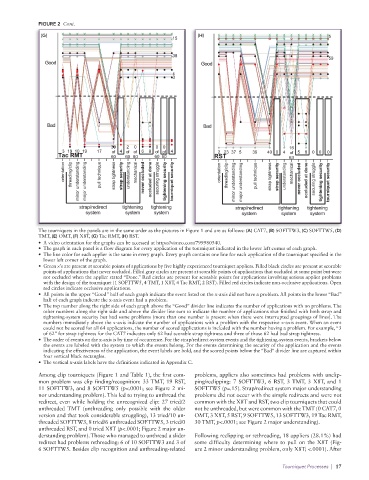
FIGURE 2  Cont.

              (G)                                                 (H)                                       5
                                                         15

                                                         38                                                 59
                Good                                               Good
                                                         4
                                                         3


                Bad                                                Bad


                                     39   2  0      0  0                                       16
                     3  19  10 19  17  of  4  of  of  6 8 of  of  4     2  23  37 5  39  40  0  4  of  5  0
                                                                                                            0
                                                                                                     60
                    Tac RMT          60   60  60   60  60              RST                     63
                      orientation  threading/clip  understanding  understanding  pull technique  strap tightness  security  understanding  mechanical  never occluded  done  at  securing struggle  security  security  orientation  threading/clip  understanding  understanding  pull technique  strap tightness  security  understanding  mechanical  never occluded  done  at  securing struggle  security  security


                           minor  major  strap    occluded  tightening  tourniquet  minor  major  strap  occluded  tightening  tourniquet

                           strap/redirect  tightening  tightening             strap/redirect  tightening  tightening
                             system       system   system                       system       system   system

              The tourniquets in the panels are in the same order as the pictures in Figure 1 and are as follows: (A) CAT7, (B) SOFTTW3, (C) SOFTTW5, (D)
              TMT, (E) OMT, (F) X8T, (G) Tac RMT, (H) RST.
              •  A video orientation for the graphs can be accessed at https://vimeo.com/799980540.
              •  The graph in each panel is a flow diagram for every application of the tourniquet indicated in the lower left corner of each graph.
              •  The line color for each applier is the same in every graph. Every graph contains one line for each application of the tourniquet specified in the
               lower left corner of the graph.
              •  Green ×’s are present at scorable points of applications by five highly experienced tourniquet appliers. Filled black circles are present at scorable
               points of applications that never occluded. Filled gray circles are present at scorable points of applications that occluded at some point but were
               not occluded when the applier stated “Done.” Red circles are present for scorable points for applications involving serious applier problems
               with the design of the tourniquet (1 SOFTTW5, 4 TMT, 1 X8T, 4 Tac RMT, 2 RST). Filled red circles indicate non-occlusive applications. Open
               red circles indicate occlusive applications.
              •  All points in the upper “Good” half of each graph indicate the event listed on the x-axis did not have a problem. All points in the lower “Bad”
               half of each graph indicate the x-axis event had a problem.
              •  The top number along the right side of each graph above the “Good” divider line indicates the number of applications with no problems. The
               other numbers along the right side and above the divider line sum to indicate the number of applications that finished with both strap and
               tightening-system security but had some problems (more than one number is present when there were interrupted groupings of lines). The
               numbers immediately above the x-axis indicate the number of applications with a problem with the respective x-axis event. When an event
               could not be scored for all 64 applications, the number of scored applications is included with the number having a problem. For example, “3
               of 62” for strap tightness for the CAT7 indicates only 62 had scorable strap tightness and three of those 62 had bad strap tightness.
              •  The order of events on the x-axis is by time of occurrence. For the strap/redirect-system events and the tightening-system events, brackets below
               the events are labeled with the system to which the events belong. For the events determining the security of the application and the events
               indicating the effectiveness of the application, the event labels are bold, and the scored points below the “Bad” divider line are captured within
               four vertical black rectangles.
              •  The vertical x-axis labels have the definitions indicated in Appendix C.

              Among clip tourniquets (Figure 1 and Table 1), the first com-  problems, appliers also sometimes had problems with unclip-
              mon problem was clip finding/recognition: 33 TMT, 19 RST,   ping/reclipping: 7 SOFTTW3, 6 RST, 3 TMT, 3 X8T, and 1
              11 SOFTTW3, and 8 SOFTTW5 (p<.0001; see Figure 2 mi-  SOFTTW5 (p=.15). Strap/redirect system major understanding
              nor understanding problem). This led to trying to unthread the   problems did not occur with the simple redirects and were not
              redirect, even while holding the unrecognized clip: 27 tried/2   common with the X8T and RST, two clip tourniquets that could
              unthreaded  TMT (unthreading only possible with the older   not be unthreaded, but were common with the TMT (0 CAT7, 0
              version and that took considerable struggling), 13 tried/10 un-  OMT, 3 X8T, 5 RST, 9 SOFTTW5, 13 SOFTTW3, 19 Tac RMT,
              threaded SOFTTW3, 8 tried/6 unthreaded SOFTTW5, 3 tried/0   30 TMT, p<.0001; see Figure 2 major understanding).
              unthreaded RST, and 0 tried X8T (p<.0001; Figure 2 major un-
              derstanding problem). Those who managed to unthread a slider   Following reclipping or rethreading, 18 appliers (28.1%) had
              redirect had problems rethreading: 6 of 10 SOFTTW3 and 3 of   some difficulty determining where to pull on the X8T (Fig-
              6 SOFTTW5. Besides clip recognition and unthreading-related   ure 2 minor understanding problem, only X8T; <.0001). After

                                                                                             Tourniquet Processes  |  17

