


Page 18 - JSOM Winter 2023
P. 18
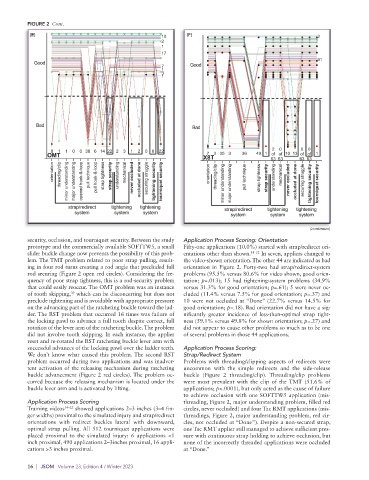
FIGURE 2  Cont.
           (E)                                        10      (F)                                        2
                                                      2
                                                      1
                                                      17
                                                                                                         61
            Good                                               Good
                                                      7
                                                      1
                                                      3
                                                      1


             Bad                                                Bad


                  8  1  1  0  0  38 6  14  22  2  3  1  2  0  0  22                       2  0     0  0
                                                                     7
                                                                                          of
                                                                                                     of
                                                                                            of
                OMT                                                X8T 3  35 3  36   49  1  63  63  10  13 of  63  1
                                                                                                   63
                  orientation  threading/clip  understanding  understanding  opened hook-&-loop  pull technique  pull hook-&-loop  strap tightness  security  understanding  mechanical  never occluded  done  at  securing struggle  security  security  orientation  threading/clip  understanding  understanding  pull technique  strap tightness  security  understanding  mechanical  never occluded  done  at  securing struggle  security  security
                       minor  major  strap     occluded  tightening  tourniquet  minor  major  strap  occluded  tightening  tourniquet

                       strap/redirect  tightening  tightening             strap/redirect  tightening  tightening
                         system       system    system                      system       system    system

                                                                                                      (continues)
          security, occlusion, and tourniquet security. Between the study   Application Process Scoring: Orientation
          prototype and the commercially available SOFTTW5, a small   Fifty-one applications (10.0%) started with strap/redirect ori-
          slider buckle change now prevents the possibility of this prob-  entations other than shown. 14–22  In seven, appliers changed to
          lem. The TMT problem related to poor strap pulling, result-  the video-shown orientation. The other 44 are indicated as bad
          ing in four rod turns creating a rod angle that precluded full   orientation in Figure 2. Forty-two had strap/redirect-system
          rod securing (Figure 2 open red circles). Considering the fre-  problems (95.5% versus 80.6% for video shown, good orien-
          quency of poor strap tightness, this is a rod-security problem   tation;  p=.013);  15  had  tightening-system  problems  (34.9%
          that could easily reoccur. The OMT problem was an instance   versus 31.3% for good orientation; p=.61); 5 were never oc-
          of tooth skipping,  which can be disconcerting but does not   cluded (11.4% versus 7.5% for good orientation; p=.37) and
                        39
          preclude tightening and is avoidable with appropriate pressure   10  were  not occluded  at “Done”  (22.7%  versus  14.5%  for
          on the advancing part of the ratcheting buckle toward the lad-  good orientation; p=.18). Bad orientation did not have a sig-
          der. The RST problem that occurred 16 times was failure of   nificantly greater incidence of less-than-optimal strap tight-
          the locking pawl to advance a full tooth despite correct, full   ness (59.1% versus 49.8% for shown orientation; p=.27) and
          rotation of the lever arm of the ratcheting buckle. The problem   did not appear to cause other problems so much as to be one
          did not involve tooth skipping. In each instance, the applier   of several problems in those 44 applications.
          reset and re-rotated the RST ratcheting buckle lever arm with
          successful advances of the locking pawl over the ladder teeth.   Application Process Scoring:
          We don’t know what caused this problem. The second RST   Strap/Redirect System
          problem occurred during two applications and was inadver-  Problems with threading/clipping aspects of redirects were
          tent activation of the releasing mechanism during ratcheting   uncommon with the simple redirects and the side-release
          buckle advancement (Figure 2 red circles). The problem oc-  buckle (Figure 2  threading/clip).  Threading/clip problems
          curred because the releasing mechanism is located under the   were most prevalent with the clip of the TMT (51.6% of
          buckle lever arm and is activated by lifting.      applications; p<.0001), but only acted as the cause of failure
                                                             to achieve occlusion with one SOFTTW5 application (mis-
          Application Process Scoring                        threading, Figure 2, major understanding problem, filled red
          Training videos 14–22  showed applications 2–3 inches (3–4 fin-  circles, never occluded) and four Tac RMT applications (mis-
          ger widths) proximal to the simulated injury and strap/ redirect   threadings, Figure 2, major understanding problem, red cir-
          orientations  with  redirect  buckles  lateral  with  downward,   cles, not occluded at “Done”). Despite a non-secured strap,
          optimal strap pulling. All 512 tourniquet applications were   one Tac RMT applier still managed to achieve sufficient pres-
          placed proximal to  the simulated injury: 6 applications <1   sure with continuous strap holding to achieve occlusion, but
          inch proximal, 490 applications 2–3inches proximal, 16 appli-  none of the incorrectly threaded applications were occluded
          cations >3 inches proximal.                        at “Done.”

          16  |  JSOM   Volume 23, Edition 4 / Winter 2023

