


Page 14 - JSOM Winter 2023
P. 14
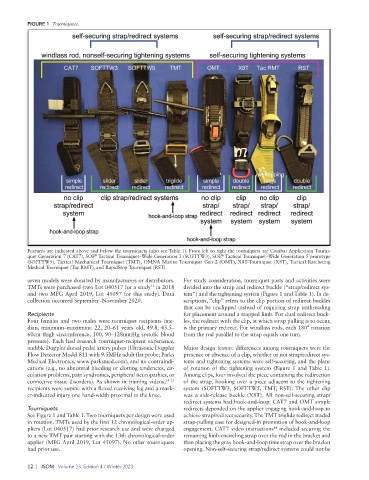
FIGURE 1  Tourniquets.


          Features are indicated above and below the tourniquets (also see Table 1). From left to right the tourniquets are Combat Application Tourni-
          quet Generation 7 (CAT7), SOF  Tactical Tourniquet–Wide Generation 3 (SOFTTW3), SOF  Tactical Tourniquet–Wide Generation 5 prototype
                                                                         ®
                                ®
          (SOFTTW5), Tactical Mechanical Tourniquet (TMT), OMNA Marine Tourniquet Gen 2 (OMT), X8T-Tourniquet (X8T), Tactical Ratcheting
          Medical Tourniquet (Tac RMT), and RapidStop Tourniquet (RST).
          seven models were donated by manufacturers or distributors.   For study consideration, tourniquet parts and activities were
                                                  13
          TMTs were purchased (two Lot 040517 for a study  in 2018   divided into the strap and redirect buckle (“strap/redirect sys-
          and two MFG April 2019, Lot 45097 for this study). Data   tem”) and the tightening system (Figure 1 and Table 1). In de-
          collection occurred September–November 2020.       scriptions, “clip” refers to the clip portion of redirect buckles
                                                             that can be unclipped instead of requiring strap unthreading
          Recipients                                         for placement around a trapped limb. For dual redirect buck-
          Four females and two males were tourniquet recipients (me-  les, the redirect with the clip, at which strap pulling is to occur,
          dian, minimum–maximum: 22, 20–61 years old, 49.8, 43.5–  is the primary redirect. For windlass rods, each 180° rotation
          60cm thigh circumference, 100, 90–128mmHg systolic blood   from the rod parallel to the strap equals one turn.
          pressure). Each had research tourniquet-recipient experience,
          audible Doppler dorsal pedal artery pulses (Ultrasonic Doppler   Major design feature differences among tourniquets were the
          Flow Detector Model 811 with 9.5MHz adult flat probe; Parks   presence or absence of a clip, whether or not strap/redirect sys-
          Medical Electronics, www.parksmed.com), and no contraindi-  tems and tightening systems were self-securing, and the plane
          cations (e.g., no abnormal bleeding or clotting tendencies, cir-  of rotation of the tightening system (Figure 1 and Table 1).
          culation problems, pain syndromes, peripheral neuropathies, or   Among clips, four involved the piece containing the redirection
          connective tissue disorders). As shown in training videos, 14–21    of the strap, hooking over a piece adjacent to the tightening
          recipients were supine with a flexed receiving leg and a mark-  system (SOFTTW3, SOFTTW5,  TMT, RST).  The other clip
          er-indicated injury one hand-width proximal to the knee.  was a side-release buckle (X8T). All non-self-securing strap/
                                                             redirect systems had hook-and-loop: CAT7 and OMT simple
          Tourniquets                                        redirects depended on the applier engaging hook-and-loop to
          See Figure 1 and Table 1. Two tourniquets per design were used   achieve strap/redirect security. The TMT triglide redirect traded
          in rotation. TMTs used by the first 12 chronological- order ap-  strap-pulling ease for designed-in promotion of hook-and-loop
                                                                                          14
          pliers (Lot 040517) had prior research use and were changed   engagement. CAT7 video instructions  included securing the
          to a new TMT pair starting with the 13th chronological-order   remaining limb-encircling strap over the rod in the bracket and
          applier (MFG April 2019, Lot 45097). No other tourniquets   then placing the gray hook-and-loop time strap over the bracket
          had prior use.                                     opening. Non-self-securing strap/redirect systems could not be

          12  |  JSOM   Volume 23, Edition 4 / Winter 2023

