


Page 16 - JSOM Winter 2023
P. 16
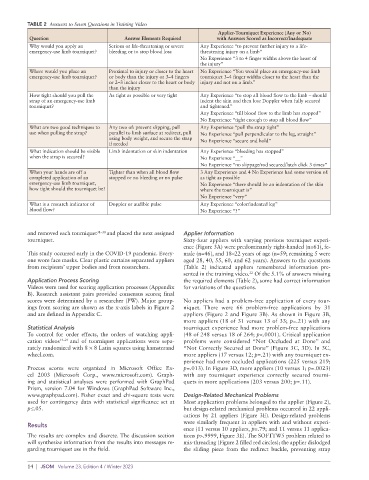
TABLE 2  Answers to Seven Questions in Training Video
                                                                        Applier-Tourniquet Experience (Any or No)
           Question                       Answer Elements Required      with Answers Scored as Incorrect/Inadequate
           Why would you apply an    Serious or life-threatening or severe   Any Experience “to prevent further injury to a life-
           emergency-use limb tourniquet?  bleeding or to stop blood loss  threatening injury on a limb”
                                                                  No Experience “3 to 4 finger widths above the heart of
                                                                  the injury”
           Where would you place an   Proximal to injury or closer to the heart   No Experience “You would place an emergency-use limb
           emergency-use limb tourniquet?  or body than the injury or 3–4 fingers   tourniquet 3–4 finger widths closer to the heart than the
                                     or 2–3 inches closer to the heart or body  injury and not on a limb.”
                                     than the injury
           How tight should you pull the   As tight as possible or very tight  Any Experience “to stop all blood flow to the limb – should
           strap of an emergency-use limb                         indent the skin and then lose Doppler when fully secured
           tourniquet?                                            and tightened.”
                                                                  Any Experience “till blood flow to the limb has stopped”
                                                                  No Experience “tight enough to stop all blood flow”
           What are two good techniques to   Any two of: prevent slipping, pull   Any Experience “pull the strap tight”
           use when pulling the strap?  parallel to limb surface at redirect, pull   No Experience “pull perpendicular to the leg, straight”
                                     using body weight, and secure the strap   No Experience “secure and hold”
                                     if needed
           What indication should be visible   Limb indentation or skin indentation  Any Experience “bleeding has stopped”
           when the strap is secured?                             No Experience “__”
                                                                  No Experience “no slippage/rod secured/latch click 3 times”
           When your hands are off a   Tighter than when all blood flow   3 Any Experience and 4 No Experience had some version of:
           completed application of an   stopped or no bleeding or no pulse  as tight as possible
           emergency-use limb tourniquet,                         No Experience “there should be an indentation of the skin
           how tight should the tourniquet be?                    where the tourniquet is”
                                                                  No Experience “very”
           What is a research indicator of   Doppler or audible pulse  Any Experience “color/indented leg”
           blood flow?                                            No Experience “?”


          and removed each tourniquet 31–38  and placed the next assigned   Applier Information
          tourniquet.                                        Sixty-four appliers with varying previous tourniquet experi-
                                                             ence (Figure 3A) were predominantly right-handed (n=61), fe-
          This study occurred early in the COVID-19 pandemic. Every-  male (n=46), and 18–22 years of age (n=59; remaining 5 were
          one wore face masks. Clear plastic curtains separated appliers   aged 28, 40, 55, 60, and 62 years). Answers to the questions
          from recipients’ upper bodies and from researchers.  (Table 2) indicated appliers remembered information pre-
                                                             sented in the training video.  Of the 5.1% of answers missing
                                                                                   22
          Application Process Scoring                        the required elements (Table 2), some had correct information
          Videos were used for scoring application processes (Appendix   for variations of the questions.
          B). Research assistant pairs provided consensus scores; final
          scores were determined by a researcher (PW). Major group-  No appliers had a problem-free application of every tour-
          ings from scoring are shown as the x-axis labels in Figure 2   niquet.  There were 66 problem-free applications by 31
          and are defined in Appendix C.                     appliers (Figure 2 and Figure 3B). As shown in Figure 3B,
                                                             more appliers (18 of 31 versus 13 of 33; p=.21) with any
          Statistical Analysis                               tourniquet experience had more problem-free applications
          To control for order effects, the orders of watching appli-  (48 of 248 versus 18 of 264; p<.0001). Critical application
          cation videos 14–21  and of tourniquet applications were sepa-  problems were considered  “Not Occluded at Done” and
          rately randomized with 8 × 8 Latin squares using hamsterand   “Not Correctly Secured at Done” (Figure 3C, 3D). In 3C,
          wheel.com.                                         more appliers (17 versus 12; p=.21) with any tourniquet ex-
                                                             perience had more occluded applications (225 versus 219;
          Process scores were organized in Microsoft Office Ex-  p=.013). In Figure 3D, more appliers (10 versus 1; p=.0023)
          cel  2003 (Microsoft  Corp.,  www.microsoft.com). Graph-  with any tourniquet experience correctly secured tourni-
          ing and statistical analyses were performed with GraphPad   quets in more applications (203 versus 200; p=.11).
          Prism, version 7.04 for Windows (GraphPad Software Inc.,
          www.graphpad.com). Fisher exact and chi-square tests were   Design-Related Mechanical Problems
          used for contingency data with statistical significance set at     Most application problems belonged to the applier (Figure 2),
          p≤.05.                                             but design-related mechanical problems occurred in 22 appli-
                                                             cations by 21 appliers (Figure 3E). Design-related problems
                                                             were similarly frequent in appliers with and without experi-
          Results
                                                             ence (11 versus 10 appliers, p=.79; and 11 versus 11 applica-
          The results are complex and discrete. The discussion section   tions p>.9999, Figure 3E). The SOFTTW5 problem related to
          will synthesize information from the results into messages re-  mis-threading (Figure 2 filled red circles); the applier dislodged
          garding tourniquet use in the field.               the sliding piece from the redirect buckle, preventing strap

          14  |  JSOM   Volume 23, Edition 4 / Winter 2023

