


Page 11 - JSOM Winter 2023
P. 11
personnel who deploy frequently and may be assigned to U.S.
              embassies in countries with access to sophisticated neurotech-
              nology. Biological, chemical, and directed energy neuroweap-
              ons are discussed.

              Bluetooth Tactical Headsets Improve the Speed of Accurate
              Patient Handoffs: Stinner and colleagues studied 24 simulated
              tactical patient handoffs to compare Bluetooth and traditional
              methods of communication used in tactical medical evacu-
              ation. They found that Bluetooth headsets resulted in faster
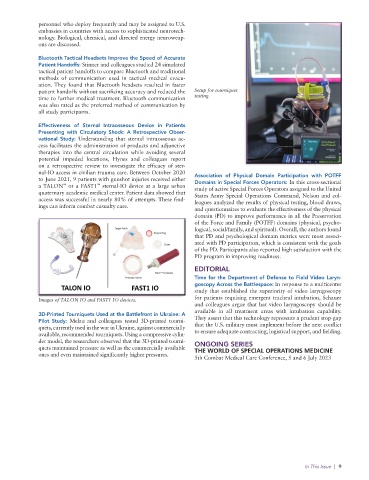
              patient handoffs without sacrificing accuracy and reduced the   Setup for tourniquet
              time to further medical treatment. Bluetooth communication   testing.
              was also rated as the preferred method of communication by
              all study participants.

              Effectiveness of Sternal Intraosseous Device in Patients
              Presenting  with  Circulatory  Shock:  A  Retrospective  Obser-
              vational Study:  Understanding that sternal intraosseous ac-
              cess facilitates the administration of products and adjunctive
              therapies into the central circulation while avoiding several
              potential  impeded  locations,  Hynes  and  colleagues  report
              on a retrospective review to investigate the efficacy of ster-
              nal-IO access in civilian trauma care. Between October 2020   Association of Physical Domain Participation with POTFF
              to June 2021, 9 patients with gunshot injuries received either   Domains in Special Forces Operators: In this cross-sectional
                                 ™
                      ™
              a TALON  or a FAST1  sternal-IO device at a large urban   study of active Special Forces Operators assigned to the United
              quaternary academic medical center. Patient data showed that   States Army Special Operations Command, Nelson and col-
              access was successful in nearly 80% of attempts. These find-  leagues analyzed the results of physical testing, blood draws,
              ings can inform combat casualty care.
                                                                 and questionnaires to evaluate the effectiveness of the physical
                                                                 domain (PD) to improve performance in all the Preservation
                                                                 of the Force and Family (POTFF) domains (physical, psycho-
                                                                 logical, social/family, and spiritual). Overall, the authors found
                                                                 that PD and psychological domain metrics were most associ-
                                                                 ated with PD participation, which is consistent with the goals
                                                                 of the PD. Participants also reported high satisfaction with the
                                                                 PD program in improving readiness.
                                                                 EDITORIAL
                                                                 Time for the Department of Defense to Field Video Laryn-
                                                                 goscopy Across the Battlespace: In response to a multicenter
                                                                 study that established the superiority of video laryngoscopy
              Images of TALON IO and FAST1 IO devices.           for patients requiring emergent tracheal intubation, Schauer
                                                                 and colleagues argue that hat video laryngoscopy should be
                                                                 available in all treatment areas with intubation capability.
              3D-Printed Tourniquets Used at the Battlefront in Ukraine: A
              Pilot Study:  Melau and colleagues tested 3D-printed tourni-  They assert that this technology represents a prudent stop-gap
              quets, currently used in the war in Ukraine, against commercially   that the U.S. military must implement before the next conflict
              available, recommended tourniquets. Using a compressive cylin-  to ensure adequate contracting, logistical support, and fielding.
              der model, the researchers observed that the 3D-printed tourni-  ONGOING SERIES
              quets maintained pressure as well as the commercially available   THE WORLD OF SPECIAL OPERATIONS MEDICINE
              ones and even maintained significantly higher pressures.
                                                                 5th Combat Medical Care Conference, 5 and 6 July 2023


                                                                                                     In This Issue  |  9

