


Page 10 - JSOM Winter 2023
P. 10
FEATURE ARTICLES                                   on the human brain are  not completely  understood, Edlow
          Effects of Tourniquet Features on Application Processes: In   and colleagues discuss the development and implementation
          this the first of two related articles, Wall and colleagues ex-  of a reliable diagnostic test for repeated blast brain injury
          amined the effects of emergency-use limb tourniquet design   (rBBI) and the benefits of such a tool for the Special Operation
          features on application processes. Participants included 2 male   Forces community. The authors explore establish priorities for
          tourniquet recipients and a convenience sample of 64 appli-  such a test, including the need to define rBBI and recovery,
          ers who watched training videos and then each applied eight   categorize Operators with blast exposure, and create a diag-
          types of tourniquets. The researchers found that self-securing   nostic risk assessment matrix to facilitate individualized care
          systems have process advantages.                   and operational flexibility.

                                                             Effects of Airway Localization Device Use During Surgical
                                                             Cricothyrotomy on Procedural Times and Confidence Levels
                                                             of Pre-Hospital Personnel:  Using a 6-in-1 model, Schlocker
                                                             and colleagues evaluated the effect of an airway localization
                                                             device (ALD) on surgical cricothyrotomy (SC) success rates
                                                             and prehospital provider confidence.  Two groups—35 U.S.
                                                             Navy hospital corpsmen 10 Navy Special Operation Forces
                                                             members—were randomly assigned to SC sequences of ALD/
                                                             no ALD or no ALD/ALD. Procedural times were longer with
                                                             ALD than without; however, this finding may have no clini-
                                                             cal significance. User confidence in their ability to successfully
                                                             perform an SC increased after two procedures using an airway
                                                             model.


          Tourniquets.

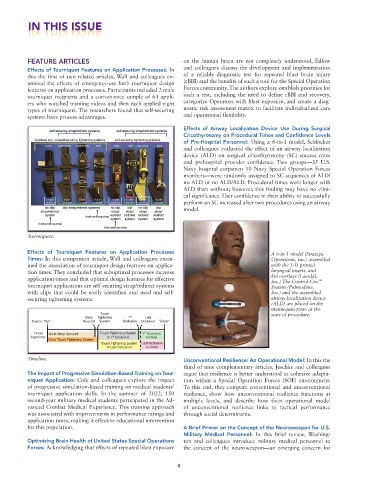
          Effects of Tourniquet Features on Application Processes                         A 6-in-1 model (Strategic
          Times: In this companion article, Wall and colleagues exam-                     Operations, Inc.) assembled
          ined the association of tourniquet design features on applica-                  with the 3-D printed
          tion times. They concluded that suboptimal processes increase                   laryngeal inserts, and
          application times and that optimal design features for effective                kin overlays (Laerdal,  ™
                                                                                          Inc.) The Control-Cric
          tourniquet applications are self-securing strap/redirect systems                System (Pulmodyne,
          with clips that could be easily identified and used and self-                   Inc.) and the assembled
          securing tightening systems.                                                    airway localization device
                                                                                          (ALD) are placed on the
                                                                                          mannequin torso at the
                                  Touch                                                   start of procedure.
                             Strap  Tightening  1 st  Last
           Events: "Go"     Secured  System  Occlusion  Occlusion  "Done"
                                                st
            Timed  Go to Strap Secured  Touch Tightening System  1  Occlusion
           Segments:                to 1  Occlusion  to Done
                                      st
                 Go to Touch Tightening System
                                  Touch Tightening System  Last Occlusion
                                    to Last Occlusion  to Done
          Timeline.                                          Unconventional Resilience: An Operational Model: In this the
                                                             third of nine complementary articles, Jeschke and colleagues
          The Impact of Progressive Simulation-Based Training on Tour-  argue that resilience is better understood as cohesive adapta-
          niquet Application:  Cole and colleagues explore the impact   tion within a Special Operation Forces (SOF) environment.
          of progressive simulation-based training on medical students’   To this end, they compare conventional and unconventional
          tourniquet application  skills. In  the summer of 2022, 150   resilience, show how unconventional resilience functions at
          second-year military medical students participated in the Ad-  multiple  levels,  and describe  how  their  operational model
          vanced Combat Medical Experience. This training approach   of unconventional resilience links to tactical performance
          was associated with improvements in performance ratings and   through social determinants.
          application times, making it effective educational intervention
          for this population.                               A Brief Primer on the Concept of the Neuroweapon for U.S.
                                                             Military Medical Personnel:  In this brief review,  Washing-
          Optimizing Brain Health of United States Special Operations   ton and colleagues introduce military medical personnel to
          Forces: Acknowledging that effects of repeated blast exposure   the concept of the neuroweapon—an emerging concern for


                                                           8

