


Page 20 - JSOM Winter 2023
P. 20
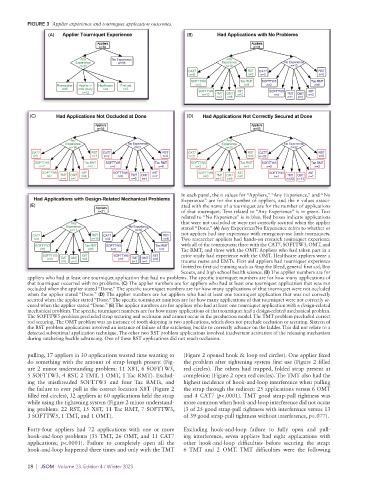
FIGURE 3  Applier experience and tourniquet application outcomes.
                 (A)                                          (B)


           (C)                                                (D)


                                                            In each panel, the n values for “Appliers,” “Any Experience,” and “No
                                                            Experience” are for the number of appliers, and the n values associ-
           (E)                                              ated with the name of a tourniquet are for the number of applications
                                                            of that tourniquet. Text related to “Any Experience” is in green. Text
                                                            related to “No Experience” is in blue. Red boxes indicate applications
                                                            that were not occluded or were not correctly secured when the applier
                                                            stated “Done.” (A) Any Experience/No Experience refers to whether or
                                                            not appliers had any experience with emergency-use limb tourniquets.
                                                            Two researcher appliers had hands-on research tourniquet experience
                                                            with all of the tourniquets; three with the CAT7, SOFTTW3, OMT, and
                                                            Tac RMT; and three with the OMT. Appliers who had taken part in a
                                                            prior study had experience with the OMT. Healthcare appliers were a
                                                            trauma nurse and EMTs. First aid appliers had tourniquet experience
                                                            limited to first aid training such as Stop the Bleed, general first aid, Boy
                                                            Scouts, and high school health science. (B) The applier numbers are for
          appliers who had at least one tourniquet application that had no problems. The specific tourniquet numbers are for how many applications of
          that tourniquet occurred with no problems. (C) The applier numbers are for appliers who had at least one tourniquet application that was not
          occluded when the applier stated “Done.” The specific tourniquet numbers are for how many applications of that tourniquet were not occluded
          when the applier stated “Done.” (D) The applier numbers are for appliers who had at least one tourniquet application that was not correctly
          secured when the applier stated “Done.” The specific tourniquet numbers are for how many applications of that tourniquet were not correctly se-
          cured when the applier stated “Done.” (E) The applier numbers are for appliers who had at least one tourniquet application with a design-related
          mechanical problem. The specific tourniquet numbers are for how many applications of that tourniquet had a design-related mechanical problem.
          The SOFTTW5 problem precluded strap securing and occlusion and cannot occur in the production model. The TMT problem precluded correct
          rod securing. The OMT problem was an instance of tooth skipping in two applications, which does not preclude occlusion or securing. Sixteen of
          the RST problem applications involved an instance of failure of the ratcheting buckle to correctly advance on the ladder. This did not relate to a
          detected suboptimal application technique. The other two RST problem applications involved inadvertent activation of the releasing mechanism
          during ratcheting buckle advancing. One of these RST applications did not reach occlusion.


          pulling, 17 appliers in 30 applications wasted time wanting to   (Figure 2 opened hook & loop red circles). One applier fixed
          do something with the amount of strap length present (Fig-  the problem after tightening system first use (Figure 2 filled
          ure 2 minor understanding problem: 11 X8T, 6 SOFTTW5,    red circles). The others had trapped, folded strap present at
          5 SOFTTW3, 4 RST, 2 TMT, 1 OMT, 1 Tac RMT). Exclud-  completion (Figure 2 open red circles). The TMT also had the
          ing the misthreaded SOFTTW5 and four  Tac RMTs, and   highest incidence of hook-and-loop interference when pulling
          the failure to ever pull in the correct location X8T (Figure 2   the strap through the redirect: 25 applications versus 6 OMT
          filled red circles), 32 appliers in 60 applications held the strap   and 4 CAT7 (p<.0001). TMT good strap-pull tightness was
          while using the tightening system (Figure 2 minor understand-  more common when hook-and-loop interference did not occur
          ing problem: 22 RST, 15 X8T, 11 Tac RMT, 7 SOFTTW3,     (3 of 25 good strap-pull tightness with interference versus 13
          3 SOFTTW5, 1 TMT, and 1 OMT).                      of 39 good strap-pull tightness without interference, p=.077).

          Forty-four appliers had 72 applications with one or more   Excluding  hook-and-loop  failure to  fully  open and  pull-
          hook-and-loop problems (35 TMT, 26 OMT, and 11 CAT7   ing interference, seven appliers had eight applications with
          applications;  p<.0001). Failure to completely open all the   other hook-and-loop difficulties before securing the strap:
          hook-and-loop happened three times and only with the TMT   6  TMT and 2 OMT.  TMT difficulties were the following

          18  |  JSOM   Volume 23, Edition 4 / Winter 2023

