


Page 24 - JSOM Winter 2023
P. 24
advancement. Another understanding problem was two appli-  Application Process Scoring: Occlusion
          ers lifting the releasing mechanism of the RST while lifting the   Twenty appliers had 35 applications that never reached occlu-
          ratcheting buckle lever arm (Figure 3E).           sion (Figure 2 never occluded, p=.057 across all tourniquets),
                                                             and an additional 15 appliers had an additional 33 applica-
          Other windlass rod-tightening system problems (Figure 2   tions that were not occluded when the applier said “Done”
          mechanical) were losing hold of the windlass rod (11 TMT,     (Figure 2 occluded at “Done” and Figure 3C; p=.0041 across
          9 SOFTTW5, 3 SOFTTW3, and 4 CAT7) or intentionally   all tourniquets). A few applications achieved such quiet Dop-
          redoing windlass rod rotations (9 TMT – 4 also lost hold,     pler signals when the applier had finished that an inexperi-
          9 SOFTTW3 – 2 also lost hold, 8 SOFFTW5 – 3 also lost hold,   enced applier may not have realized a pulse was still present.
          and 1 CAT7).                                       In many of the 33 applications that reached occlusion but
                                                             had a pulse return before the applier said “Done,” the applier
          The other ratchet-tightening-system problems (Figure 2 me-  clearly realized the mistake but had already committed to be-
          chanical) were one OMT lever arm slipping from the lifting   ing finished with the application.
          thumb and the previously  detailed tooth skipping (2 OMT,
          Figure 3E), and failures of the RST to advance (16 RST,    The most frequent reason for occlusion failure was premature
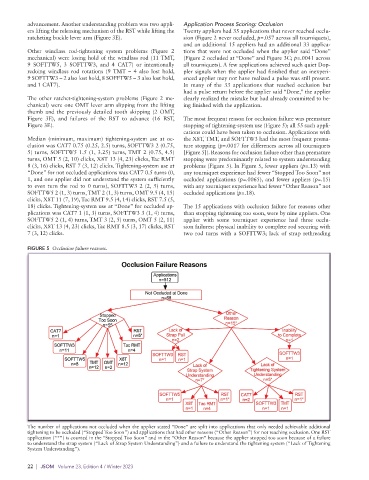
          Figure 3E).                                        stopping of tightening-system use (Figure 5); all 55 such appli-
                                                             cations could have been taken to occlusion. Applications with
          Median (minimum, maximum) tightening-system use at oc-  the X8T, TMT, and SOFTTW3 had the most frequent prema-
          clusion was CAT7 0.75 (0.25, 2.5) turns, SOFTTW3 2 (0.75,   ture stopping (p=.0017 for differences across all tourniquets
          5) turns, SOFTTW5 1.5 (1, 3.25) turns, TMT 2 (0.75, 4.5)   [Figure 5]). Reasons for occlusion failure other than premature
          turns, OMT 5 (2, 10) clicks, X8T 13 (4, 23) clicks, Tac RMT   stopping were predominantly related to system understanding
          8 (3, 16) clicks, RST 7 (3, 12) clicks. Tightening-system use at   problems (Figure 5). In Figure 5, fewer appliers (p=.13) with
          “Done” for not occluded applications was CAT7 0.5 turns (0,   any tourniquet experience had fewer “Stopped Too Soon” not
          1, and one applier did not understand the system sufficiently   occluded applications (p=.0065), and fewer appliers (p=.15)
          to even turn the rod to 0 turns), SOFTTW3 2 (2, 5) turns,   with any tourniquet experience had fewer “Other Reason” not
          SOFTTW5 2 (1, 3) turns, TMT 2 (1, 3) turns, OMT 9.5 (4, 15)   occluded applications (p=.18).
          clicks, X8T 11 (7, 19), Tac RMT 9.5 (4, 14) clicks, RST 7.5 (5,
          18) clicks. Tightening-system use at “Done” for occluded ap-  The 15 applications with occlusion failure for reasons other
          plications was CAT7 1 (1, 3) turns, SOFTTW3 3 (1, 4) turns,   than stopping tightening too soon, were by nine appliers. One
          SOFTTW5 2 (1, 4) turns, TMT 3 (2, 5) turns, OMT 5 (2, 11)   applier with some tourniquet experience had three occlu-
          clicks, X8T 13 (4, 23) clicks, Tac RMT 8.5 (3, 17) clicks, RST   sion failures: physical inability to complete rod securing with
          7 (3, 12) clicks.                                  two rod turns with a SOFTTW3; lack of strap rethreading

          FIGURE 5  Occlusion failure reasons.


          The number of applications not occluded when the applier stated “Done” are split into applications that only needed achievable additional
          tightening to be occluded (“Stopped Too Soon”) and applications that had other reasons (“Other Reason”) for not reaching occlusion. One RST
          application (“*”) is counted in the “Stopped Too Soon” and in the “Other Reason” because the applier stopped too soon because of a failure
          to understand the strap system (“Lack of Strap System Understanding”) and a failure to understand the tightening system (“Lack of Tightening
          System Understanding”).

          22  |  JSOM   Volume 23, Edition 4 / Winter 2023

