


Page 73 - JSOM Fall 2023
P. 73
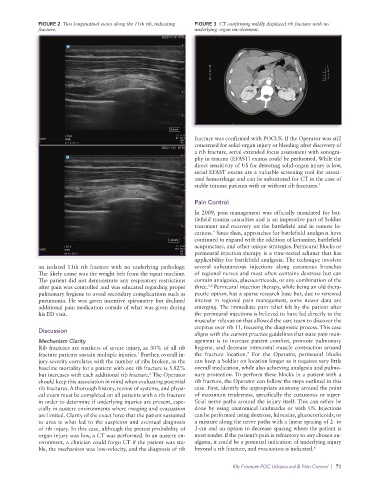
FIGURE 2  Two longitudinal views along the 11th rib, indicating   FIGURE 3  CT confirming mildly displaced rib fracture with no
              fracture.                                          underlying organ involvement.


                                                                 fracture was confirmed with POCUS. If the Operator was still
                                                                 concerned for solid-organ injury or bleeding after discovery of
                                                                 a rib fracture, serial extended focus assessment with sonogra-
                                                                 phy in trauma (EFAST) exams could be performed. While the
                                                                 direct sensitivity of US for detecting solid-organ injury is low,
                                                                 serial EFAST exams are a valuable screening tool for associ-
                                                                 ated hemorrhage and can be substituted for CT in the case of
                                                                 stable trauma patients with or without rib fractures. 3

                                                                 Pain Control

                                                                 In 2009, pain management was officially mandated for bat-
                                                                 tlefield trauma casualties and is an imperative part of Soldier
                                                                 treatment and recovery on the battlefield and in remote lo-
                                                                 cations.  Since then, approaches for battlefield analgesia have
                                                                       4
                                                                 continued to expand with the addition of ketamine, battlefield
                                                                 acupuncture, and other unique strategies. Perineural blocks or
                                                                 perineural injection therapy is a time-tested adjunct that has
                                                                 applicability for battlefield analgesia. The technique involves
              an isolated 11th rib fracture with no underlying pathology.   several  subcutaneous injections  along cutaneous  branches
              The likely cause was the weight belt from the squat machine.   of regional nerves and most often contains dextrose but can
              The patient did not demonstrate any respiratory restrictions   contain analgesics, glucocorticoids, or any combination of the
                                                                     5,6
              after pain was controlled and was educated regarding proper   three.  Perineural injection therapy, while being an old thera-
              pulmonary hygiene to avoid secondary complications such as   peutic option, has a sparse research base but, due to renewed
              pneumonia. He was given incentive spirometry but declined   interest  in  regional  pain  management,  some  newer  data  are
              additional pain medication outside of what was given during   emerging. The immediate pain relief felt by the patient after
              his ED visit.                                      the perineural injections is believed to have led directly to the
                                                                 muscular relaxation that allowed the care team to discover the
                                                                 crepitus over rib 11, focusing the diagnostic process. This case
              Discussion
                                                                 aligns with the current practice guidelines that state pain man-
              Mechanism Clarity                                  agement is to increase patient comfort, promote pulmonary
              Rib fractures are markers of severe injury, as 30% of all rib   hygiene, and decrease intercostal muscle contraction around
              fracture patients sustain multiple injuries.  Further, overall in-  the fracture location.  For the Operator, perineural blocks
                                              1
                                                                                  7
              jury severity correlates with the number of ribs broken, as the   can keep a Soldier on location longer as it requires very little
              baseline mortality for a patient with one rib fracture is 5.82%   overall medication, while also achieving analgesia and pulmo-
              but increases with each additional rib fracture.  The Operator   nary protection. To perform these blocks in a patient with a
                                                  2
              should keep this association in mind when evaluating potential   rib fracture, the Operator can follow the steps outlined in this
              rib fractures. A thorough history, review of systems, and physi-  case. First, identify the appropriate anatomy around the point
              cal exam must be completed on all patients with a rib fracture   of maximum tenderness, specifically the cutaneous or super-
              in order to determine if underlying injuries are present, espe-  ficial nerve paths around the injury itself. This can either be
              cially in austere environments where imaging and evacuation   done by using anatomical landmarks or with US. Injections
              are limited. Clarity of the exact force that the patient sustained   can be performed using dextrose, lidocaine, glucocorticoids, or
              to area is what led to the suspicion and eventual diagnosis   a mixture along the nerve paths with a linear spacing of 2- to
              of rib injury. In this case, although the pretest probability of   3-cm and an option to decrease spacing where the patient is
              organ injury was low, a CT was performed. In an austere en-  most tender. If the patient’s pain is refractory to any chosen an-
              vironment, a clinician could forgo CT if the patient was sta-  algesia, it could be a potential indication of underlying injury
              ble, the mechanism was low-velocity, and the diagnosis of rib   beyond a rib fracture, and evacuation is indicated. 8

                                                                             Rib Fracture POC Ultrasound & Pain Control  |  71

