


Page 96 - JSOM Winter 2022
P. 96
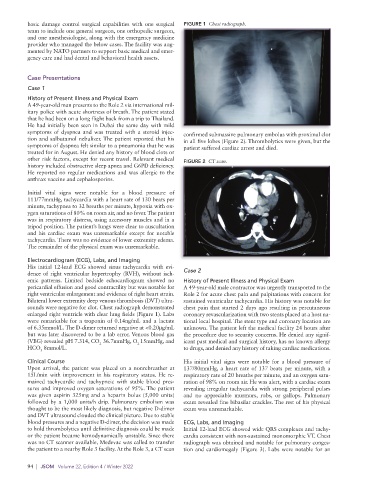
basic damage control surgical capabilities with one surgical   FIGURE 1  Chest radiograph.
          team to include one general surgeon, one orthopedic surgeon,
          and one anesthesiologist, along with the emergency medicine
          provider who managed the below cases. The facility was aug-
          mented by NATO partners to support basic medical and emer-
          gency care and had dental and behavioral health assets.


          Case Presentations
          Case 1
          History of Present Illness and Physical Exam
          A 49-year-old man presents to the Role 2 via international mil-
          itary police with acute shortness of breath. The patient stated
          that he had been on a long flight back from a trip to Thailand.
          He had initially been seen in Dubai the same day with mild
          symptoms of dyspnea and was treated with a steroid injec-  confirmed submassive pulmonary embolus with proximal clot
          tion and salbutamol nebulizer. The patient reported that his   in all five lobes (Figure 2). Thrombolytics were given, but the
          symptoms of dyspnea felt similar to a pneumonia that he was   patient suffered cardiac arrest and died.
          treated for in August. He denied any history of blood clots or
          other risk factors, except for recent travel. Relevant medical   FIGURE 2  CT scan.
          history included obstructive sleep apnea and G6PD deficiency.
          He reported no regular medications and was allergic to the
          anthrax vaccine and cephalosporins.

          Initial vital signs were notable for a blood pressure of
          111/77mmHg, tachycardia with a heart rate of 130 beats per
          minute, tachypnea to 32 breaths per minute, hypoxia with ox-
          ygen saturations of 80% on room air, and no fever. The patient
          was in respiratory distress, using accessory muscles and in a
          tripod position. The patient’s lungs were clear to auscultation
          and  his  cardiac  exam  was  unremarkable  except  for  notable
          tachycardia. There was no evidence of lower extremity edema.
          The remainder of the physical exam was unremarkable.
          Electrocardiogram (ECG), Labs, and Imaging
          His initial 12-lead ECG showed sinus tachycardia with evi-
          dence of right ventricular hypertrophy (RVH), without isch-  Case 2
          emic patterns. Limited bedside echocardiogram showed no   History of Present Illness and Physical Exam
          pericardial effusion and good contractility but was notable for   A 49-year-old male contractor was urgently transported to the
          right ventricular enlargement and evidence of right heart strain.   Role 2 for acute chest pain and palpitations with concern for
          Bilateral lower extremity deep venous thrombosis (DVT) ultra-  sustained ventricular tachycardia. His history was notable for
          sounds were negative for clot. Chest radiograph demonstrated   chest pain that started 2 days ago resulting in percutaneous
          enlarged right ventricle with clear lung fields (Figure 1). Labs   coronary revascularization with two stents placed at a host na-
          were remarkable for a troponin of 0.14ng/mL and a lactate   tional local hospital. The stent type and coronary location are
          of 6.35mmol/L. The D-dimer returned negative at <0.20μg/mL   unknown. The patient left the medical facility 24 hours after
          but was later discovered to be a lab error.  Venous blood gas   the procedure due to security concerns. He denied any signif-
          (VBG) revealed pH 7.314, CO  36.7mmHg, O 15mmHg, and   icant past medical and surgical history, has no known allergy
                                  2
                                              2
          HCO  8mmol/L.                                      to drugs, and denied any history of taking cardiac medications.
              3
          Clinical Course                                    His initial vital signs were notable for a blood pressure of
          Upon arrival, the patient was placed on a nonrebreather  at   137/80mmHg, a heart rate of 137 beats per minute, with a
          15L/min with improvement in his respiratory status. He re-  respiratory rate of 20 breaths per minute, and an oxygen satu-
          mained tachycardic and tachypneic with stable blood pres-  ration of 98% on room air. He was alert, with a cardiac exam
          sures and improved oxygen saturations of 95%. The patient   revealing irregular tachycardia with strong peripheral pulses
          was given aspirin 325mg and a heparin bolus (5,000 units)   and no appreciable murmurs, rubs, or gallops. Pulmonary
          followed by a 1,000 units/h drip. Pulmonary embolism was   exam revealed fine bibasilar crackles. The rest of his physical
          thought to be the most likely diagnosis, but negative D-dimer   exam was unremarkable.
          and DVT ultrasound clouded the clinical picture. Due to stable
          blood pressures and a negative D-dimer, the decision was made   ECG, Labs, and Imaging
          to hold thrombolytics until definitive diagnosis could be made   Initial 12-lead ECG showed wide QRS complexes and tachy-
          or the patient became hemodynamically unstable. Since there   cardia consistent with non-sustained monomorphic VT. Chest
          was no CT scanner available, Medevac was called to transfer   radiograph was obtained and notable for pulmonary conges-
          the patient to a nearby Role 3 facility. At the Role 3, a CT scan   tion and cardiomegaly (Figure 3). Labs were notable for an

          94  |  JSOM   Volume 22, Edition 4 / Winter 2022

