


Page 99 - JSOM Winter 2022
P. 99
An Ongoing Series


                                                 Omega-3 Fatty Acids

                                        Benefits for Performance and Recovery


                         Melissa Rittenhouse, PhD, RD, CSSD *; Patricia A. Deuster, PhD, MPH, FACSM  2
                                                            1


              ABSTRACT
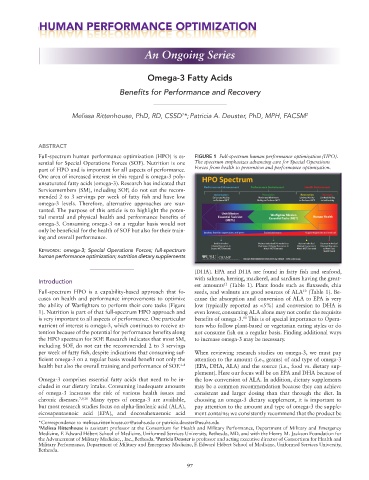
              Full-spectrum human performance optimization (HPO) is es-  FIGURE 1  Full-spectrum human performance optimization (HPO).
              sential for Special Operations Forces (SOF). Nutrition is one   The spectrum emphasizes advancing care for Special Operations
              part of HPO and is important for all aspects of performance.   Forces from health to prevention and performance optimization.
              One area of increased interest in this regard is omega-3 poly-
              unsaturated fatty acids (omega-3). Research has indicated that
              Servicemembers (SM), including SOF, do not eat the recom-
              mended 2 to 3 servings per week of fatty fish and have low
              omega-3 levels.  Therefore, alternative approaches are war-
              ranted. The purpose of this article is to highlight the poten-
              tial mental and physical health and performance benefits of
              omega-3. Consuming omega-3 on a regular basis would not
              only be beneficial for the health of SOF but also for their train-
              ing and overall performance.
              Keywords: omega-3; Special Operations Forces; full-spectrum
              human performance optimization; nutrition dietary supplements

                                                                 (DHA). EPA and DHA are found in fatty fish and seafood,
              Introduction                                       with salmon, herring, mackerel, and sardines having the great-
                                                                 est amounts  (Table 1). Plant foods such as flaxseeds, chia
                                                                          11
              Full-spectrum HPO is a capability-based approach that fo-  seeds, and walnuts are good sources of ALA  (Table 1). Be-
                                                                                                    10
              cuses on health and performance improvements to optimize   cause the absorption and conversion of ALA to EPA is very
              the ability of Warfighters to perform their core tasks (Figure   low (typically reported as <5%) and conversion to DHA is
              1). Nutrition is part of that full-spectrum HPO approach and   even lower, consuming ALA alone may not confer the requisite
              is very important to all aspects of performance. One particular   benefits of omega-3.  This is of special importance to Opera-
                                                                                10
              nutrient of interest is omega-3, which continues to receive at-  tors who follow plant-based or vegetarian eating styles or do
              tention because of the potential for performance benefits along   not consume fish on a regular basis. Finding additional ways
              the HPO spectrum for SOF. Research indicates that most SM,   to increase omega-3 may be necessary.
              including SOF, do not eat the recommended 2 to 3 servings
              per week of fatty fish, despite indications that consuming suf-  When reviewing research studies on omega-3, we must pay
              ficient omega-3 on a regular basis would benefit not only the   attention to the amount (i.e., grams) of and type of omega-3
              health but also the overall training and performance of SOF.    (EPA, DHA, ALA) and the source (i.e., food vs. dietary sup-
                                                            1–8
                                                                 plement). Here our focus will be on EPA and DHA because of
              Omega-3 comprises essential fatty acids that need to be in-  the low conversion of ALA. In addition, dietary supplements
              cluded in our dietary intake. Consuming inadequate amounts   may be a common recommendation because they can achieve
              of omega-3 increases the risk of various health issues and   consistent and larger dosing than that through the diet. In
              chronic diseases. 7,9,10  Many types of omega-3 are available,   choosing an omega-3 dietary supplement, it is important to
              but most research studies focus on alpha-linolenic acid (ALA),   pay attention to the amount and type of omega-3 the supple-
              eicosapentaenoic acid (EPA), and docosahexaenoic acid     ment contains; we consistently recommend that the product be
              *Correspondence to melissa.rittenhouse.ctr@usuhs.edu or patricia.deuster@usuhs.edu
              1 Melissa Rittenhouse is assistant professor at the Consortium for Health and Military Performance, Department of Military and Emergency
              Medicine, F. Edward Hébert School of Medicine, Uniformed Services University, Bethesda, MD, and with the Henry M. Jackson Foundation for
              the Advancement of Military Medicine, , Inc., Bethesda.  Patricia Deuster is professor and acting executive director of Consortium for Health and
                                                    2
              Military Performance, Department of Military and Emergency Medicine, F. Edward Hébert School of Medicine, Uniformed Services University,
              Bethesda.
                                                              97

