


Page 102 - JSOM Winter 2022
P. 102
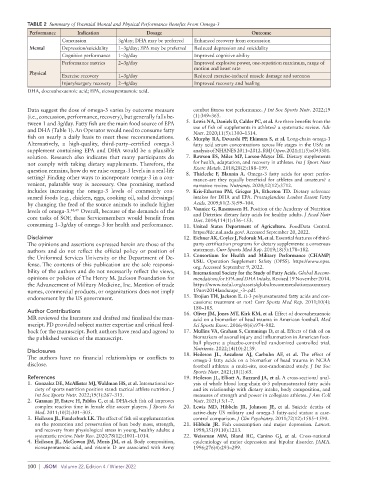
TABLE 2  Summary of Potential Mental and Physical Performance Benefits From Omega-3
           Performance    Indication             Dosage                            Outcome
                     Concussion         3g/day; DHA may be preferred  Enhanced recovery from concussion
           Mental    Depression/suicidality  1–3g/day; EPA may be preferred  Reduced depression and suicidality
                     Cognitive performance  1–2g/day            Improved cognitive ability
                     Performance metrics  2–3g/day              Improved explosive power, one-repetition maximum, range of
                                                                motion and heart rate
           Physical
                     Exercise recovery  1–3g/day                Reduced exercise-induced muscle damage and soreness
                     Injury/surgery recovery  2–4g/day          Improved recovery and healing
          DHA, docosahexaenoic acid; EPA, eicosapentaenoic acid.


          Data suggest the dose of omega-3 varies by outcome measure   combat fitness test performance. J Int Soc Sports Nutr. 2022;19
          (i.e., concussion, performance, recovery), but generally falls be-  (1):349–365.
          tween 1 and 3g/day. Fatty fish are the main food source of EPA   5.  Lewis NA, Daniels D, Calder PC, et al. Are there benefits from the
          and DHA (Table 1). An Operator would need to consume fatty   use of fish oil supplements in athletes? a systematic review. Adv
                                                                Nutr. 2020;11(5):1300–1314.
          fish on nearly a daily basis to meet these recommendations.   6.  Murphy RA, Devarshi PP, Ekimura S, et al. Long-chain omega-3
          Alternatively, a high-quality, third-party–certified omega-3   fatty acid serum concentrations across life stages in the USA: an
          supplement containing EPA and DHA would be a plausible   analysis of NHANES 2011–2012. BMJ Open. 2021;11(5):e043301.
          solution. Research also indicates that many participants do   7.  Rawson ES, Miles MP, Larson-Meyer DE. Dietary supplements
          not comply with  taking dietary  supplements. Therefore,  the   for health, adaptation, and recovery in athletes. Int J Sport Nutr
          question remains, how do we raise omega-3 levels in a real-life   Exerc Metab. 2018;28(2):188–199.
          setting? Finding other ways to incorporate omega-3 in a con-  8.  Thielecke F, Blannin  A. Omega-3 fatty acids for sport perfor-
                                                                mance–are they equally beneficial for athletes and amateurs? a
          venient, palatable way is necessary. One promising method   narrative review. Nutrients. 2020;12(12):3712.
          includes  increasing  the omega-3  levels  of commonly  con-  9.  Kris-Etherton PM, Grieger JA, Etherton TD. Dietary reference
          sumed foods (e.g., chicken, eggs, cooking oil, salad dressings)   intakes for DHA and EPA. Prostaglandins Leukot Essent Fatty
          by changing the feed of the source animals to include higher   Acids. 2009;81(2-3):99–104.
          levels of omega-3. 48,49  Overall, because of the demands of the   10.  Vannice G, Rasmussen H. Position of the Academy of Nutrition
          core tasks of SOF, these Servicemembers would benefit from   and Dietetics: dietary fatty acids for healthy adults. J Acad Nutr
                                                                Diet. 2014;114(1):136–153.
          consuming 1–3g/day of omega-3 for health and performance.  11.  United States Department of  Agriculture. FoodData Central.
                                                                https://fdc.nal.usda.gov/. Accessed September 20, 2022.
          Disclaimer                                         12.  Eichner AK, Coyles J, Fedoruk M, et al. Essential features of third-
          The opinions and assertions expressed herein are those of the   party certification programs for dietary supplements: a consensus
          authors and do not reflect the official policy or position of   statement. Curr Sports Med Rep. 2019;18(5):178–182.
          the Uniformed Services University or the Department of De-  13.  Consortium for Health and Military Performance (CHAMP)
          fense. The contents of this publication are the sole responsi-  USU. Operation Supplement Safety (OPSS).  https://www.opss.
                                                                org. Accessed September 9, 2022.
          bility of the authors and do not necessarily reflect the views,   14.  International Society for the Study of Fatty Acids. Global Recom-
          opinions or policies of The Henry M. Jackson Foundation for   mendations for EPA and DHA Intake. Revised 19 November 2014.
          the Advancement of Military Medicine, Inc. Mention of trade   https://www.issfal.org/assets/globalrecommendationssummary
          names, commercial products, or organizations does not imply   19nov2014landscape_-3-.pdf.
          endorsement by the US government.                  15.  Trojian TH, Jackson E. Ω-3 polyunsaturated fatty acids and con-
                                                                cussions: treatment or not? Curr Sports Med Rep. 2011;10(4):
                                                                180–185.
          Author Contributions                               16.  Oliver JM, Jones MT, Kirk KM, et al. Effect of docosahexaenoic
          MR reviewed the literature and drafted and finalized the man-  acid on a biomarker of head trauma in American football. Med
          uscript. PD provided subject matter expertise and critical feed-  Sci Sports Exerc. 2016;48(6):974–982.
          back for the manuscript. Both authors have read and agreed to   17.  Mullins VA, Graham S, Cummings D, et al. Effects of fish oil on
          the published version of the manuscript.              biomarkers of axonal injury and inflammation in American foot-
                                                                ball players: a placebo-controlled randomized controlled trial.
          Disclosures                                           Nutrients. 2022;14(10):2139.
          The  authors  have  no  financial  relationships  or  conflicts  to   18.  Heileson JL,  Anzalone  AJ, Carbuhn  AF, et al.  The effect of
                                                                omega-3 fatty acids on a biomarker of head trauma in NCAA
          disclose.                                             football athletes: a multi-site, non-randomized study.  J Int Soc
                                                                Sports Nutr. 2021;18(1):65.
          References                                         19.  Heileson JL, Elliott A, Buzzard JA, et al. A cross-sectional anal-
          1.  Gonzalez DE, McAllister MJ, Waldman HS, et al. International so-  ysis of whole blood long-chain ω-3 polyunsaturated fatty acids
            ciety of sports nutrition position stand: tactical athlete nutrition. J   and its relationship with dietary intake, body composition, and
            Int Soc Sports Nutr. 2022;19(1):267–315.            measures of strength and power in collegiate athletes. J Am Coll
          2.  Guzman JF, Esteve H, Pablos C, et al. DHA-rich fish oil improves   Nutr. 2021;13:1–7.
            complex reaction time in female elite soccer players. J Sports Sci   20.  Lewis MD, Hibbeln JR, Johnson JE, et al.  Suicide deaths of
            Med. 2011;10(2):301–305.                              active-duty US military and omega-3 fatty-acid status: a case-
          3.  Heileson JL, Funderburk LK. The effect of fish oil supplementation   control comparison. J Clin Psychiatry. 2011;72(12):1585–1590.
            on the promotion and preservation of lean body mass, strength,   21.  Hibbeln JR. Fish consumption and major depression.  Lancet.
            and recovery from physiological stress in young, healthy adults: a   1998;351(9110):1213.
            systematic review. Nutr Rev. 2020;78(12):1001–1014.  22.  Weissman MM, Bland RC, Canino GJ, et al. Cross-national
          4.  Heileson JL, McGowen JM, Moris JM, et al. Body composition,   epidemiology of major depression and bipolar disorder. JAMA.
            eicosapentaenoic acid, and vitamin D are associated with Army  1996;276(4):293–299.

          100  |  JSOM   Volume 22, Edition 4 / Winter 2022

