


Page 105 - JSOM Winter 2022
P. 105
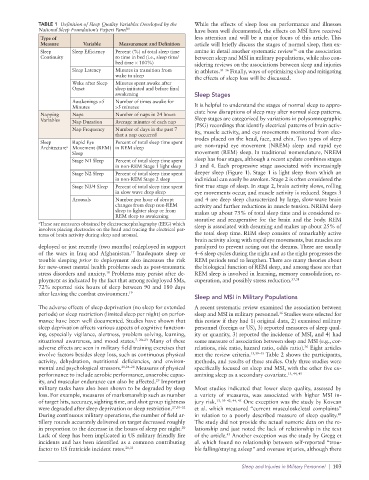
TABLE 1  Definition of Sleep Quality Variables Developed by the   While the effects of sleep loss on performance and illnesses
              National Sleep Foundation’s Expert Panel 10        have been well documented, the effects on MSI have received
              Type of                                            less attention and will be a major focus of this article. This
              Measure       Variable    Measurement and Definition  article will briefly discuss the stages of normal sleep, then ex-
                                                                                                 36
              Sleep      Sleep Efficiency  Percent (%) of total sleep time   amine in detail another systematic review  on the association
              Continuity               to time in bed (i.e., sleep time/  between sleep and MSI in military populations, while also con-
                                       bed time × 100%)          sidering reviews on the associations between sleep and injuries
                         Sleep Latency   Minutes in transition from   in athletes. 34–36  Finally, ways of optimizing sleep and mitigating
                                       wake to sleep             the effects of sleep loss will be discussed.
                         Wake after Sleep   Minutes spent awake after
                         Onset         sleep initiated and before final
                                       awakening                 Sleep Stages
                         Awakenings >5   Number of times awake for
                         Minutes       >5 minutes                It is helpful to understand the stages of normal sleep to appre-
              Napping    Naps          Number of naps in 24 hours  ciate how disruptions of sleep may alter normal sleep patterns.
              Variables  Nap Duration  Average minutes of each nap  Sleep stages are categorized by variations in polysomnographic
                         Nap Frequency  Number of days in the past 7   (PSG) recordings that identify electrical patterns of brain activ-
                                                                 ity, muscle activity, and eye movements monitored from elec-
                                       that a nap occurred
              Sleep      Rapid Eye     Percent of total sleep time spent   trodes placed on the head, face, and chin. Two types of sleep
              Architecture a  Movement (REM)  in REM sleep       are non-rapid eye movement (NREM) sleep and rapid eye
                         Sleep                                   movement (REM) sleep. In traditional nomenclature, NREM
                         Stage N1 Sleep  Percent of total sleep time spent   sleep has four stages, although a recent update combines stages
                                       in non-REM Stage 1 light sleep  3 and 4. Each progressive stage associated with increasingly
                         Stage N2 Sleep  Percent of total sleep time spent   deeper sleep (Figure 1). Stage 1 is light sleep from which an
                                       in non-REM Stage 2 sleep  individual can easily be awoken. Stage 2 is often considered the
                         Stage N3/4 Sleep  Percent of total sleep time spent   first true stage of sleep. In stage 2, brain activity slows, rolling
                                       in slow wave deep sleep   eye movements occur, and muscle activity is reduced. Stages 3
                         Arousals      Number per hour of abrupt   and 4 are deep sleep characterized by large, slow-wave brain
                                       changes from deep non-REM   activity and further reductions in muscle tension. NREM sleep
                                       sleep to lighter sleep or from   makes up about 75% of total sleep time and is considered re-
                                       REM sleep to awakening    storative and recuperative for the brain and the body. REM
              a These are measures obtained by electroencephalography (EEG) which   sleep is associated with dreaming and makes up about 25% of
              involves placing electrodes on the head and tracing the electrical pat-
              terns of brain activity during sleep and arousal.  the total sleep time. REM sleep consists of remarkably active
                                                                 brain activity along with rapid eye movements, but muscles are
              deployed or just recently (two months) redeployed in support   paralyzed to prevent acting out the dreams. There are usually
                                            17
              of the wars in Iraq and  Afghanistan.  Inadequate sleep or   4–6 sleep cycles during the night and as the night progresses the
              trouble sleeping  prior to  deployment also increases the risk   REM periods tend to lengthen. There are many theories about
              for new-onset mental health problems such as post-traumatic   the biological function of REM sleep, and among these are that
              stress disorders and anxiety.  Problems may persist after de-  REM sleep is involved in learning, memory consolidation, re-
                                    18
              ployment as indicated by the fact that among redeployed SMs,   cuperation, and possibly stress reduction. 37,38
              72% reported ≤six hours of sleep between 90 and 180 days
              after leaving the combat environment. 19
                                                                 Sleep and MSI in Military Populations
              The adverse effects of sleep deprivation (no sleep for extended   A recent systematic review examined the association between
                                                                                            36
              periods) or sleep restriction (limited sleep per night) on perfor-  sleep and MSI in military personnel.  Studies were selected for
              mance have been well documented. Studies have shown that   this review if they had 1) original data, 2) examined military
              sleep deprivation affects various aspects of cognitive function-  personnel (foreign or US), 3) reported measures of sleep qual-
              ing, especially vigilance, alertness, problem solving, learning,   ity or quantity, 3) reported the incidence of MSI, and 4) had
              situational awareness, and mood states. 7, 20–23  Many of these   some measure of association between sleep and MSI (e.g., cor-
              adverse effects are seen in military field training exercises that   relations, risk ratio, hazard ratio, odds ratio).  Eight articles
                                                                                                     36
              involve factors besides sleep loss, such as continuous physical   met the review criteria. 13,39–45  Table 2 shows the participants,
              activity, dehydration, nutritional deficiencies, and environ-  methods, and results of these studies. Only three studies were
              mental and psychological stressors. 20,24–28  Measures of physical   specifically focused on sleep and MSI, with the other five ex-
              performance to include aerobic performance, anaerobic capac-  amining sleep as a secondary covariate. 13, 44, 45
              ity, and muscular endurance can also be affected.  Important
                                                    29
              military tasks have also been shown to be degraded by sleep   Most studies indicated that lower sleep quality, assessed by
              loss. For example, measures of marksmanship such as number   a variety of measures, was associated with higher MSI in-
              of target hits, accuracy, sighting time, and shot group tightness   jury risk. 13, 39–42, 44, 45  One exception was the study by Kovcan
              were degraded after sleep deprivation or sleep restriction. 27,30–32    et al. which measured “current musculoskeletal complaints”
              During continuous military operations, the number of field ar-  in relation to a poorly described measure of sleep quality.
                                                                                                               43
              tillery rounds accurately delivered on target decreased roughly   The study did not provide the actual numeric data on the re-
                                                            20
              in proportion to the decrease in the hours of sleep per night.    lationship and just noted the lack of relationship in the text
              Lack of sleep has been implicated in US military friendly fire   of the article.  Another exception was the study by Gregg et
                                                                           43
              incidents and has been identified as a common contributing   al. which found no relationship between self-reported “trou-
              factor to US fratricide incident rates. 20,33      ble falling/staying asleep” and overuse injuries, although there
                                                                                Sleep and Injuries in Military Personnel  |  103

