


Page 22 - JSOM Winter 2022
P. 22
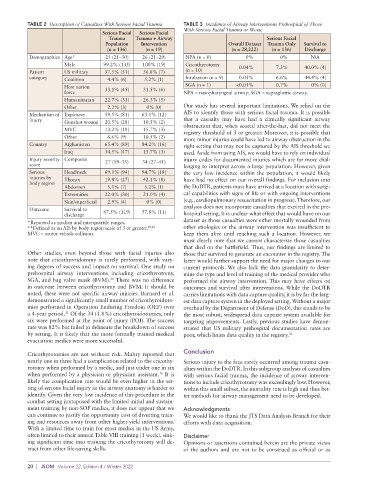
TABLE 2  Description of Casualties With Serious Facial Trauma  TABLE 3  Incidence of Airway Interventions Prehospital of Those
                                                             With Serious Facial Trauma or Worse
                                   Serious Facial   Serious Facial
                                     Trauma   Trauma + Airway                           Serious Facial
                                   Population  Intervention                 Overall Dataset  Trauma Only  Survival to
                                    (n = 136)    (n = 19)                    (n = 28,222)  (n = 136)  Discharge
           Demographics Age*       25 (21–30)   26 (21–29)    NPA (n = 0)        0%          0%        N/A
                      Male         99.2% (135)  100% (19)     Cricothyrotomy   0.04%       7.3%      40.0% (4)
           Patient    US military  37.5% (51)   36.8% (7)     (n = 10)
           category   Coalition     4.4% (6)    5.2% (1)      Intubation (n = 9)  0.03%    6.6%      44.4% (4)
                      Host nation   33.1% (45)  31.5% (6)     SGA (n = 1)     <0.01%       0.7%        0% (0)
                      force                                  NPA = nasopharyngeal airway; SGA = supraglottic airway.
                      Humanitarian  22.7% (31)  26.3% (5)
                      Other         2.2% (3)     0% (0)      Our study has several important limitations. We relied on the
           Mechanism of  Explosive  59.5% (81)  63.1% (12)   AIS to identify those with serious facial trauma. It is possible
           injury     Gunshot wound  20.5% (28)  10.5% (2)   that a casualty may have had a clinically significant airway
                      MVC          13.2% (18)   15.7% (3)    obstruction that, when scored after-the-fact, did not meet the
                                                             registry threshold of 3 or greater. Moreover, it is possible that
                      Other         6.6% (9)    10.5% (2)    more minor injuries could have led to airway obstruction in the
           Country    Afghanistan  65.4% (89)  84.2% (16)    right setting that may not be captured by the AIS threshold we
                      Iraq         34.5% (47)   15.7% (3)    used. Aside from using AIS, we would have to rely on individual
           Injury severity  Composite  27 (19–35)  34 (27–41)  injury codes for documented injuries which are far more chal-
           score                                             lenging to interpret across a large population. However, given
           Serious    Head/neck    69.1% (94)  94.7% (18)    the very low incidence within the population, it would likely
           injuries by   Thorax    19.8% (27)   42.1% (8)    have had no effect on our overall findings. For inclusion into
           body region
                      Abdomen       5.1% (7)    5.2% (1)     the DoDTR, patients must have arrived at a location with surgi-
                      Extremities  22.0% (30)   21.0% (4)    cal capabilities with signs of life or with ongoing interventions
                      Skin/superficial  2.9% (4)  0% (0)     (e.g., cardiopulmonary resuscitation in progress). Therefore, our
           Outcome    Survival to                            analysis does not incorporate casualties that expired in the pre-
                      discharge    87.5% (119)  57.8% (11)   hospital setting. It is unclear what effect that would have on our
          *Reported as median and interquartile ranges.      dataset as those casualties were either mortally wounded from
          **Defined as an AIS by body region scale of 3 or greater. 20,28  other etiologies or the airway intervention was insufficient to
          MVC = motor vehicle collision.                     keep them alive until reaching such a location. However, we
                                                             must clearly note that we cannot characterize those casualties
                                                             that died on the battlefield. Thus, our findings are limited to
          Other studies, even beyond those with facial injuries also   those that survived to generate an encounter in the registry. The
          note that cricothyroidotomy is rarely performed, with vary-  latter would further support the need for major changes to our
          ing degrees of success and impact on survival. One study on   current protocols. We also lack the data granularity to deter-
          prehospital  airway  interventions  including  cricothyrotomy,   mine the type and level of training of the medical provider who
          SGA, and bag valve mask (BVM).  There was no difference   performed the airway intervention. This may have effects on
                                     30
          in outcome between cricothyrotomy and BVM. It should be   outcomes and survival after interventions. While the DoDTR
          noted, these were not specific airway injuries. Barnard et al.   carries limitations with data capture quality, it is by far the larg-
          demonstrated a significantly small number of cricothyroidoto-  est data capture system in the deployed setting. Without a major
          mies performed in Operation Enduring Freedom (OEF) over   overhaul by the Department of Defense (DoD), this stands to be
          a 4-year period.  Of the 34 (1.8%) cricothyroidotomies, only   the most robust, widespread data capture system available for
                      31
          six were performed at the point of injury (POI). The success   targeting improvements. Lastly, previous studies have demon-
          rate was 82% but failed to delineate the breakdown of success   strated that US military prehospital documentation rates are
          by setting. It is likely that the more formally trained medical   poor, which limits data quality in the registry. 32
          evacuation medics were more successful.

          Cricothyrotomies are not without risk. Mabry reported that   Conclusion
          nearly one in three had a complication related to the cricothy-  Serious injury to the face rarely occurred among trauma casu-
          rotomy when performed by a medic, and just under one in six   alties within the DoDTR. In this subgroup analysis of casualties
          when performed by a physician or physician assistant.  It is   with serious facial trauma, the incidence of airway interven-
                                                     16
          likely the complication rate would be even higher in the set-  tions to include cricothyrotomy was exceedingly low. However,
          ting of serious facial injury as the airway anatomy is harder to   within this small subset, the mortality rate is high and thus bet-
          identify. Given the very low incidence of this procedure in the   ter methods for airway management need to be developed.
          combat setting juxtaposed with the limited initial and sustain-
          ment training by non-SOF medics, it does not appear that we   Acknowledgments
          can continue to justify the opportunity cost of diverting train-  We would like to thank the JTS Data Analysis Branch for their
          ing and resources away from other higher-yield interventions.   efforts with data acquisition.
          With a limited time to train for most medics in the US Army,
          often limited to their annual Table VIII training (1 week), sink-  Disclaimer
          ing significant time into training the cricothyrotomy will de-  Opinions or assertions contained herein are the private views
          tract from other life-saving skills.               of the authors and are not to be construed as official or as

          20  |  JSOM   Volume 22, Edition 4 / Winter 2022

