


Page 21 - JSOM Winter 2022
P. 21
Data Acquisition                                   group of 28,222 subjects, we identified 136 (0.5%) casualties
              We conducted a retrospective review of prospectively collected   with serious or worse facial trauma, of whom 4 (0.01% of to-
              data within the DoDTR. We queried the DoDTR using a series   tal dataset) had isolated injury to the face. Of note, there were
              of emergency department (ED) procedure codes to acquire the   no casualties with an AIS of 5 or 6 for the facial body region
              subjects which is previously described.  We then searched for   (Figure 1). Of subjects with serious facial trauma, the median
                                            19
              all casualties with an abbreviated injury scale (AIS) score of 3   age was 25 (IQR 21–30), the median injury severity score (ISS)
              (serious) or greater to the face to define the baseline popula-  was 27 (IQR 19–35), most were male (99.2%). Additionally,
              tion (Table 1).  Within that population, we searched for all   the US military made up the greatest proportion (37.5%), most
                         20
              airway interventions.                              were injured by explosives (59.5%), most were in Afghanistan
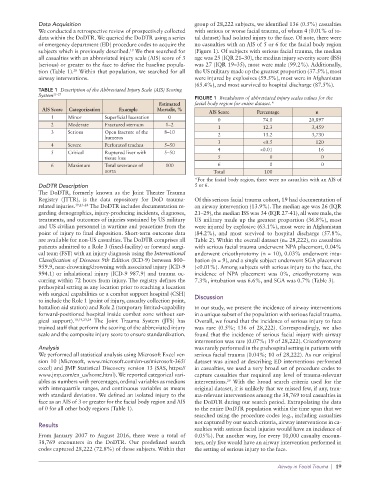
                                                                 (65.4%), and most survived to hospital discharge (87.5%).
              TABLE 1  Description of the Abbreviated Injury Scale (AIS) Scoring
              System 25–27
                                                                 FIGURE 1  Breakdown of abbreviated injury scales values for the
                                                     Estimated   facial body region for entire dataset.*
               AIS Score  Categorization  Example   Mortalit, %      AIS Score       Percentage         n
                  1    Minor       Superficial laceration  0            0              74.0           20,897
                  2    Moderate    Fractured sternum   1–2
                                                                        1              12.3            3,459
                  3    Serious     Open fracture of the   8–10          2              13.2            3,730
                                   humerus
                                                                        3              <0.5             120
                  4    Severe      Perforated trachea  5–50
                  5    Critical    Ruptured liver with   5–50           4             <0.01              16
                                   tissue loss                          5                0                0
                  6    Maximum     Total severance of   100             6                0                0
                                   aorta                               Total           100
                                                                 *For the facial body region, there were no casualties with an AIS of
              DoDTR Description                                  5 or 6.
              The DoDTR, formerly known as the Joint Theater Trauma
              Registry (JTTR), is the data repository for DoD trauma-   Of this serious facial trauma cohort, 19 had documentation of
              related injuries. 19,21–24  The DoDTR includes documentation re-  an airway intervention (13.9%). The median age was 26 (IQR
              garding demographics, injury-producing incidents, diagnoses,   21–29), the median ISS was 34 (IQR 27-41), all were male, the
              treatments, and outcomes of injuries sustained by US military   US military made up the greatest proportion (36.8%), most
              and US civilian personnel in wartime and peacetime from the   were injured by explosive (63.1%), most were in Afghanistan
              point of injury to final disposition. Short-term outcome data   (84.2%), and most survived to hospital discharge (57.8%,
              are available for non-US casualties. The DoDTR comprises all     Table 2). Within the overall dataset (n= 28,222), no casualties
              patients admitted to a Role 3 (fixed-facility) or forward surgi-  with serious facial trauma underwent NPA placement, 0.04%
              cal team (FST) with an injury diagnosis using the International   underwent cricothyrotomy (n = 10), 0.03% underwent intu-
              Classification of Diseases 9th Edition (ICD-9) between 800–  bation (n = 9), and a single subject underwent SGA placement
              959.9, near-drowning/drowning with associated injury (ICD-9   (<0.01%). Among subjects with serious injury to the face, the
              994.1) or inhalational injury (ICD-9 987.9) and trauma oc-  incidence  of NPA  placement  was  0%,  cricothyrotomy  was
              curring within 72 hours from injury. The registry defines the   7.3%, intubation was 6.6%, and SGA was 0.7% (Table 3).
              prehospital setting as any location prior to reaching a location
              with surgical capabilities or a combat support hospital (CSH)   Discussion
              to include the Role 1 (point of injury, casualty collection point,
              battalion aid station) and Role 2 (temporary limited- capability   In our study, we present the incidence of airway interventions
              forward-positioned hospital inside combat zone without sur-  in a unique subset of the population with serious facial trauma.
              gical support). 10,19,23,24   The Joint  Trauma System (JTS) has   Overall, we found that the incidence of serious injury to face
              trained staff that perform the scoring of the abbreviated injury   was rare (0.5%; 136 of 28,222). Correspondingly, we also
              scale and the composite injury score to ensure standardization.  found that the incidence of serious facial injury with airway
                                                                 intervention was rare (0.07%; 19 of 28,222). Cricothyrotomy
              Analysis                                           was rarely performed in the prehospital setting in patients with
              We performed all statistical analysis using Microsoft Excel ver-  serious facial trauma (0.04%; 10 of 28,222). As our original
              sion 10 (Microsoft, www.microsoft.com/en-us/microsoft-365/  dataset was aimed at describing ED interventions performed
              excel) and JMP Statistical Discovery version 13 (SAS, https://  in casualties, we used a very broad set of procedure codes to
              www.jmp.com/en_us/home.html). We reported categorical vari-  capture casualties that required any level of trauma-relevant
              ables as numbers with percentages, ordinal variables as medians   interventions.   With the broad search criteria used for the
                                                                           29
              with interquartile ranges, and continuous variables as means   original dataset, it is unlikely that we missed few, if any, trau-
              with standard deviation. We defined an isolated injury to the   ma-relevant interventions among the 38,769 total casualties in
              face as an AIS of 3 or greater for the facial body region and AIS   the DoDTR during our search period. Extrapolating the data
              of 0 for all other body regions (Table 1).         to the entire DoDTR population within the time span that we
                                                                 searched using the procedure codes (e.g., including casualties
              Results                                            not captured by our search criteria, airway interventions in ca-
                                                                 sualties with serious facial injuries would have an incidence of
              From January 2007 to  August 2016, there were a total of   0.05%). Put another way, for every 10,000 casualty encoun-
              38,769 encounters in the DoDTR. Our predefined search   ters, only five would have an airway intervention performed in
              codes captured 28,222 (72.8%) of those subjects. Within that   the setting of serious injury to the face.

                                                                                            Airway in Facial Trauma  |  19

