


Page 25 - JSOM Winter 2022
P. 25
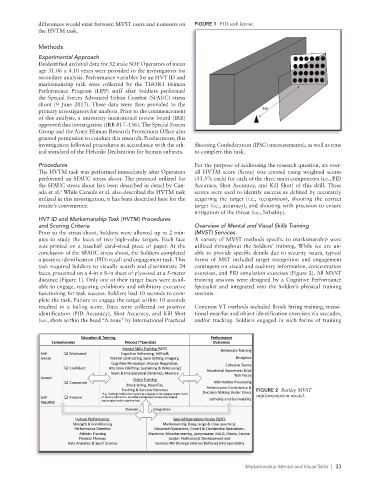
differences would exist between MVST users and nonusers on   FIGURE 1  PID task layout.
              the HVTM task.

              Methods
              Experimental Approach
              Deidentified archival data for 52 male SOF Operators of mean
              age 31.06 ± 4.10 years were provided to the investigators for
              secondary analysis. Performance variables for an HVT ID and
              marksmanship  task  were collected by  the  THOR3  Human
              Performance Program (HPP) staff after Soldiers performed
              the Special Forces Advanced Urban Combat (SFAUC) stress
              shoot (9 June 2017). These data were then provided to the
              primary investigators for analysis. Prior to the commencement
              of this analysis, a university institutional review board (IRB)
              approved this investigation (IRB #17–156). The Special Forces
              Group and the Army Human Research Protections Office also
              granted permission to conduct this research. Furthermore, this
              investigation followed procedures in accordance with the eth-  Shooting Confederation (IPSC) measurements), as well as time
              ical standard of the Helsinki Declaration for human subjects.  to complete this task.

              Procedures                                         For the purpose of addressing the research question, an over-
              The HVTM task was performed immediately after Operators   all HVTM score (Score) was created using weighted scores
              performed an SFAUC stress shoot. The protocol utilized for   (33.3% each) for each of the three main components (i.e., PID
              the SFAUC stress shoot has been described in detail by Can-  Accuracy, Shot Accuracy, and Kill Shot) of this drill. These
                     2
              ada et al.  While Canada et al. also described the HVTM task   scores were used to identify success as defined by accurately
              utilized in this investigation, it has been described here for the   acquiring  the target  (i.e.,  recognition),  shooting the  correct
              reader’s convenience.                              target (i.e., accuracy), and shooting with precision to ensure
                                                                 mitigation of the threat (i.e., lethality).
              HVT ID and Marksmanship Task (HVTM) Procedures
              and Scoring Criteria                               Overview of Mental and Visual Skills Training
              Prior to the stress shoot, Soldiers were allowed up to 2 min-  (MVST) Services
              utes to study the faces of two high-value targets. Each face   A variety of MVST methods specific to marksmanship were
              was  printed  on  a  baseball  card–sized  piece  of  paper. At  the   utilized throughout the Soldiers’ training. While we are un-
              conclusion of the SFAUC stress shoot, the Soldiers completed   able to provide specific details due to security issues, typical
              a positive identification (PID) recall and engagement task. This   forms of MST included target recognition and engagement
              task required Soldiers to visually search and discriminate 24   contingent on visual and auditory information, concentration
              faces, presented on a 4-in × 8-in sheet of plywood at a 5-meter   exercises, and PID simulation exercises (Figure 2). All MVST
              distance (Figure 1). Only one of their target faces were avail-  training sessions were designed by a Cognitive Performance
              able to engage, requiring exhibitory and inhibitory executive   Specialist and integrated into the Soldier’s physical training
              functioning for task success. Soldiers had 10 seconds to com-  sessions.
              plete the task. Failure to engage the target within 10 seconds
              resulted in a failing score. Data were collected on positive   Common VT methods included Brock String training, transi-
              identification (PID Accuracy), Shot Accuracy, and Kill Shot   tional near/far and object identification exercises via saccades,
              (i.e., shots within the head “A zone” by International Practical   and/or  tracking.  Soldiers  engaged  in  such  forms  of  training


                                                                                     FIGURE 2  Bartley MVST
                                                                                     implementation model.


                                                                                 Marksmanship Mental and Visual Skills  |  23

