


Page 135 - JSOM Fall 2022
P. 135
Dependent Variables younger than midcareer combat Servicemembers, which was
Subjective wellbeing was measured via the Mental Health Con statistically different (t = –7.07, p < .01). For this reason,
56
tinuum Short Form (MHCSF), which is a valid and reliable age was controlled for in preliminary analyses. On average,
measure that has been used in the SOF population. 9,11,22 De SOF combat Servicemembers had approximately 12.6 years in
pressive symptoms were measured via the 9item Patient Health active military service. Total military service differed by SOF
Questionnaire (PHQ9), which has been used in mTBI and US career stage, t = –5.53, p < .01, with SOF midcareer combat
53
military samples. 23,24 Anxiety symptoms were measured via the Servicemembers reporting approximately 6.6 years longer to
7item Generalized Anxiety Disorder Diagnostic tool (GAD7), tal military service. Although presumed that SOF midcareer
which has been used to assess anxiety symptoms in U.S. military combat Servicemembers should have more total military ser
samples. 24,25 Posttraumatic stress symptoms were measured via vice than SOF career start combat Servicemembers, this is not
the Posttraumatic Stress Disorder Checklist (PCL5) and mili always true. Therefore, total military service was controlled
tary Servicemembers. Total symptom scores were calculated for to ensure the SOF career stage differences were indicative
26
by aggregating all item responses for each scale, respectively. of SOF, rather than general military effects.
Higher symptom scores were indicative of a greater number of
symptoms experienced and/or higher symptom frequency. There were no mental health symptom differences between
USSOCOM branches (USASOC versus AFSOC) for the MHC
2
2
Statistical Analyses (χ [1] = 0.15, p = .70), PHQ9 (χ [1] = 0.66, p = .42), GAD7
2
Descriptive statistics were generated for all study variables and (χ [1] = 1.08, p = .30), and PCL5 (χ [1] = 0.99, p = .32). Age
2
data were tested for statistical assumptions prior to hypothesis did not have a significant fixed effect on any mental health
2
testing. ShapiroWilks normality test was used to determine symptom scores (χ [1] ranged from 0.00–1.755, p ≥ .19 for
normal distributions of participant responses. Each dependent all), and was therefore dropped from all proceeding models.
variable was nonnormally skewed (W ranged from 0.66 to Overall, SOF combat Servicemembers were moderately men
0.92, p < .01 for all). Therefore, Poisson regression analyses tally healthy (some subjective wellbeing and generally low
were employed to investigate SOF career stage group differ mental illness symptoms), but with variability (Table 1). All
ences in subjective wellbeing, depression, anxiety, and post mental health symptoms were related to one another in the
traumatic stress symptoms, respectively. These models also expected directions and all predictor variables were statisti
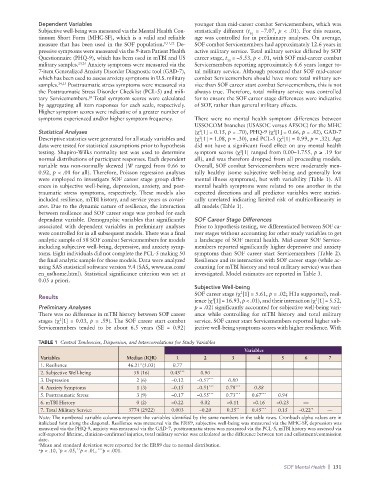
included resilience, mTBI history, and service years as covari cally unrelated indicating limited risk of multicollinearity in
ates. Due to the dynamic nature of resilience, the interaction all models (Table 1).
between resilience and SOF career stage was probed for each
dependent variable. Demographic variables that significantly SOF Career Stage Differences
associated with dependent variables in preliminary analyses Prior to hypothesis testing, we differentiated between SOF ca
were controlled for in all subsequent models. There was a final reer stages without accounting for other study variables to get
analytic sample of 58 SOF combat Servicemembers for models a landscape of SOF mental health. Midcareer SOF Service
including subjective wellbeing, depressive, and anxiety symp members reported significantly higher depressive and anxiety
toms. Eight individuals did not complete the PCL5 making 50 symptoms than SOF career start Servicemembers (Table 2).
the final analytic sample for those models. Data were analyzed Resilience and its interaction with SOF career stage (while ac
using SAS statistical software version 9.4 (SAS, www.sas.com/ counting for mTBI history and total military service) was then
en_us/home.html). Statistical significance criterion was set at investigated. Model estimates are reported in Table 3.
0.05 a priori.
Subjective Well-being
SOF career stage (χ [1] = 5.61, p = .02; H1a supported), resil
2
Results
2
2
ience (χ [1] = 16.93, p < .01), and their interaction (χ [1] = 5.52,
Preliminary Analyses p = .02) significantly accounted for subjective wellbeing vari
There was no difference in mTBI history between SOF career ance while controlling for mTBI history and total military
2
stages (χ [1] = 0.03, p = .59). The SOF career start combat service. SOF career start Servicemembers reported higher sub
Servicemembers tended to be about 6.5 years (SE = 0.92) jective wellbeing symptoms scores with higher resilience. With
TABLE 1 Central Tendencies, Dispersion, and Intercorrelations for Study Variables
Variables
Variables Median (IQR) 1 2 3 4 5 6 7
a
1. Resilience 46.21 (5.03) 0.77
2. Subjective Wellbeing 58 (16) 0.43 *** 0.90
3. Depression 2 (6) –0.12 –0.57 *** 0.80
4. Anxiety Symptoms 1 (3) –0.15 –0.51 *** 0.78 *** 0.88
5. Posttraumatic Stress 3 (9) –0.17 –0.55 *** 0.73 *** 0.67 *** 0.94
6. mTBI History 0 (2) –0.22 0.02 –0.11 –0.16 –0.23 —
7. Total Military Service 3774 (2922) 0.003 –0.20 0.35 ** 0.45 *** 0.15 –0.22 + —
Note: The numbered variable columns represent the variables identified by the same numbers in the table rows. Cronbach alpha values are in
italicized font along the diagonal. Resilience was measured via the ER89, subjective wellbeing was measured via the MHCSF, depression was
measured via the PHQ9, anxiety was measured via the GAD7, posttraumatic stress was measured via the PCL5, mTBI history was assessed via
selfreported lifetime, clinicianconfirmed injuries, total military service was calculated as the difference between test and enlistment/commission
date.
a Mean and standard deviation were reported for the ER89 due to normal distribution.
+ p < .10, p < .05, p < .01, p < .001.
***
**
*
SOF Mental Health | 131

