


Page 9 - JSOM Summer 2022
P. 9
care testing in increasingly forward deployed settings further   all of which can quickly progress in a prolonged field care envi-
              enables medics to perform these tasks. Prehospital Electrolyte   ronment. These conditions present complex problems to emer-
              Care: A Review of Symptoms, Evaluation, and Management   gency department and intensive care unit teams worldwide.
              provides a brief review of these vital electrolytes, as well as
              additional kidney function evaluation considerations, to assist
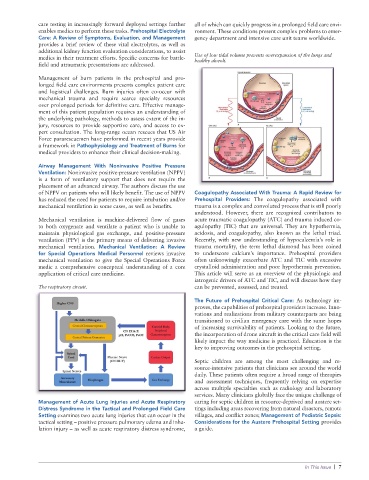
              medics in their treatment efforts. Specific concerns for battle-  Use of low tidal volume prevents overexpansion of the lungs and
                                                                 healthy alveoli.
              field and atraumatic presentations are addressed.
              Management of burn patients in the prehospital and pro-
              longed field care environments presents complex patient care
              and logistical  challenges.  Burn injuries  often  co-occur  with
              mechanical trauma and require scarce specialty resources
              over prolonged periods for definitive care. Effective manage-
              ment of this patient population requires an understanding of
              the underlying pathology, methods to assess extent of the in-
              jury, resources to provide supportive care, and access to ex-
              pert consultation. The long-range ocean rescues that US Air
              Force pararescuemen have performed in recent years provide
              a framework in Pathophysiology and Treatment of Burns for
              medical providers to enhance their clinical decision-making.

              Airway Management With Noninvasive Positive Pressure
              Ventilation: Noninvasive positive-pressure ventilation (NPPV)
              is a form of ventilatory support that does not require the
              placement of an advanced airway. The authors discuss the use
              of NPPV on patients who will likely benefit. The use of NPPV   Coagulopathy Associated With Trauma: A Rapid Review for
              has reduced the need for patients to require intubation and/or   Prehospital Providers:  The  coagulopathy  associated  with
              mechanical ventilation in some cases, as well as benefits.  trauma is a complex and convoluted process that is still poorly
                                                                 understood. However, there are recognized contributors to
              Mechanical ventilation is machine-delivered flow of gases   acute traumatic coagulopathy (ATC) and trauma induced co-
              to both oxygenate and ventilate a patient who is unable to   agulopathy (TIC) that are universal. They are hypothermia,
              maintain physiological  gas exchange,  and  positive-pressure   acidosis, and coagulopathy, also known as the lethal triad.
              ventilation (PPV) is the primary means of delivering invasive   Recently, with new understanding of hypocalcemia’s role in
              mechanical ventilation.  Mechanical Ventilation: A Review   trauma mortality, the term lethal diamond has been coined
              for Special Operations Medical Personnel  reviews  invasive   to underscore calcium’s importance. Prehospital providers
              mechanical ventilation to give the Special Operations Force   often unknowingly exacerbate ATC and TIC with excessive
              medic a comprehensive conceptual understanding of a core   crystalloid administration and poor hypothermia prevention.
              application of critical care medicine.             This article will serve as an overview of the physiologic and
                                                                 iatrogenic drivers of ATC and TIC, and will discuss how they
              The respiratory circuit.                           can be prevented, assessed, and treated.
                                                                 The Future of Prehospital Critical Care: As technology im-
                                                                 proves, the capabilities of prehospital providers increase. Inno-
                                                                 vations and realizations from military counterparts are being
                                                                 transitioned to civilian emergency care with the same hopes
                                                                 of increasing survivability of patients. Looking to the future,
                                                                 the incorporation of drone aircraft in the critical care field will
                                                                 likely impact the way medicine is practiced. Education is the
                                                                 key to improving outcomes in the prehospital setting.

                                                                 Septic children are among the most challenging and re-
                                                                 source-intensive patients that clinicians see around the world
                                                                 daily. These patients often require a broad range of therapies
                                                                 and assessment techniques, frequently relying on expertise
                                                                 across multiple specialties such as radiology and laboratory
                                                                 services. Many clinicians globally face the unique challenge of
              Management of Acute Lung Injuries and Acute Respiratory   caring for septic children in resource-deprived and austere set-
              Distress Syndrome in the Tactical and Prolonged Field Care   tings including areas recovering from natural disasters, remote
              Setting examines two acute lung injuries that can occur in the   villages, and conflict zones; Management of Pediatric Sepsis:
              tactical setting – positive pressure pulmonary edema and inha-  Considerations for the Austere Prehospital Setting provides
              lation injury – as well as acute respiratory distress syndrome,   a guide.


                                                                                                     In This Issue  |  7

