


Page 14 - JSOM Summer 2022
P. 14
therapist, an X-ray technician, a behavioral health tech-  be carried out using the MH-60S helicopters, since MV-22s
            nician and two general duty corpsmen. Some of the em-  are not able to land on destroyers and they do not have a
            barked FST personnel are typically dual-hatted to serve as   hoist capability to enable them to hoist casualties up to the
            members of the Amphibious Task Force, with the Officer in   aircraft. MV-22s may, however, play a key role in trans-
            Charge of the FST serving as the Commander, Amphibious   porting casualties from the LHA to a ground-based medical
            Task Force, Surgeon.                               treatment facility. They may also be useful in transporting
             – There is also a Marine Expeditionary Unit (MEU) em-  Casualty 6 to a hyperbaric treatment facility.
            barked on the LHA. A MEU comprises approximately     – The maximum operating range of an MH-60S Seahawk
            2200 Marines, and is split into the Command Element, the   helicopter for ship-to-ship operations without refueling is
            Ground Combat Element, the Aviation Combat Element,   described as approximately 380nm, 16,19  although this var-
            and the Logistics Combat Element. 14               ies with the fuel load. Squadron standard operating proce-
               The MEU is accompanied by a Shock Trauma Platoon   dures, however, typically use a more conservative estimate
            (Minus) [STP (–)]. An STP (–) has eight personnel: an Emer-  of 250-280nm with a single auxiliary fuel tank (personal
            gency Medicine physician, an Emergency Medicine Nurse,   communications — CDR Nicholas Koetter, 19 November
            and six Corpsmen.                                  2021; LCDR Ann Long and MCPO Todd Burkholder, 3
             – There are no organic aircraft on the stricken destroyer, so   Nov 2021). Thus, these helicopters have the range to fly
            casualty evacuation will need to be carried out using air   from the LHA to the casualty ship, 100 nm away, pick up
            assets from the LHA.                               the casualties, and then fly back to the LHA.
             – The aircraft carried on an LHA will vary according to
            the mission. The US Navy website notes that the aviation   The MH-60S as a Navy Ship-to-Ship Casualty
            forces on board can include: “A mix of: F-35B Joint Strike   Evacuation Platform
            Fighter STOVL aircraft; MV-22 Osprey VTOL tiltrotors;     – Each MH-60S aircraft carries a single Search and Rescue
            CH-53E Sea Stallion helicopters; UH-1Y Huey helicopters;   Medical Technician (SMT). The Navy’s goal is to have ev-
            AH-1Z Super Cobra helicopters; and MH-60S Sea Hawk   ery SMT trained to the paramedic level, but that goal has
            helicopters.” 15                                   not been fully achieved at this point in time.
             – This scenario makes the operational assumption that the     – MH-60S aircraft used as SAR helicopters also carry a crew
            LHA has four embarked Sikorsky MH-60S Seahawk he-  chief and a rescue swimmer, both of whom are Basic Life
            licopters (Figure 6) that would be used to carry out ship-  Support-certified and could assist with ventilating casual-
                                   16
            to-ship  casualty  evacuation.   The  number  of  available   ties, if needed, as well as with medical documentation.
            helicopters may vary based on the mission and on aircraft     – Each of the MH-60S helicopters can carry two litter patients
            mechanical readiness. For this scenario, the assumption is   or 1 litter patient and two to three ambulatory patients.
            that one aircraft is not in a flight status for mechanical rea-    – An extra medical person from the LHA cannot be added to
            sons. There are two MH-60S helicopters available to evac-  the medical team on the MH-60S to help care for the two
            uate casualties from the casualty ship and a third MH-60S   litter patients during transport without reducing the evacu-
            is held in reserve for a possible Search and Rescue Mission.  ation capacity of the MH-60S to a single litter patient, due
                                                               to space limitations.
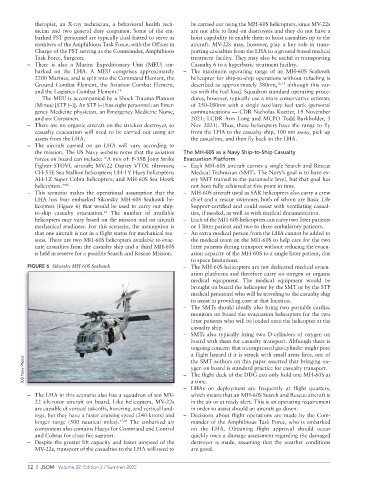
          FIGURE 6  Sikorsky MH-60S Seahawk                     – The MH-60S helicopters are not dedicated medical evacu-
                                                               ation platforms and therefore carry no oxygen or organic
                                                               medical equipment.  The  medical equipment  would be
                                                               brought on board the helicopter by the SMT or by the STP
                                                               medical personnel who will be traveling to the casualty ship
                                                               to assist in providing care at that location.
                                                                – The SMTs should ideally also bring two portable cardiac
                                                               monitors on board the evacuation helicopters for the two
                                                               litter patients who will be loaded onto the helicopter at the
                                                               casualty ship.
                                                                – SMTs also typically bring two D-cylinders of oxygen on
                                                               board with them for casualty transport. Although there is
                                                               ongoing concern that a compressed gas cylinder might pose
                                                               a flight hazard if it is struck with small arms fires, one of
         (US Navy Photo)                                        – The flight deck of the DDG can only hold one MH-60S at
                                                               the SMT authors on this paper asserted that bringing ox-
                                                               ygen on board is standard practice for casualty transport.
                                                               a time.
                                                                – LHAs  on  deployment  are  frequently  at  flight  quarters,
             – The LHA in this scenario also has a squadron of ten MV-  which means that an MH-60S Search and Rescue aircraft is
            22 tilt-rotor aircraft on board. Like helicopters, MV-22s   in the air or at ready alert. This is an operating requirement
            are capable of vertical takeoffs, hovering, and vertical land-  in order to assist should an aircraft go down.
            ings, but they have a faster cruising speed (240 knots) and     – Decisions about flight operations are made by the Com-
            longer range  (500 nautical miles). 17,18   The embarked air   mander of the Amphibious Task Force, who is embarked
            component also contains Hueys for Command and Control   on the LHA. Obtaining flight approval should occur
            and Cobras for close fire support.                 quickly once a damage assessment regarding the damaged
             – Despite the greater lift capacity and faster airspeed of the   destroyer  is made,  assuming  that  the  weather  conditions
            MV-22s, transport of the casualties to the LHA will need to   are good.


          12  |  JSOM   Volume 22, Edition 2 / Summer 2022

