


Page 12 - JSOM Summer 2022
P. 12
1.  “Damage Control,” as we know it in medicine today was   6.  Transport of casualties from the stricken vessel to the
            adopted from the Navy. Damage control as performed on   CRTS may be delayed by conditions on the casualty ship
            a stricken ship is a priority in maritime operations and   and their potential impact on flight operations. Other chal-
            maintaining  the integrity  of the  ship will  ultimately save   lenges to ship-to-ship casualty evacuation may include ad-
            the most lives. TCCC emphasizes that good medicine may   verse weather conditions, a high sea state, and the presence
            sometimes be bad operational tactics; this is true for the   of hostile combatant craft or aircraft.
            maritime environment as well as ground combat. A ship
            that has sustained damage from hostile fire or a mine ex-  Shipboard Casualty Scenario – Missile Strike on a
            plosion may be in danger of sinking. This means that dam-  Guided Missile Destroyer Followed by a Second
            age control efforts to fight fires and control flooding must   Missile That Misses the Ship but Causes an
            be the top priority for the ship’s crew.         Underwater Explosion
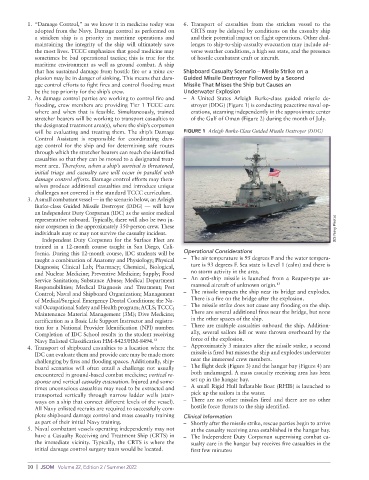
          2.  As damage control parties are working to control fire and     – A United States Arleigh Burke-class guided missile de-
            flooding, crew members are providing Tier 1 TCCC care   stroyer (DDG) (Figure 1) is conducting peacetime naval op-
            where and when that is feasible. Simultaneously, trained   erations, steaming independently in the approximate center
            stretcher bearers will be working to transport casualties to   of the Gulf of Oman (Figure 2) during the month of July.
            the designated treatment area(s), where the ship’s corpsmen
            will be evaluating and treating them. The ship’s Damage   FIGURE 1  Arleigh Burke-Class Guided Missile Destroyer (DDG)
            Control Assistant is responsible for coordinating dam-
            age control for the ship and for determining safe routes
            through which the stretcher bearers can reach the identified
            casualties so that they can be moved to a designated treat-
            ment area. Therefore, when a ship’s survival is threatened,
            initial triage and casualty care will occur in parallel with
            damage control efforts. Damage control efforts may them-
            selves produce additional casualties and introduce unique
            challenges not covered in the standard TCCC curriculum.
          3.  A small combatant vessel — in the scenario below, an Arleigh
            Burke-class Guided Missile Destroyer (DDG) — will have
            an Independent Duty Corpsman (IDC) as the senior medical
            representative onboard. Typically, there will also be two ju-
            nior corpsmen in the approximately 350-person crew. These                                          (US Navy Photo)
            individuals may or may not survive the casualty incident.
               Independent Duty Corpsmen for the Surface Fleet are
            trained in a 12-month course taught in San Diego, Cali-
            fornia. During this 12-month course, IDC students will be   Operational Considerations
            taught a combination of Anatomy and Physiology; Physical     – The air temperature is 95 degrees F and the water tempera-
            Diagnosis; Clinical Lab; Pharmacy; Chemical, Biological,   ture is 93 degrees F. Sea state is Level 1 (calm) and there is
            and Nuclear Medicine; Preventive Medicine; Supply; Food   no storm activity in the area.
            Service Sanitation; Substance Abuse; Medical Department     – An anti-ship missile is launched from a Reaper-type un-
            Responsibilities; Medical Diagnosis and Treatment; Pest   manned aircraft of unknown origin. 13
            Control; Naval and Shipboard Organization; Management     – The missile impacts the ship near its bridge and explodes.
            of Medical/Surgical Emergency Dental Conditions; the Na-  There is a fire on the bridge after the explosion.
            val Occupational Safety and Health program; ACLS; TCCC;     – The missile strike does not cause any flooding on the ship.
            Maintenance Material Management (3M); Dive Medicine;   There are several additional fires near the bridge, but none
            certification as a Basic Life Support Instructor and registra-  in the other spaces of the ship.
            tion for a National Provider Identification (NPI) number.     – There are multiple casualties onboard the ship. Addition-
            Completion of IDC School results in the student receiving   ally, several sailors fell or were thrown overboard by the
            Navy Enlisted Classification HM-8425/HM-8494. 12   force of the explosion.
          4.  Transport of shipboard casualties to a location where the     – Approximately 3 minutes after the missile strike, a second
            IDC can evaluate them and provide care may be made more   missile is fired but misses the ship and explodes underwater
            challenging by fires and flooding spaces. Additionally, ship-  near the immersed crew members.
            board scenarios will often entail a challenge not usually     – The flight deck (Figure 3) and the hangar bay (Figure 4) are
            encountered in ground-based combat medicine; vertical re-  both undamaged. A mass casualty receiving area has been
            sponse and vertical casualty evacuation. Injured and some-  set up in the hangar bay.
            times unconscious casualties may need to be extracted and     – A small Rigid Hull Inflatable Boat (RHIB) is launched to
            transported vertically through narrow ladder wells (stair-  pick up the sailors in the water.
            ways on a ship that connect different levels of the vessel).     – There are no other missiles fired and there are no other
            All Navy enlisted recruits are required to successfully com-  hostile force threats to the ship identified.
            plete shipboard damage control and mass casualty training   Clinical Information
            as part of their initial Navy training.             – Shortly after the missile strike, rescue parties begin to arrive
          5.  Naval combatant vessels operating independently may not   at the casualty receiving area established in the hangar bay.
            have a Casualty Receiving and Treatment Ship (CRTS) in     – The Independent Duty Corpsman supervising combat ca-
            the immediate vicinity. Typically, the CRTS is where the   sualty care in the hangar bay receives five casualties in the
            initial damage control surgery team would be located.  first few minutes:


          10  |  JSOM   Volume 22, Edition 2 / Summer 2022

