


Page 8 - JSOM Summer 2022
P. 8
n this issue, the JSOM Critical Care Supplement provides   consider in theaters with extended evacuation times and lim-
           an up-to-date guide to critical care medicine in an array of   ited local medical assets. Although blood loss is often associ-
         Iarticles on timely issues.                         ated with settings of acute traumatic hemorrhage in military
                                                             medicine, there is the possibility for other hematologic com-
          Management of Severe Crush Injuries in Austere Environ-  promises. The authors provide a brief review of hemoglobin
          ments:  A  Special  Operations  Perspective:  Crush  injuries   function and composition, and presentation and management
          present a challenging case for medical providers and require   considerations of anemia, to assist medics in their treatment
          knowledge and skill to manage the subsequent damage to mul-  efforts. We also address specific concerns for battlefield and
          tiple organ systems. In an austere environment, in which re-  atraumatic presentations.
          sources are limited and evacuation time is extensive, a medic
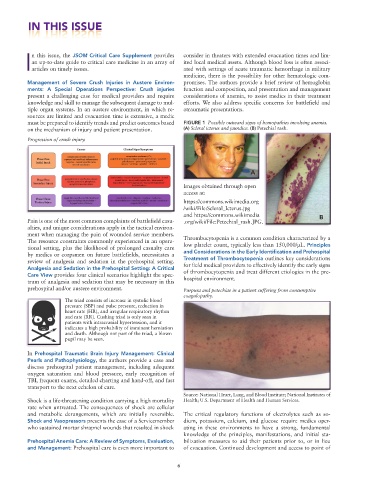
          must be prepared to identify trends and predict outcomes based   FIGURE 1  Possible outward signs of hemopathies involving anemia.
          on the mechanism of injury and patient presentation.  (A) Scleral icterus and jaundice. (B) Petechial rash.
          Progression of crush injury.


                                                                                   A
                                                             Images obtained through open
                                                             access at:
                                                             https://commons.wikimedia.org
                                                             /wiki/File:Scleral_Icterus.jpg
                                                             and https://commons.wikimedia
          Pain is one of the most common complaints of battlefield casu-  .org/wiki/File:Petechial_rash.JPG.  B
          alties, and unique considerations apply in the tactical environ-
          ment when managing the pain of wounded service members.
          The resource constraints commonly experienced in an opera-  Thrombocytopenia is a common condition characterized by a
          tional setting, plus the likelihood of prolonged casualty care   low platelet count, typically less than 150,000/μL. Principles
          by medics or corpsmen on future battlefields, necessitates a   and Considerations in the Early Identification and Prehospital
          review of analgesia and sedation in the prehospital setting.   Treatment of Thrombocytopenia outlines key considerations
                                                             for field medical providers to effectively identify the early signs
          Analgesia and Sedation in the Prehospital Setting: A Critical   of thrombocytopenia and treat different etiologies in the pre-
          Care View provides four clinical scenarios highlight the spec-
          trum of analgesia and sedation that may be necessary in this   hospital environment.
          prehospital and/or austere environment.            Purpura and petechiae in a patient suffering from consumptive
                                                             coagulopathy.
                      The triad consists of increase in systolic blood
                      pressure (SBP) and pulse pressure, reduction in
                      heart rate (HR), and irregular respiratory rhythm
                      and rate (RR). Cushing triad is only seen in
                      patients with intracranial hypertension, and it
                      indicates a high probability of imminent herniation
                      and death. Although not part of the triad, a blown
                      pupil may be seen.


          In  Prehospital  Traumatic  Brain  Injury  Management:  Clinical
          Pearls and Pathophysiology, the authors provide a case and
          discuss prehospital patient management, including adequate
          oxygen saturation and blood pressure, early recognition of
          TBI, frequent exams, detailed charting and hand-off, and fast
          transport to the next echelon of care.
                                                             Source: National Heart, Lung, and Blood Institute; National Institutes of
          Shock is a life-threatening condition carrying a high mortality   Health; U.S. Department of Health and Human Services.
          rate when untreated. The consequences of shock are cellular
          and metabolic derangements, which are initially reversible.   The critical regulatory functions of electrolytes such as so-
          Shock and Vasopressors presents the case of a Servicemember   dium, potassium, calcium, and glucose require medics oper-
          who sustained mortar shrapnel wounds that resulted in shock  ating in these environments to have a strong, fundamental
                                                             knowledge of the principles, manifestations, and initial sta-
          Prehospital Anemia Care: A Review of Symptoms, Evaluation,   bilization  measures  to  aid  their  patients  prior  to,  or  in  lieu
          and Management: Prehospital care is even more important to   of evacuation. Continued development and access to point of

                                                           6

