


Page 6 - JSOM Summer 2022
P. 6
fromthe

                                            SOMA PRESIDENT


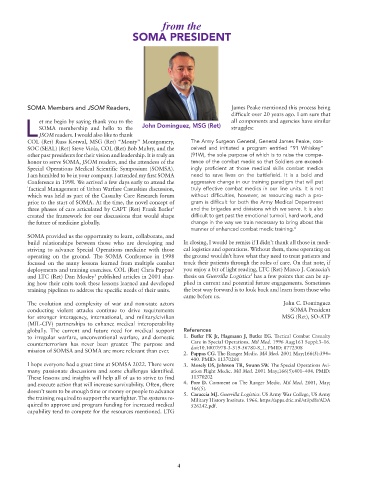
          SOMA Members and JSOM Readers,                                     James Peake mentioned this process being
                                                                             difficult over 20 years ago. I am sure that
              et me begin by saying thank you to the                         all components and agencies have similar
              SOMA membership and hello to the   John Dominguez, MSG (Ret)   struggles:
         L JSOM readers. I would also like to thank
          COL (Ret) Russ Kotwal, MSG (Ret) “Monty” Montgomery,   The Army Surgeon General, General James Peake, con-
          SOC (SEAL) (Ret) Steve Viola, COL (Ret) Bob Mabry, and the   ceived and initiated a program entitled “91 Whiskey”
          other past presidents for their vision and leadership. It is truly an   (91W), the sole purpose of which is to raise the compe-
          honor to serve SOMA, JSOM readers, and the attendees of the   tence of the combat medic so that Soldiers are exceed-
          Special Operations Medical  Scientific Symposium (SOMSA).     ingly proficient at those medical skills combat medics
          I am humbled to be in your company. I attended my first SOMA   need to save lives on the battlefield. It is a bold and
          Conference in 1998. We arrived a few days early to attend the   aggressive change in our training paradigm that will put
          Tactical Management of Urban Warfare Casualties discussion,   truly effective combat medics in our line units. It is not
          which was held as part of the Casualty Care Research forum   without difficulties, however, as resourcing such a pro-
          prior to the start of SOMA. At the time, the novel concept of   gram is difficult for both the Army Medical Department
                                                         1
          three phases of care articulated by CAPT (Ret) Frank Butler    and the brigades and divisions which we serve. It is also
          created the framework for our discussions that would shape   difficult to get past the emotional turmoil, hard work, and
          the future of medicine globally.                     change in the way we train necessary to bring about this
                                                               manner of enhanced combat medic training. 4
          SOMA provided us the opportunity to learn, collaborate, and
          build relationships between those who are developing and   In closing, I would be remiss if I didn’t thank all those in medi-
          striving to advance Special Operations medicine with those   cal logistics and operations. Without them, those operating on
          operating on the ground. The  SOMA Conference in 1998   the ground wouldn’t have what they need to treat patients and
          focused on the many lessons learned from multiple combat   track their patients through the roles of care. On that note, if
                                                         2
          deployments and training exercises. COL (Ret) Chris Pappas    you enjoy a bit of light reading, LTC (Ret) Marco J. Caraccia’s
                                                                                   5
          and LTC (Ret) Dan Mosley  published articles in 2001 shar-  thesis on Guerrilla Logistics  has a few points that can be ap-
                                3
          ing how their units took these lessons learned and developed   plied in current and potential future engagements. Sometimes
          training pipelines to address the specific needs of their units.   the best way forward is to look back and learn from those who
                                                             came before us.
          The evolution and complexity of war and non-state actors                            John C. Dominguez
          conducting violent attacks continue to drive requirements                             SOMA President
          for  stronger  interagency, international,  and  military/civilian                 MSG (Ret), SO-ATP
          (MIL-CIV) partnerships to enhance medical interoperability
          globally. The current and future need for medical support   References
          to irregular warfare, unconventional warfare, and domestic   1.  Butler FK Jr, Hagmann J, Butler EG. Tactical Combat Casualty
          counterterrorism has never been greater. The purpose and   Care in Special Operations. Mil Med. 1996 Aug;161 Suppl:3–16.
          mission of SOMSA and SOMA are more relevant than ever.  doi:10.1007/978-3-319-56780-8_1. PMID: 8772308
                                                             2.  Pappas CG. The Ranger Medic. Mil Med. 2001 May;166(5):394–
                                                               400. PMID: 11370201
          I hope everyone had a great time at SOMSA 2022. There were   3.  Mosely DS, Johnson TR, Swann SW. The Special Operations Avi-
          many passionate discussions and some challenges identified.   ation Flight Medic. Mil Med. 2001 May;166(5):401–404. PMID:
          These lessons and insights will help all of us to strive to find   11370202
          and execute action that will increase survivability. Often, there   4.  Porr D. Comment on The Ranger Medic. Mil Med. 2001, May;
                                                               166(5).
          doesn’t seem to be enough time or money or people to advance   5.  Caraccia MJ. Guerrilla Logistics. US Army War College, US Army
          the training required to support the warfighter. The systems re-  Military History Institute. 1966. https://apps.dtic.mil/sti/pdfs/ADA
          quired to approve and program funding for increased medical   526242.pdf.
          capability tend to compete for the resources mentioned. LTG


                                                           4

