


Page 114 - JSOM Summer 2022
P. 114
Coagulopathy Associated With Trauma

                                   A Rapid Review for Prehospital Providers


                       Jonathan Friedman, BSN, RN, FP-C ; Ricky Ditzel, BSHS, CCP-C, SO-ATP ;
                                                                                              2
                                                          1
                                            Andrew D. Fisher, MD, MPAS *
                                                                         3


          ABSTRACT
          The coagulopathy associated with trauma is a complex and   The lethal triad is a combination of coagulopathy, acidosis,
          convoluted process that is still poorly understood. However,   and hypothermia, in which each component exacerbates the
          there are recognized contributors to acute traumatic coagulop-  others. The lethal triad is also described as iatrogenic due to
          athy (ATC) and trauma induced coagulopathy (TIC) that are   crystalloid fluid administration and inadequate hypothermia
          universal. They are hypothermia, acidosis, and coagulopathy,   prevention. Recently, hypocalcemia has been considered a dis-
          also known as the lethal triad. Recently, with new understand-  tinct part of iatrogenic coagulopathy secondary to blood prod-
          ing of hypocalcemia’s role in trauma mortality, the term lethal   uct administration containing citrate. In addition, patients
          diamond has been coined to underscore calcium’s importance.   often arrive hypocalcemic at the first role of care, thereby com-
          Prehospital providers often unknowingly exacerbate ATC and   pounding this issue. For many years, the best recommended
          TIC with excessive crystalloid administration and poor hypo-  prevention of the lethal triad in battlefield medicine was hy-
          thermia prevention. This article will serve as an overview of   pothermia prevention with the use of commercially manufac-
          the physiologic and iatrogenic drivers of ATC and TIC, and   tured external heating devices such as body warmers and fluid
          will discuss how they can be prevented, assessed, and treated.  warmers. More recently, there has been an increased use of
                                                             blood products – primarily whole blood – to address coagulop-
          Keywords: lethal triad; critical care; prehospital; coagulopathy;   athy and acidosis, along with trauma induced coagulopathy.
          trauma; resuscitation; lethal diamond
                                                             Trauma-induced coagulopathy (TIC) is an overarching con-
                                                             cept with a spectrum of hypercoagulable and hypocoagulable
          Introduction                                       states and involves the exogenous (iatrogenic) and endogenous
                                                             (inherent) pathways (Figure 2).  Acute traumatic coagulopa-
                                                                                     4–6
          Traumatic injury and hemorrhage are the leading causes of   thy (ATC) is a complicated aspect of the endogenous pathway.
          death in the United States for ages 44 and under.  Furthermore,   The drivers of ATC are poorly understood, however, there
                                               1
          hemorrhage is the leading cause of potentially preventable   are basic mechanisms that are universal. This review, while
          death in combat.  In the US, the median time to death from   only touching the surface of coagulopathy in trauma, is meant
                       2
                                                3
          hemorrhage after hospital admission is 2 hours.  To mitigate   to increase understanding of the coagulopathy phenomenon
          mortality and morbidity, there is an urgency to identify and   in trauma and how treatments  and resuscitation efforts are
          treat life-threatening injuries and control hemorrhage. Inad-  interrelated.
          equate treatment of patients suffering from hemorrhage may
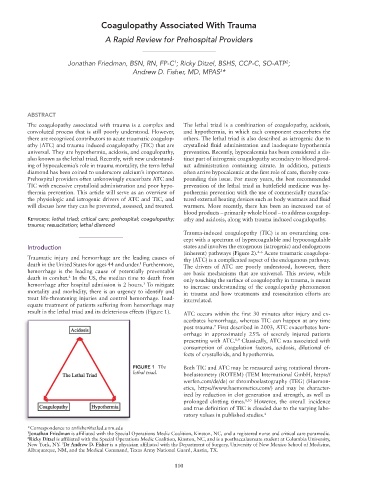
          result in the lethal triad and its deleterious effects (Figure 1).  ATC occurs within the first 30 minutes after injury and ex-
                                                             acerbates hemorrhage, whereas TIC can happen at any time
                                                             post trauma.  First described in 2003, ATC exacerbates hem-
                                                                       7
                                                             orrhage in approximately 25% of severely injured patients
                                                             presenting with ATC.  Classically, ATC was associated with
                                                                              8,9
                                                             consumption of coagulation factors, acidosis, dilutional ef-
                                                             fects of crystalloids, and hypothermia.
                                            FIGURE 1  The    Both TIC and ATC may be measured using rotational throm-
                                            lethal triad.    boelastometry (ROTEM) (TEM International GmbH, https://
                                                             werfen.com/de/de) or thromboelastography (TEG) (Haemon-
                                                             etics,  https://www.haemonetics.com/) and may be character-
                                                             ized by reduction in clot generation and strength, as well as
                                                             prolonged  clotting  times. 8,10   However,  the  overall  incidence
                                                             and true definition of TIC is clouded due to the varying labo-
                                                             ratory values in published studies. 4

          *Correspondence to anfisher@salud.unm.edu
          1 Jonathan Friedman is affiliated with the Special Operations Medic Coalition, Kinston, NC, and a registered nurse and critical care paramedic.
          2 Ricky Ditzel is affiliated with the Special Operations Medic Coalition, Kinston, NC, and is a postbaccalaureate student at Columbia University,
          New York, NY.  Dr Andrew D. Fisher is a physician affiliated with the Department of Surgery, University of New Mexico School of Medicine,
                     3
          Albuquerque, NM, and the Medical Command, Texas Army National Guard, Austin, TX.
                                                          110
                                                          110

