


Page 110 - JSOM Summer 2022
P. 110
Diagnostics                                        Treatments
          There is a wide range of diagnostic equipment available to   All three conditions share the same treatment goals and prin-
          the SOF medic to help diagnose and guide the treatment of   ciples, with the aim of effectively oxygenating the patient by
          patients with BLI, inhalation injury and ARDS, particularly   counteracting pulmonary edema, atelectasis and infections.
          in the PFC setting. In this section, and in the following one   This is accomplished through two primary means: the use
          concerning treatment, there will be many ranges and values   of positive pressure ventilations with positive end expiratory
          listed to help drive the treatment of these critically ill patients.   pressure (PEEP), and low tidal volumes (TV) to protect the
          The authors would like to emphasize that it is important for   lungs. As the patient’s alveoli collapse, some undergo an irre-
          any provider to never let numbers on diagnostic tools over-  versible collapse while others can be “recruited,” or essentially
          rule their clinical assessment of the patient’s condition. Use   reinflated, in order to increase oxygen diffusion. This is done
          these numbers as a guide, but always treat your patient, not   through properly ventilating the patient and through the use
          the numbers.                                       of PEEP, which maintains pressure in the lungs during expira-
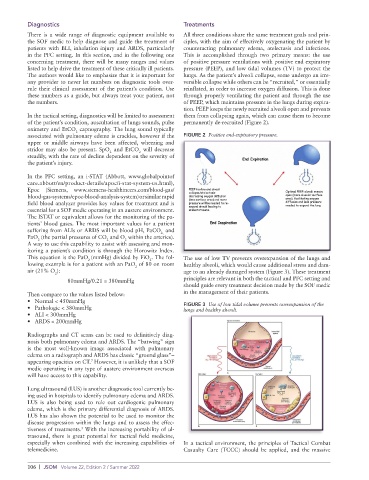
                                                             tion. PEEP keeps the newly recruited alveoli open and prevents
          In the tactical setting, diagnostics will be limited to assessment   them from collapsing again, which can cause them to become
          of the patient’s condition, auscultation of lungs sounds, pulse   permanently de-recruited (Figure 2).
          oximetry and EtCO  capnography. The lung sound typically
                          2
          associated with pulmonary edema is crackles, however if the   FIGURE 2  Positive end-expiratory pressure.
          upper or middle airways have been affected, wheezing and
          stridor may also be present. SpO  and EtCO  will decrease
                                     2
                                              2
          steadily, with the rate of decline dependent on the severity of
          the patient’s injury.
          In  the  PFC  setting,  an  i-STAT  (Abbott,  www.globalpointof
          care.abbott/en/product-details/apoc/i-stat-system-us.html),
          Epoc (Siemens,  www.siemens-healthineers.com/blood-gas/
          blood-gas-systems/epoc-blood-analysis-system) or similar rapid
          field blood analyzer provides key values for treatment and is
          essential for a SOF medic operating in an austere environment.
          The ISTAT or equivalent allows for the monitoring of the pa-
          tients’ blood gases. The most important values for a patient
          suffering from ALIs or ARDS will be blood pH, PaCO  and
                                                      2,
          PaO  (the partial pressures of CO  and O  within the arteries).
                                    2
                                          2
             2
          A way to use this capability to assist with assessing and mon-
          itoring a patient’s condition is through the Horowitz Index.
          This equation is the PaO (mmHg) divided by FiO . The fol-  The use of low TV prevents overexpansion of the lungs and
                              2
                                                  2
          lowing example is for a patient with an PaO  of 80 on room   healthy alveoli, which would cause additional stress and dam-
                                             2
          air (21% O ):                                      age to an already damaged system (Figure 3). These treatment
                   2
                       80mmHg/0.21 = 380mmHg                 principles are relevant in both the tactical and PFC setting and
                                                             should guide every treatment decision made by the SOF medic
          Then compare to the values listed below:           in the management of their patients.
          •  Normal < 450mmHg
          •  Pathologic < 380mmHg                            FIGURE 3  Use of low tidal volume prevents overexpansion of the
                                                             lungs and healthy alveoli.
          •  ALI < 300mmHg
          •  ARDS < 200mmHg
          Radiographs and CT scans can be used to definitively diag-
          nosis both pulmonary edema and ARDS. The “batwing” sign
          is  the most  well-known  image  associated  with pulmonary
          edema on a radiograph and ARDS has classic “ground glass”–
                               7
          appearing opacities on CT.  However, it is unlikely that a SOF
          medic operating in any type of austere environment overseas
          will have access to this capability.

          Lung ultrasound (LUS) is another diagnostic tool currently be-
          ing used in hospitals to identify pulmonary edema and ARDS.
          LUS  is also  being  used  to  rule out  cardiogenic  pulmonary
          edema, which is the primary differential diagnosis of ARDS.
          LUS has also shown the potential to be used to monitor the
          disease progression within the lungs and to assess the effec-
          tiveness of treatments.  With the increasing portability of ul-
                            3
          trasound, there is great potential for tactical field medicine,
          especially when combined with the increasing capabilities of   In a tactical environment, the principles of Tactical Combat
          telemedicine.                                      Casualty Care (TCCC) should be applied, and the massive


          106  |  JSOM   Volume 22, Edition 2 / Summer 2022

