


Page 105 - JSOM Summer 2022
P. 105
are grossly categorized into the phases of the mechanical venti-  portable therapeutic liquid oxygen (PTLOX) systems capable
                                                      26
              lation cycle: triggering, flow, and cycle dyssynchrony.  Careful   of providing oxygen for extended durations and at altitude.
              clinical examination of the patient including auscultation takes
              precedence before attempting ventilator or sedation adjustment.   At lower altitude and without the gas expansion advantages
              Following this, the entire ventilator circuit should be thoroughly   of Boyle’s law, mechanical ventilators are limited in hypox-
              inspected for discontinuity or kinking. The “DOPE” mnemonic   emic patients by O  availability. Not all mechanical ventilators
                                                                               2
              may be a helpful reminder in determining the source of potential   utilize the same oxygen flow rates for a given fractional oxy-
              issues: discontinuity, obstruction, patient problems, equipment   gen percentage (FdO ). Further complicating this matter is a
                                                                                 2
              failure. Increasing ventilator flow and allowing greater time in   potential lack of electrical power required to operate a device
              the inspiratory limb solve most asynchronies. 27   for the extended durations of a prolonged field care situation.
                                                                 Tables are widely available for oxygen tank volumes (and thus
              Hypoxia may manifest because of the injury or ventilator   run times) are various altitudes. Mechanical ventilators may
              treatment. Avoiding derecruitment of the lung is critical, par-  be powered by ever improving commercial portable batteries.
              ticularly when high airway pressures are required to maintain
              oxygenation. This may involve clamping an endotracheal tube
              with padded forceps or hemostats when transitioning to and   Case Study Continued
              from devices such as a BVM or the ventilator. Short term BVM   You opt to intubate the patient and begins gathering equip-
              application using a PEEP valve should be regarded as the de-  ment. A BVM is hooked up to an O  tank, Yankeur catheter
                                                                                             2
              fault for unexplained hypoxia. Recruitment maneuvers refer   with suction placed at the head, oral airway inserted, and a
              to various temporary methods to apply a sustained increase   portable ventilator with tubing is set up next to you. The pa-
              in airway pressure for the purpose of reexpanding heteroge-  tient is successfully intubated using the rapid sequence intuba-
              neously atelectatic portions of lung. An example of a common   tion (RSI) maneuver.
              recruitment maneuver protocol is the application of 40cmH O
                                                            2
              of airway pressure for 30 seconds.  Recruitment maneuvers   V-AC is set as the mode with a TV of 510cc, RR 18, PEEP
                                         28
              are controversial, should not be performed routinely, nor in   10mmHg, and FiO  100% according to our algorithm. Within
                                                                               2
              the absence of expert consultation.                a minute the SpO  recovers to 99% and you begin downtitrat-
                                                                              2
                                                                 ing FiO  by decrements of 10%. An end-tidal CO monitoring
                                                                      2
                                                                                                       2
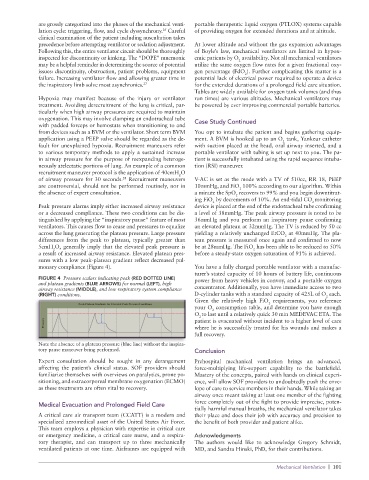
              Peak pressure alarms imply either increased airway resistance   device is placed at the end of the endotracheal tube confirming
              or a decreased compliance. These two conditions can be dis-  a level of 38mmHg. The peak airway pressure is noted to be
              tinguished by applying the “inspiratory pause” feature of most   36mmHg and you perform an inspiratory pause confirming
              ventilators. This causes flow to cease and pressures to equalize   an elevated plateau at 32mmHg. The TV is reduced by 50 cc
              across the lung generating the plateau pressure. Large pressure   yielding a relatively unchanged EtCO  at 40mmHg. The pla-
                                                                                              2
              differences  from the peak to plateau, typically greater than   teau pressure is measured once again and confirmed to now
              5cmH O, generally imply that the elevated peak pressure is   be at 28mmHg. The FiO  has been able to be reduced to 50%
                                                                                    2
                  2
              a result of increased airway resistance. Elevated plateau pres-  before a steady-state oxygen saturation of 91% is achieved.
              sures with a low peak-plateau gradient reflect decreased pul-
              monary compliance (Figure 4).                      You have a fully charged portable ventilator with a manufac-
                                                                 turer’s stated capacity of 10 hours of battery life, continuous
              FIGURE 4  Pressure scalars indicating peak (RED DOTTED LINE)    power from heavy vehicles in convoy, and a portable oxygen
              and plateau gradients (BLUE ARROWS) for normal (LEFT), high
              airway resistance (MIDDLE), and low respiratory system compliance   concentrator. Additionally, you have immediate access to two
              (RIGHT) conditions.                                D- cylinder tanks with a standard capacity of 425L of O  each.
                                                                                                            2
                                                                 Given the relatively high FiO  requirements, you reference
                                                                                         2
                                                                 your O  consumption table, and determine you have enough
                                                                      2
                                                                 O to last until a relatively quick 30 min MEDEVAC ETA. The
                                                                  2
                                                                 patient is evacuated without incident to a higher level of care
                                                                 where he is successfully treated for his wounds and makes a
                                                                 full recovery.
              Note the absence of a plateau pressure (blue line) without the inspira-
              tory pause maneuver being performed.               Conclusion
              Expert consultation should be sought in any derangement   Prehospital mechanical ventilation brings an advanced,
              affecting the patient’s clinical status. SOF providers should   force-multiplying life-support capability to the battlefield.
              familiarize themselves with overviews on paralytics, prone po-  Mastery of the concepts, paired with hands on clinical experi-
              sitioning, and extracorporeal membrane oxygenation (ECMO)   ence, will allow SOF providers to undoubtedly push the enve-
              as these treatments are often vital to recovery.   lope of care to service members in their hands. While taking an
                                                                 airway once meant taking at least one member of the fighting
                                                                 force completely out of the fight to provide imprecise, poten-
              Medical Evacuation and Prolonged Field Care
                                                                 tially harmful manual breaths, the mechanical ventilator takes
              A critical care air transport team (CCATT) is a modern and   their place and does their job with accuracy and precision to
              specialized aeromedical asset of the United States Air Force.   the benefit of both provider and patient alike.
              This team employs a physician with expertise in critical care
              or emergency medicine, a critical care nurse, and a respira-  Acknowledgments
              tory therapist, and can transport up to three mechanically   The authors would like to acknowledge Gregory Schmidt,
              ventilated patients at one time. Airframes are equipped with   MD, and Sandra Hinski, PhD, for their contributions.

                                                                                           Mechanical Ventilation  |  101

