


Page 104 - JSOM Summer 2022
P. 104
patients with moderate to severe ARDS utilizing the high PEEP   Adjunctive Equipment
                         20
          ARDSnet  strategy.   Adjuncts  including  tube  thoracostomy
          may be required with mechanical ventilation. Overall, most   A  bag-valve  mask  (BVM),  suction  catheter  (Yankauer  or
          thoracic injury trauma cases are managed nonoperatively.  DuCanto), oral and nasal airways, and oxygen source are the
                                                             minimum stockage for a provider with a mechanical ventila-
                                                             tion capability. The ventilator may allow the medic or pro-
          Individualization of Ventilator Settings           vider to perform other functions in a patient with respiratory
                                                             failure ordinarily requiring BVM treatment. Prehospital or
          Establishing initial settings for the mechanical ventilator is
          straightforward in most patients requiring ventilation. The   transport ventilators used by SOF medics and providers are
          plurality of patients with profound hypoxic or ventilatory de-  traditionally smaller and less feature available than their hos-
          fects can be effectively managed by an algorithmic approach   pital-based counterparts. Sophisticated turbine-based designs
          to mechanical ventilation, adjusting to the clinical situation.  have now largely replaced pneumatic ventilator units. Most of
          1.  Establish Ventilator Mode                      these ventilators have an established ability to maintain ade-
               o Start with Volume Assist-Control.           quate SpO  in severe acute hypoxic respiratory failure animal
                                                                     2
          2.  Set Tidal Volume (TV)                          models and should be regarded as sufficient to treat even the
                                                                        24
               o Calculate the ideal body weight (IBW) in kilograms.   ARDS patient.
               This is not the patient’s actual body weight, despite hav-
               ing a fit physique.                           Continuous Monitoring Techniques
                  – IBW (male) (kg) = 50 + 2.3 (height in inches – 60)
                  – IBW (female) (kg) = 45.5 + 2.3 (height in inches – 60)  Approximately 97% of the capacity of delivered oxygen is
               o Select a tidal volume of 7cc/kg multiplied by the IBW.  bound to the hemoglobin unit. Therefore, pulse oximetry
               o Ultimately, target a 6–8cc/kg IBW goal.     of the peripheral saturation of O  (SpO ) is the mainstay of
                                                                                             2
                                                                                       2
          3.  Set the Respiratory Rate (RR)                  monitoring for patients receiving mechanical ventilation.
               o Start with a respiratory rate of 18 breaths per minute.   More accurate and direct measurement of SpO  PaO , and
                                                                                                        2
                                                                                                   2,
               Normal ventilation rates run between 10 and 22.  PaCO  can be accomplished by point-of-care oximetry in a
                                                                  2
               o Change RR instead of TV to change patient’s minute   prehospital situation but are not essential. Capnography and/
               ventilation.                                  or end-tidal CO  (EtCO ) can provide capability for monitor-
                                                                                2
                                                                          2
               o Adjust RR to achieve pH > 7.25 to 7.30 or PaCO  35–45   ing ventilation factors and are considered the gold standard of
                                                    2        monitoring tube placement and ventilation status.  Indepen-
                                                                                                    25
               or ETCO  35–45. As tidal volume is restricted in prac-
                      2
               ticing LTVV, you may require advancing the RR into the   dent variables of ventilation should be monitored frequently:
               30s in order to achieve respiratory compensation.  peak and plateau airway pressures  should be monitored in
          4.  Oxygenate the Patient                          volume-controlled modes, while TV should be observed when
               o Start FiO  of 100%.                         pressure is being controlled. Sedation should be examined by
                      2                                      validated tools such as the Richmond Agitation-Sedation Scale
               o Start PEEP at 5 for patients without significant hypoxia
               prior to intubation.                          (RASS) as undersedation may contribute to patient–ventilator
               o Alternatively, start PEEP at 10 for hypoxic patients.  asynchrony
               o Decrease FiO  by 10% every 2–5 minutes as to keep
                         2
               SpO  > 90%.                                   Troubleshooting
                  2
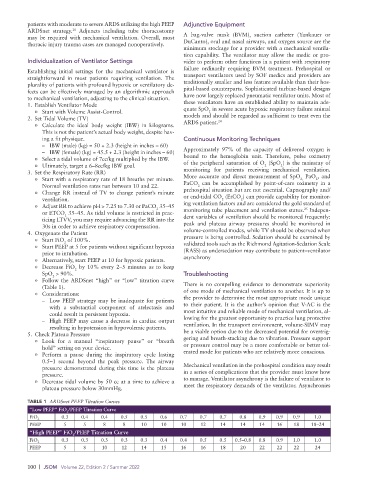
               o Follow the ARDSnet “high” or “low” titration curve
               (Table 1).                                    There  is no  compelling  evidence  to demonstrate  superiority
               o Considerations:                             of one mode of mechanical ventilation to another. It is up to
                  – Low PEEP strategy may be inadequate for patients   the provider to determine the most appropriate mode unique
                 with a substantial component of atelectasis and   to their patient. It is the author’s opinion that V-AC is the
                 could result in persistent hypoxia.         most intuitive and reliable mode of mechanical ventilation, al-
                  – High PEEP may cause a decrease in cardiac output   lowing for the greatest opportunity to practice lung protective
                 resulting in hypotension in hypovolemic patients.  ventilation. In the transport environment, volume-SIMV may
          5.  Check Plateau Pressure                         be a viable option due to the decreased potential for overtrig-
               o Look  for  a  manual  “inspiratory  pause”  or  “breath   gering and breath-stacking due to vibration. Pressure support
               hold” setting on your device.                 or pressure control may be a more comfortable or better tol-
               o Perform  a  pause  during  the  inspiratory  cycle  lasting   erated mode for patients who are relatively more conscious.
               0.5–1 second beyond the peak pressure. The airway
               pressure  demonstrated  during  this  time  is  the  plateau   Mechanical ventilation in the prehospital condition may result
               pressure.                                     in a series of complications that the provider must know how
               o Decrease tidal volume by 50 cc at a time to achieve a   to manage. Ventilator asynchrony is the failure of ventilator to
               plateau pressure below 30mmHg.                meet the respiratory demands of the ventilator. Asynchronies
          TABLE 1  ARDSnet PEEP Titration Curves
           “Low PEEP” FiO /PEEP Titration Curve
                       2
                     0.3    0.4   0.4    0.5   0.5   0.6    0.7   0.7    0.7   0.8    0.9  0.9   0.9    1.0
           FiO 2
           PEEP       5     5      8     8     10     10    10     12    14     14    14   16    18    18–24
           “High PEEP” FiO /PEEP Titration Curve
                         2
                     0.3    0.3   0.3    0.3   0.3   0.4    0.4   0.5    0.5  0.5–0.8  0.8  0.9  1.0    1.0
           FiO 2
           PEEP       5     8     10     12    14     15    16     16    18     20    22   22    22     24

          100  |  JSOM   Volume 22, Edition 2 / Summer 2022

